

Published September 2026 · Data verified September 2026
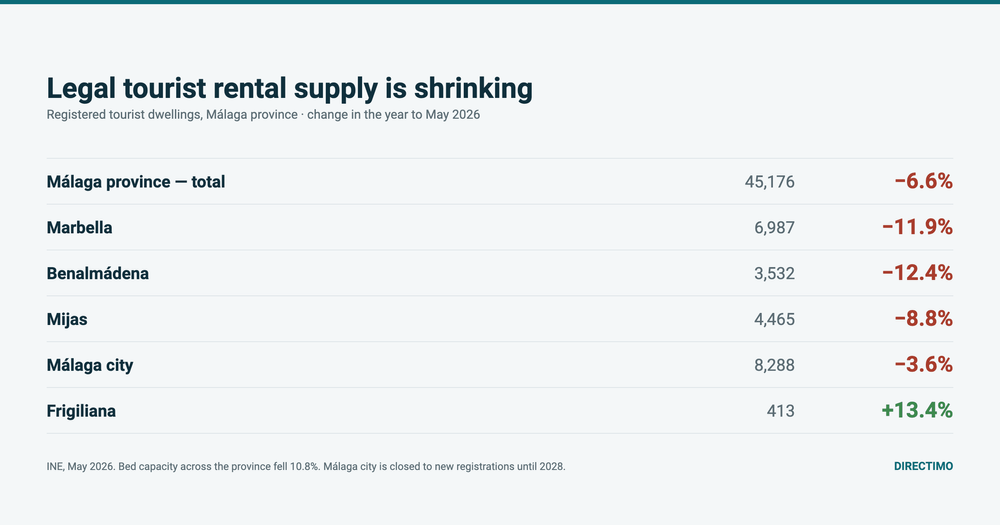
Legal tourist rental supply on the Costa del Sol is shrinking for the first time since the market developed. Málaga province had 45,176 registered tourist dwellings in May 2026, down 6.6% in a year, with bed capacity down 10.8%. Marbella lost 11.9% of its registered stock and Benalmádena 12.4%.
That contraction is the context for every rule below. A property that can legally be let to tourists is becoming a scarcer asset, and the checks that establish whether a specific property qualifies have got stricter during 2026.
Three approvals, and you need all three
| Layer | Who decides |
|---|---|
| Urban planning compatibility and municipal licence | The town hall |
| Tourist registration in the Andalusian register | The Junta de Andalucía |
| The building's registered statutes | The owners of the building |
Any one of them can stop the operation. The third is the one buyers miss.
What changed in 2026: the statutes decide
In April 2026 the Spanish Supreme Court confirmed that where a building's registered statutes contain an express ban on lodging use, tourist letting is prohibited — with no new vote required from the neighbours. The case concerned a property that had been operating legally since 2018.
An administrative licence and an entry in the tourism register do not override that. The building's own rules sit above both.
What this means when you buy. A tourist licence transfers with the property under Andalusian rules. If the statutes of that building prohibit tourist use, you inherit a licence you cannot lawfully use. The statutes and the minute book are read before the offer, not after.
Separately, since April 2025, starting a new tourist letting activity in an apartment building requires the approval of three-fifths of the owners, representing three-fifths of the ownership quotas. That applies going forward and does not affect properties already operating.
Detached villas and whole buildings under single ownership fall outside both rules.
Where the town halls stand
| Municipality | New licences | What applies |
|---|---|---|
| Málaga city | Blocked | City-wide freeze on new registrations, in force 23 August 2025 to 23 August 2028. A separate freeze on hotels and tourist apartments on residentially zoned land runs 25 July 2026 to 25 July 2029. The general plan caps 43 districts entirely |
| Fuengirola | Restricted | An independent street entrance has been required since February 2024. Waste charges raised and the IBI discount withdrawn |
| Manilva | Restricted | Ordinance under preparation, saturation identified. Verify the current position with the town hall before purchase |
| Rincón de la Victoria | Restricted | The municipal housing plan requires independent access; buildings must be uniformly residential or uniformly tourist |
| Marbella | Open | No general moratorium. Converting ground-floor commercial premises to tourist use is prohibited |
| Estepona | Open | No moratorium. Planning policy is actively facilitating hotel and residence projects |
| Benalmádena | Open | Saturation mapping complete; zone-specific limits under study, none yet in force |
| Torremolinos | Open | No tourist licence restriction. A separate rule prohibits building dwellings under 37.5 m² |
| Mijas | Open | No municipal tourist rental ordinance |
| Benahavís, Casares | Open | No municipal restriction identified |
| Nerja, Torrox, Frigiliana, Vélez-Málaga | Open | The Axarquía remains the most flexible part of the coast |
An open municipality is not the same as an unconstrained one. Mijas has no ordinance and is heavily saturated; Benalmádena has completed its saturation mapping and has limits under study. In both, the building's own statutes decide the outcome.
The Andalusian High Court upheld Málaga city's regime in full on 18 February 2026, confirming that municipalities may cap tourist housing through the general plan. Other town halls now have a tested route to do the same, so an open municipality today is not a permanent state.
Registered supply, municipality by municipality
| Municipality | Registered dwellings, May 2026 | Change on the year |
|---|---|---|
| Málaga city | 8,288 | −3.6% |
| Marbella | 6,987 | −11.9% |
| Mijas | 4,465 | −8.8% |
| Benalmádena | 3,532 | −12.4% |
| Nerja | 2,731 | +1.5% |
| Frigiliana | 413 | +13.4% |
Estepona's registered stock fell 6.0% over the same period; the absolute figure is not published. Cómpeta in the inland Axarquía grew 34.6%, the fastest rate in the province.
The coastal municipalities are contracting and the inland Axarquía is absorbing displaced supply. Prices and character by stretch are in our geographic guide to the Costa del Sol.
The consequence for price. An existing, transferable licence in a building whose statutes permit tourist use is now scarce. In Málaga city it cannot be replaced at any price until 2028. In Marbella and Mijas the pool is shrinking by roughly a tenth a year. Properties that carry one command a premium over identical properties that do not, and that gap is likely to widen.
The national registration number was annulled
A national short-term rental registration framework introduced in 2024 required every advertised property to obtain a number through the Property Registry. The Supreme Court annulled that requirement in May 2026, on the grounds that the state had duplicated registers that belong to the regions.
The Andalusian registration is the operative one. Platforms still report letting data to the national digital window, and owners no longer need a separate national number.
What transfers to you, and what does not
Transfers with the property: the tourist registration itself, under Andalusian rules.
Does not transfer, and has to be verified separately: the building's statutory position, the municipal planning compatibility for that address, and whether the community has since resolved anything that affects lodging use.
A listing that says "with tourist licence" is describing one of the three layers. The question to answer before you offer is whether all three align for that specific property.
If tourist letting is not available
Two routes stay open on the Costa del Sol and neither needs a tourist licence.
Mid-term letting, from roughly two months up to eleven. Demand comes from northern Europeans wintering in the south, people testing an area before buying, and remote professionals. Net income reaches around 80% of the tourist net, at far lower operating cost, and the tenant pays the utilities.
Long-term letting, with near-zero vacancy and annual increases capped by an official national index at roughly 2.4–2.5% in 2026.
Any property bought partly for income should be modelled on the fallback as well as the headline strategy, because the fallback is what applies if the licence route closes. A let property is also an occupied one, which matters for squatting and what owners actually face.
Before you make an offer
Five checks, in this order:
- The municipality. Is it issuing new registrations at all, and does the property already hold one?
- The statutes. Do the building's registered statutes contain any prohibition on lodging or hospedería use?
- The minute book. Has the community resolved anything about tourist letting?
- Planning compatibility. Does the town hall accept tourist use at that address, including any independent-access requirement?
- The numbers on the fallback. What does the property return on mid-term or long-term letting if tourist use is unavailable?
Your lawyer verifies all five before you sign anything.
Yields by market, with the licence position for each one, are in our Costa del Sol rental yields analysis.
How Directimo works
Directimo represents the buyer, never the seller. Listing agents in Spain are contracted by the vendor and paid to protect the vendor's price.
We check the licence status, the municipal position for the specific address, and the building's registered statutes and minute book before you commit, and we model the mid-term fallback alongside the tourist case. The properties we source average 13.5% below area market prices. We have completed more than 1,000 transactions since 2011, totalling over €300M in property sold.
Check licence feasibility for a specific property: directimo.com/advisory-call
What a scarce licence is worth in price terms sits inside the wider market picture in our Costa del Sol investment outlook, and the purchase costs are in our costs and taxes guide.
Whether tourist letting brings VAT with it, and the increase to 21% the government has proposed, is covered in our tourist let VAT guide.
Sources. Directimo Costa del Sol Market Report, September 2026 — municipal licence status, registered supply and the regulatory position. INE — registered tourist dwellings and bed capacity, Málaga province, May 2026. Junta de Andalucía — tourist registration framework. Municipal ordinances and general plans as published by each town hall, September 2026. Spanish Supreme Court and the Andalusian High Court, 2026 rulings on community statutes and municipal caps. Directimo Costa del Sol Market Report, September 2026.
Method. Registered-dwelling counts use the INE series, which measures dwellings actively marketed on platforms. The regional register reports a higher provincial figure because it includes dormant and duplicate entries; Estepona's absolute count is not published, only its annual change. Municipal positions change frequently, are stated as at September 2026 and are reviewed quarterly.
The equivalent rules on the Costa Blanca, where registrations expire after five years, are in our Costa Blanca rental rules guide.
This guide is market research, not legal, tax or investment advice. The position for a specific property depends on its address, its building and its municipality, and should be confirmed before any offer.