

Published September 2026 · Data verified September 2026
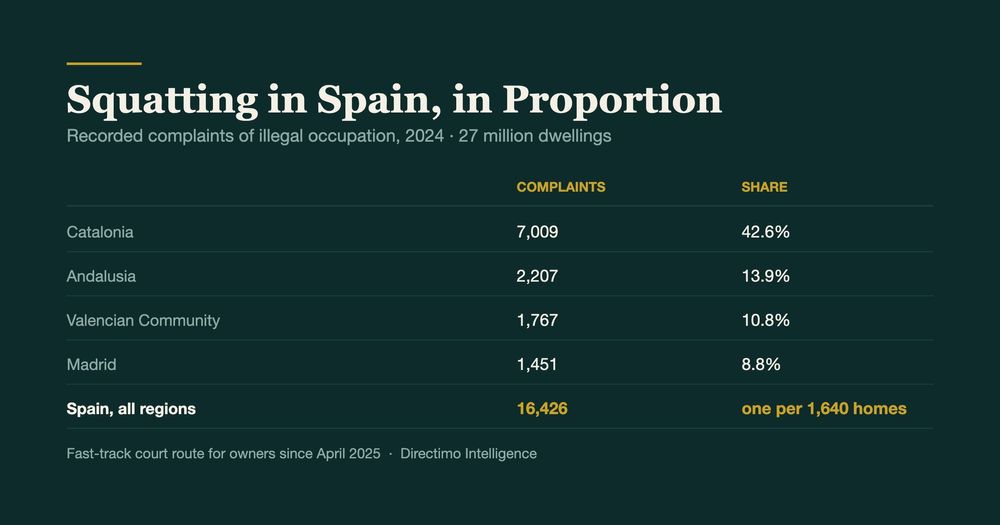
Spain recorded 16,426 complaints of illegal occupation in 2024, across a housing stock of more than 27 million homes. That is roughly one complaint per 1,640 dwellings in a year, and 43% of them were in Catalonia.
Since April 2025 owners have a fast-track court route that did not exist before. The picture for a second home on the Costa del Sol or the Costa Blanca is better than the reputation suggests. What still matters is practical: how quickly an occupation would be noticed, and what the owner does in the first two days.
Where it actually happens
| Region | Complaints, 2024 | Share of the national total |
|---|---|---|
| Catalonia | 7,009 | 42.6% |
| Andalusia | 2,207 | 13.9% |
| Valencian Community | 1,767 | 10.8% |
| Madrid | 1,451 | 8.8% |
| Rest of Spain | 3,992 | 23.9% |
National complaints rose 7.4% on 2023 and remain below the 2021 peak of 17,274. Andalusia and the Valencian Community together account for about a quarter of the national figure while holding a far larger share of Spain's coastal housing.
The properties targeted are overwhelmingly long-empty: repossessed bank stock, inherited houses nobody visits, isolated detached properties inland. A managed apartment in a gated community with neighbours in residence is a poor target, and it is the kind of property most international buyers on these coasts own.
Three different situations, and only two are criminal
Buyers hear one word and imagine one problem. Spanish law treats three separate things.
| Situation | What it is | The route |
|---|---|---|
| Someone enters a home that is in use — your own house, or your second home | Breaking into a dwelling | Criminal. Police can act immediately; the fast-track route applies |
| Someone enters a property that stands empty and is not anyone's dwelling | Taking possession of a property | Criminal, less serious. Fast-track route applies |
| A tenant with a signed contract stops paying | A contract dispute | Civil. No criminal route, no police removal |
The third causes most owner losses and falls outside the squatting rules entirely. A tenant who stops paying is removed through the civil courts, which takes months. The protection against it sits in the tenant selection and the deposit, before the contract is signed.
A second home you use, furnish and return to counts as a dwelling. Police treat entry into it as the more serious of the two criminal offences, which is the practical reason to keep evidence that the property is in use.
What changed in April 2025
Illegal occupation moved onto the fast-track court list. Cases that previously waited months for a standard hearing now go through the accelerated procedure, with the hearing set within days of the complaint.
Four conditions have to be met for the fast track to apply:
- The occupation is caught in the act, or the facts are simple enough to establish quickly.
- The police attend, identify the occupants and record them in a formal report.
- The offence carries a sentence inside the fast-track ceiling — both occupation offences do.
- The complaint is filed promptly.
The judge can also order removal as a precautionary measure before the case concludes, which is the change that matters most in practice.
Owners' communities were also given standing to bring the action directly, so a building can act where an absent owner cannot.
Does the fifteen-day figure hold up
Sometimes, and the conditions are specific. Fifteen days describes a case that runs cleanly: occupation found within hours, police called at once, formal report filed, lawyer instructed the same week.
A case discovered three weeks late, where the occupants have utility bills in their name and claim they were given keys, is no longer simple. It leaves the fast track and returns to the ordinary route, which runs to months. In the worst files it reaches a year or more.
Both outcomes come from the same law. What separates them is how quickly the occupation was discovered and how completely it was documented in the first days.
The first 48 hours
- Call the police, from the property, the moment you find it. Not the following week. Early attendance is what keeps the case on the fast track.
- Do not enter, negotiate or remove anyone yourself. Force by the owner turns a straightforward case into a complaint against you.
- Do not cut water or electricity. It has been treated as coercion, and it damages the file.
- Get the police report — the atestado — with the reference number.
- Instruct your lawyer the same day and file the complaint.
- Photograph everything, including the state of the doors and locks.
What a gated development already gives you
Most international buyers on these two coasts buy inside an urbanización: controlled vehicle and pedestrian access, a perimeter, cameras on the entrances, and in the larger schemes a concierge or contracted security presence. New developments are built this way as standard, and a large share of the resale stock has it too.
That changes the exposure in a specific way. An occupation depends on entering unobserved and then staying long enough to become established. Controlled access works against the first, and neighbours in residence work against the second. The community also has standing to act in its own name, so a building can start the process while an owner is abroad.
Two questions worth asking of any development you are considering: whether access control is staffed or automated, and whether security appears as a line in the community budget or as an occasional contract.
What to add on top, and what it costs
A monitored alarm connected to a central station. €20–49 a month in Spain, with equipment and installation usually included. The verification is what you are paying for: on a forced entry the station confirms the intrusion within about half a minute and calls the police with photographic evidence. That evidence is what puts a case on the fast track, because it establishes the offence in the act.
Occupation cover. Available from around €5 a month as an add-on to a home policy, and built into some newer policies. Cover typically runs to legal defence costs, lost rent up to about €12,000 a year, and vandalism damage to around €2,000. Two conditions to check before relying on it: most policies carry a waiting period of around three months from the start date, and none pay without a police report.
A key holder. A property manager, a neighbour, an agency — someone who enters regularly and would notice within days rather than months. Occupations concentrate on properties nobody visits, so regular access removes most of the exposure.
A solid door and cylinder. Most entries are through a weak door or an unsecured ground-floor window.
Post collected and the letterbox emptied. An overflowing letterbox signals an empty property from the street.
Timers on lights, and blinds that are not permanently shut.
Community awareness. Tell the concierge or the administrator when the property is empty and who to call.
Short lettings. A property that is let, cleaned and turned over weekly is occupied by definition. Where a licence is available, the letting itself is a form of protection — the rules by municipality are in our rental rules guide.
Alarm, insurance and key-holding together run to a few hundred euros a year on a typical apartment, against a court case and months without use.
Properties advertised with occupants inside
These appear on the market at a visible discount. What is being sold is the property plus the legal process to recover it, on a timeline the buyer does not control, with community fees running throughout and the condition of the property unknown until possession passes.
Directimo does not source them. For a buyer who wants a home to use or to let, the discount rarely covers the exposure, and the same money buys a clean property with possession on the day.
On a normal purchase your lawyer confirms the property is vacant and that possession is delivered at the deed. That confirmation is made on the day of signing.
What your lawyer checks
- That the property is free of occupants at completion, and that possession passes at the deed.
- That no tenancy or occupancy agreement is registered against it.
- That community fees are up to date, since arrears often accompany a property nobody has visited.
- That the keys and the locks are handed over complete, and changed after completion.
How Directimo works
Directimo represents the buyer, never the seller. Listing agents in Spain are contracted by the vendor and paid to protect the vendor's price.
We verify vacant possession before completion, and for owners who are not resident we set up the key-holding, the alarm and the management that keep the property visibly in use. The properties we source average 13.5% below area market prices. We have completed more than 1,000 transactions since 2011, totalling over €300M in property sold.
Talk through your own situation: directimo.com/advisory-call
The purchase process stage by stage is in our buyer's journey guide, the annual cost of holding a property in our cost of living guide, and the checks every buyer goes through in our proof of funds guide.
Sources. Ministerio del Interior — recorded complaints for unlawful entry and usurpation, Spain and by autonomous community, 2021 to 2024. Ministerio de Vivienda and INE — Spanish housing stock, 2024, and the 2021 census of empty dwellings. Spanish judicial reform in force since 3 April 2025 — the addition of both occupation offences to the accelerated criminal procedure, precautionary removal, and standing for owners' communities. Spanish criminal code — the distinction between entry into a dwelling and occupation of an empty property. Spanish monitored-alarm and home-insurance market pricing, September 2026, for connected central-station services and occupation cover. Directimo transaction record.
Method. Complaint counts are police-recorded reports, which include cases later withdrawn or reclassified and exclude occupations never reported. The per-dwelling ratio divides national complaints by the total housing stock and is a national average; concentration by region and by property type is high, so it understates risk for long-empty isolated properties and overstates it for managed coastal apartments. Timeframes describe cases handled cleanly from the first day. Alarm and insurance prices are market ranges for standard residential cover and vary with the property, the provider and the contract term.
This guide is market research, not legal advice. The route available in a specific case depends on the facts and how quickly they were recorded, and should be confirmed with a Spanish lawyer.