

Published September 2026 · Data verified September 2026
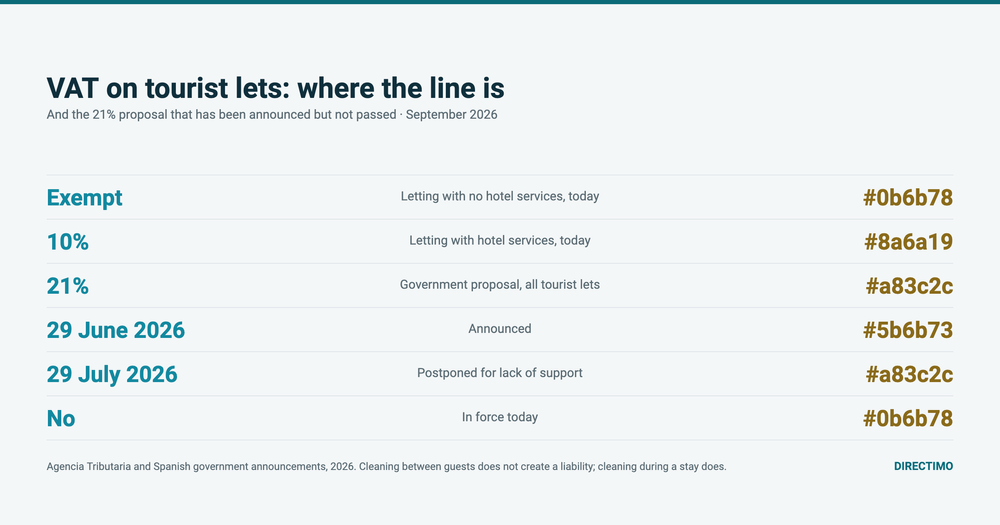
Most owners letting to tourists in Spain pay no VAT at all. The letting is exempt unless you provide hotel-type services, and the ordinary pattern — clean between guests, change the linen, hand over the keys — does not.
Provide services during the stay and the letting is taxed at 10%.
The line that decides it today
The distinction is whether you are providing accommodation with service, or simply providing a property.
These do not create a VAT liability:
- Cleaning the property before each guest arrives and after they leave
- Changing linen before arrival and after departure
- Cleaning and maintaining common areas — lobbies, stairs, lifts, gardens
- Technical repairs: plumbing, electrics, glazing, shutters, locks, appliances
These do:
- Reception and continuous attention to guests in a designated space
- Cleaning the property during the stay
- Changing linen during the stay
- Laundry, luggage storage, press, food service
The test is the service pattern during occupancy. Everything you do between guests is property management. Everything you do for guests while they are there is hotel activity.
If you do charge VAT
Charging 10% today, or 21% if the rule changes, brings a set of obligations.
Registration with the tax authority for the activity.
Quarterly VAT returns on modelo 303, and an annual summary on modelo 390.
Invoices for every letting, with VAT shown separately.
Input VAT recovery, which is the part usually left out of the comparison. Once you charge VAT, the VAT you pay on running the property becomes deductible.
On a property grossing €25,000 a year:
| Cost | Recoverable VAT | |
|---|---|---|
| Cleaning and laundry contracts | €3,500 | €735 |
| Management and agency, 20% | €5,000 | €1,050 |
| Utilities | €1,500 | €315 |
| Maintenance and repairs | €1,000 | €210 |
| Insurance, IBI, waste tax, community fees | — | None |
| Recovered each year | €2,310 |
The output side is smaller than it first appears too. On a platform the guest pays the market price, so the VAT comes out of that price rather than on top of it: €25,000 gross contains €4,339 of VAT at 21%, not €5,250.
The rate decides whether any of this costs you anything. Input VAT is recovered at 21% on your costs whatever rate you charge on the letting, so the net position changes sharply between the two rates under discussion.
| VAT inside €25,000 of revenue | Input VAT recovered | Net effect | Share of gross | |
|---|---|---|---|---|
| Exempt — no hotel services, today | — | None | €0 | 0% |
| 10% — hotel services today, and the accommodation rate | €2,273 | €2,310 | about zero | 0% |
| 21% — the Spanish proposal | €4,339 | €2,310 | €2,029 | 8.1% |
At 10% the arithmetic is close to neutral on this cost structure. You charge €2,273 and recover €2,310, and being inside the VAT system costs nothing. That is the rate hotels pay, and the rate a serviced apartment pays today.
At 21% the same property loses about €2,029 a year, or 8.1% of gross revenue.
The gap between the two is the whole argument, and it is worth more to an owner than any other line in the tax treatment of a tourist let.
The first year is better than neutral at either rate. Furnishing and fitting out a two-bedroom apartment at €18,000 carries €3,780 of recoverable VAT, which exceeds a full year of output VAT at 10% and comes close to it at 21%. A refurbishment does the same.
Recovery only works if you are registered and charging. An owner who is exempt today recovers nothing, and pays nothing.
Income tax changes too. Where hotel services make the activity a business, the income leaves the rental category and is taxed as business profit at marginal rates, without the reduction available on residential letting.
The obligation owners miss even when exempt
Platform commission is a service supplied to you, and the large booking platforms invoice from outside Spain.
Where a service is received from a supplier established in another country, Spanish VAT is accounted for by the recipient rather than the supplier. That can create a registration and filing obligation for an owner whose letting income is otherwise entirely exempt, purely because of the commission.
This catches private owners regularly. If you let through a platform, confirm the position with your adviser before the first tax authority letter arrives.
Two changes on the horizon, neither in force
Spain's own proposal. The government announced on 29 June 2026 that it intends to apply 21% VAT to all tourist lets, including those exempt today. The measure was drafted into a July decree, postponed on 29 July for lack of parliamentary support, and has not been enacted.
It carries an oddity that is part of why it is contested. Hotel accommodation in Spain is taxed at 10%, and a tourist apartment providing hotel services is taxed at that same 10% today, because it is doing the same thing. A uniform 21% would put the serviced apartment above the hotel next door for an identical service. Whether the final text keeps the 10% band for genuine hotel-type activity is one of the open questions.
On the announced form, a property grossing €25,000 a year would carry about €4,339 of VAT inside that revenue, reduced to roughly €2,029 once recoverable input VAT is set against it, as worked through above.
The European change, which is firmer. Under the EU VAT package adopted in 2025, booking platforms become the deemed supplier for short-term accommodation of up to 30 nights, and account for the VAT where the host does not. The rules are mandatory from 1 January 2030, and member states may apply them from 1 July 2028.
Two things follow. The exemption a private owner relies on today has an end date at European level, and the rate contemplated there is the accommodation rate rather than the standard one. Member states can also carve out small hosts under the EU small-enterprise scheme, so the smallest owners may stay outside it.
Nothing has changed yet in either case. Where tourist income is central to a purchase, model the case at both rates rather than assume either.
Regional and municipal taxes are separate
VAT is national. Alongside it sit the regional tourist registration rules and, in some municipalities, a tourist tax on the guest, collected by the owner.
None of those change the VAT position, and none of them substitute for it.
What to do now
Establish which side of the line you are on. Write down exactly what you provide during a guest's stay. If nothing, you are exempt today.
Do not add services casually. A mid-stay clean offered as a courtesy moves the whole activity into VAT and into business income tax.
Check the platform commission position, whether or not you charge VAT on the letting.
Model the purchase both ways if tourist income is central to it, since the proposed change has not been settled.
Keep the alternative in view. Mid-term and long-term letting sit outside this question entirely, and on the Costa Blanca a let of eleven days or more is outside tourist rental law altogether.
Your tax adviser confirms the classification for what you actually provide before you file.
How Directimo works
Directimo represents the buyer, never the seller. Listing agents in Spain are contracted by the vendor and paid to protect the vendor's price.
We model net returns after tax on the rules as they stand, and where tourist income drives the case we test the proposed change alongside it, so the decision does not rest on a measure that has not passed. The properties we source average 13.5% below area market prices. We have completed more than 1,000 transactions since 2011, totalling over €300M in property sold.
Model a specific property both ways: directimo.com/advisory-call
How rental income itself is taxed is worked through in our rental income guide. Yields by market are in our Costa del Sol and Costa Blanca analyses.
Sources. Agencia Tributaria — VAT treatment of tourist accommodation, the list of services considered proper to the hotel industry and those that are not, and the reduced 10% rate. Spanish government announcement of 29 June 2026 on raising VAT on tourist lets to 21%, and its postponement on 29 July 2026 for lack of parliamentary support. Agencia Tributaria — the 10% reduced rate on hotel accommodation. EU VAT in the Digital Age package, adopted 2025 — deemed supplier rules for short-term accommodation up to 30 nights, mandatory from 1 January 2030 with optional application from 1 July 2028. Spanish VAT rules on services received from suppliers established outside Spain.
Method. The €25,000 illustration assumes the guest price is set by the market, so VAT is contained within revenue rather than added to it. Operating costs and the resulting input VAT are Directimo modelling on a typical tourist-let cost structure and vary with the property, the management arrangement and the supplier mix. A self-managed property with low outsourced costs recovers less and the net effect at either rate is worse; a fully managed one recovers more. Input VAT is recovered at the rate charged by each supplier, generally 21%, regardless of the rate applied to the letting. Insurance, IBI, waste tax and community fees carry no recoverable VAT for the owner. The Spanish proposal described here has been announced and postponed; it is not law, and its final form may differ from what was announced. The European rules are adopted but not yet applicable, and each member state decides its own start date within the range given.
This guide is market research, not tax advice. Classification depends on the services you actually provide and should be confirmed with a Spanish tax adviser before you file.