

Published September 2026 · Data verified September 2026
Buying a home on the Costa del Sol from abroad takes about eight to twelve weeks from the first serious viewing to the keys, and most of that time is due diligence rather than paperwork. The two things that decide how it goes are settled before you view anything: your tax number and your budget including costs.
This sets out the process in the order it actually happens.
Stage 1 — Decide what the property is for
Every later decision follows from this one, and buyers who skip it end up with a property that does two things badly.
Holiday and personal use points to a location you want to be in, and a building where community fees buy services you will actually use.
Income points to licence feasibility first and location second. On the Costa del Sol that means a municipality still issuing tourist registrations, and a building whose statutes permit lodging use.
Relocation puts schooling, healthcare access and year-round services above sea views.
Capital growth points to the municipalities where prices are still moving and supply is constrained.
A property can serve two of these. Very few serve all four.
Stage 2 — Set the budget with costs included
Purchase costs on the Costa del Sol run 9.5–10.5% on a resale and 13–14% on a new build, on top of the price, paid from your own funds. A mortgage does not cover them.
On a €400,000 resale, that is €38,000–42,000. Add €15,000–20,000 to furnish, and 0.5–1% if you borrow.
Then the annual cost: roughly 1% of value a year to hold the property, covering IBI, imputed income tax, community fees, waste tax, insurance and basic utilities.
Our costs and taxes guide breaks every line down.
Stage 3 — Choose the area before the property
The Costa del Sol is a chain of distinct markets across forty kilometres, and achieved prices range from about €3,100/m² to nearly €6,900/m².
| Stretch | Towns | Achieved €/m² | Suits |
|---|---|---|---|
| Prime west | Golden Mile, Puerto Banús, Nueva Andalucía | 6,000–6,850 | Luxury, trophy assets |
| West | Marbella, Benahavís, San Pedro | 4,500–5,500 | Established international market, services |
| Far west | Estepona, Casares, Manilva | 3,100–4,200 | Value with the strongest growth on the coast |
| Centre | Fuengirola, Benalmádena, Torremolinos, Mijas | 3,700–4,450 | Yield, year-round towns, the commuter train |
| Málaga city | Málaga | 3,755 | Urban demand, remote professionals, culture |
| East | Rincón de la Victoria, Torre del Mar, Nerja, Torrox | 3,100–3,950 | Lowest entry, fastest recent growth, quieter |
Estepona and Manilva have shown the strongest price growth in the province. The centre carries the best rental depth and the only commuter rail line on the coast. The east is the value end and the most flexible on tourist licensing.
Each stretch is covered in detail — prices, letting rules and access — in our geographic guide to the Costa del Sol.
Spend a week in the shortlisted areas in low season, not August. The Costa del Sol in February is a different place from the Costa del Sol in July, and you will own it in both.
Stage 4 — Get the paperwork ready
This runs in parallel with the search and it is what most often delays a completion.
The NIE. Your Spanish tax number, required to buy anything. Three routes: a police station in Spain, where the number is often issued the same day; a Spanish consulate in your own country, which is slower; or your lawyer acting under a power of attorney, which is what most non-resident buyers use. The government fee is about €12–16. The number itself never expires, though the certificate showing it may need reissuing. The real bottleneck is appointment availability, which runs from a day to more than a month.
A Spanish bank account. Needed for the deposit, the completion transfer and the standing orders afterwards. Non-residents need a certificate of non-residency, which the bank usually arranges.
Proof of funds. Spanish anti-money-laundering rules require documented evidence of where the money comes from, and it is checked by the bank, the lawyer and the notary. Bank statements showing the accumulation, a sale contract, an inheritance deed. Assemble this early; it is the single most common cause of a delayed completion. Our guide to money-origin and identity checks lists exactly what each party asks for.
An independent lawyer. Instructed by you, not by the agent or the developer, at roughly 1% plus VAT. If you cannot travel for completion, they also hold the power of attorney.
Stage 5 — Search, and view properly
A shortlist of six to ten is workable; twenty is not.
On each viewing, check what the photographs never show: the noise at the hour you would actually be there, the orientation and how much sun the terrace gets in winter, the walk to the nearest shop, the state of the communal areas, and the parking.
Ask for the community accounts and the last three years of fees on anything you take seriously. A well-run community shows it in the accounts before it shows it in the building.
Stage 6 — Reserve, and start due diligence
A reservation contract takes the property off the market, typically for two to four weeks, against a deposit of €3,000–10,000 held by the agent or the lawyer.
That window is for your lawyer to check:
- The nota simple from the land registry — who owns it, and what charges sit against it.
- Community debts, which follow the property rather than the previous owner.
- Planning status — that the building is legal, that any extension was authorised, and that the occupancy licence exists.
- The community statutes and minute book — including any prohibition on lodging use, which since April 2026 overrides a valid tourist licence.
- The tourist licence position, if income is part of the plan.
- Utility and IBI receipts, up to date.
For a new build, add the developer's bank guarantee or insurance policy covering your stage payments, and the ten-year structural warranty.
Stage 7 — The private contract
Once due diligence is clean, the contrato de arras replaces the reservation. You pay 10% of the price, less the reservation deposit already made.
The standard form is arras penitenciales, which prices withdrawal for both sides: if you pull out, you lose the deposit; if the seller pulls out, they return double. That symmetry is what makes the contract worth having, and it is worth confirming which type you are signing, because other forms do not carry it.
The contract sets the completion date, usually four to eight weeks out.
Stage 8 — Completion at the notary
The notary authorises the deed, confirms both parties understand it, and checks the registry position on the day. Payment is made at the signing, usually by bank cheque.
You do not need to be in Spain. A power of attorney granted to your lawyer, signed at a Spanish consulate or notarised and apostilled at home, lets the whole completion happen without you.
The notary sends notice to the land registry immediately, and the deed is registered in the following weeks. Transfer tax is paid within thirty days.
Stage 9 — After completion
Utilities and the IBI direct debit move into your name. The community is notified. If the property will stand empty between visits, arrange key-holding and an alarm — see squatting and what owners actually face. If you are letting, the tourist registration and the tax filings start.
Non-resident owners file an annual return: imputed income tax if the property is not let, or rental income tax if it is. Since June 2026, non-resident rental declarations are a single annual filing between 1 and 20 April rather than four quarterly ones.
Keep every invoice from completion onwards. Acquisition costs and documented improvements are deductible against capital gains tax when you sell.
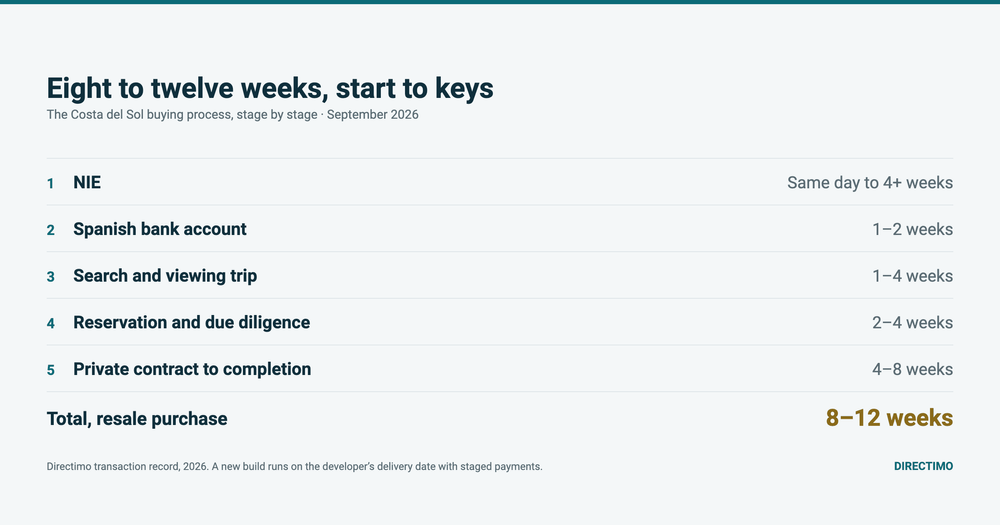
How long each stage takes
| Stage | Typical duration |
|---|---|
| NIE | Same day to 4+ weeks, depending on the appointment |
| Bank account | 1–2 weeks |
| Search and viewing trip | 1–4 weeks |
| Reservation and due diligence | 2–4 weeks |
| Private contract to completion | 4–8 weeks |
| Total, resale | 8–12 weeks |
The equivalent process on the Costa Blanca, where the purchase taxes differ, is in our Costa Blanca buyer’s journey.
A new build under construction runs on the developer's delivery date instead, with staged payments in between.
Questions buyers ask
Do I need to be in Spain for the process? No. A power of attorney granted to your lawyer covers the NIE, the bank account and the completion itself. Most non-resident purchases we handle are completed remotely.
What is the most important stage? Due diligence between reservation and private contract. Everything that can go wrong with a Spanish property is visible in the registry, the statutes and the community accounts, and all three are available before you are committed.
Buyers from outside the EU have a few additional points to settle before choosing a property — see our guide for non-EU buyers.
Can I get a mortgage as a non-resident? Up to around 70% loan to value, with a debt service cap near 35% of net income. Lenders have become more selective on second homes during 2026, so pre-approval before offering is worth having. Rates, documents and the timeline are in our mortgage guide.
Can I let the property to tourists? It depends on the municipality, the building's statutes and the registration position, not on the property itself. Málaga city is closed to new registrations until 2028. Our rental rules guide covers each town hall.
Is the process different for a new build? The legal steps are the same. The tax differs — VAT plus stamp duty instead of transfer tax — and payment is staged during construction, which makes the developer's bank guarantee the document that matters most.
What if I buy without a lawyer? The notary confirms the deed is lawful. The notary does not check whether the community statutes prohibit tourist letting, whether the building has an occupancy licence, or whether the seller owes three years of community fees. That is the lawyer's work, and it costs about 1%.
Shorter answers to the questions across the whole buying process are in our questions buyers ask.
How Directimo works
Directimo represents the buyer, never the seller. Listing agents in Spain are contracted by the vendor and paid to protect the vendor's price.
We run the process end to end and remotely: the shortlist, the viewings, the negotiation, the NIE, the bank account, an independent bilingual lawyer, the notary and the handover. The properties we source average 13.5% below area market prices. We have completed more than 1,000 transactions since 2011, totalling over €300M in property sold.
Start with a call: directimo.com/advisory-call
Where prices are heading and what supports them is in our Costa del Sol investment outlook. Yields by market are in our rental yields analysis, and the annual cost of ownership is in our cost of living guide.
Whether to buy resale or new build, and what each route costs and earns, is compared in our resale or new build guide.
How to establish what a specific property is worth, and where buyer leverage comes from, is in our negotiation guide.
Sources. Ministerio del Interior — NIE application routes, forms and the government fee. Agencia Tributaria — non-resident tax filing calendar and transfer tax deadlines. Consejo General del Notariado — deed prices by municipality, twelve months to May 2026, and notarial procedure. Banco de España — non-resident lending conditions, 2026. Junta de Andalucía and municipal ordinances — tourist registration position, September 2026. Directimo Costa del Sol Market Report, September 2026, and Directimo transaction record.
Method. Timeline ranges describe resale purchases handled by Directimo and vary with appointment availability, mortgage involvement and the complexity of the title. Achieved prices are notarial deed data and run below portal asking prices. Purchase-cost percentages are stated on the deed price.
This guide is market research, not legal or tax advice. Your position depends on your residency and the specific property, and should be confirmed by an independent lawyer before any offer.