

Foreign buyers can apply for mortgages in Spain, whether they are buying a holiday home, relocation property or investment property.
Spanish banks regularly lend to non-resident and resident foreign buyers, but the conditions vary significantly between banks.
The key point is simple: mortgage approval depends on the buyer, the property and the bank valuation — not only on the purchase price.
Last reviewed: 3 July 2026
Jurisdiction: Spain
Important: this article is general information only. It is not mortgage, legal, tax or financial advice. Mortgage terms change frequently. Buyers should confirm current offers with a Spanish bank or mortgage broker before committing to a property.
Quick Summary
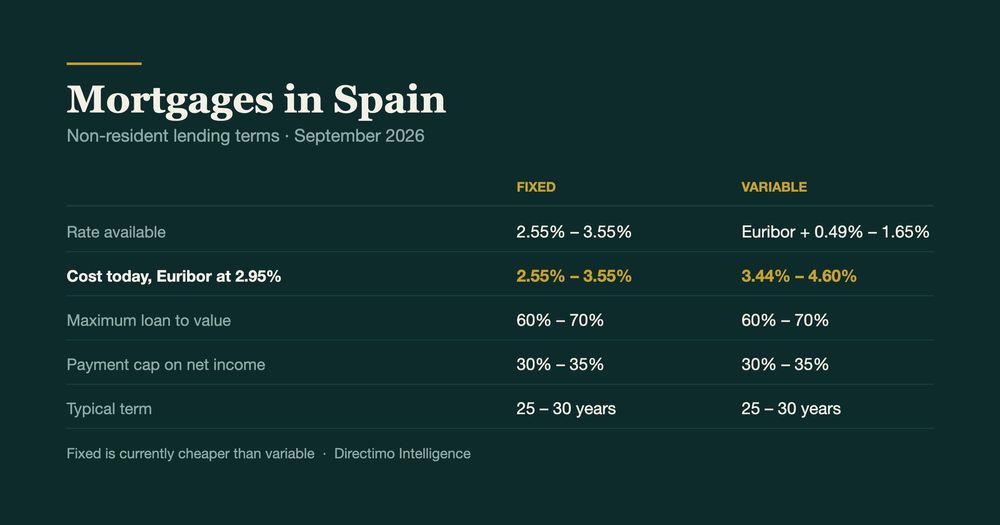
- Non-resident buyers can often borrow around 60–70% of the lower of purchase price or bank valuation.
- Spanish tax residents may access higher loan-to-value ratios, often up to around 80%, depending on profile and bank policy.
- Banks usually want total debt payments to stay around 30–35% of net monthly income, but the exact limit depends on the bank and buyer profile.
- Mortgage terms can range from 10 to 30 years, but non-resident buyers may receive shorter terms depending on age, income, currency and bank policy.
- Rates can be fixed, variable or mixed. Bonified rates may look attractive, but buyers should compare the full TAE/APR, including linked products.
- A mortgage broker can cost around 1% of the mortgage amount, but may be useful for complex foreign-buyer cases.
Quick comparison
| Buyer profile | Typical loan-to-value | Practical meaning |
|---|---|---|
| Non-resident foreign buyer | approx. 60–70% | Buyer usually needs 30–40% deposit plus buying costs |
| Spanish tax resident foreign buyer | up to approx. 80% | Stronger borrowing capacity may be possible |
| High-net-worth buyer | case by case | Assets may help, but income and affordability still matter |
| Self-employed buyer | case by case | More documents and longer review likely |
| Non-euro income buyer | case by case | Currency risk may reduce LTV or approval options |
These are working ranges, not guaranteed limits.
1. Can foreigners get a mortgage in Spain?
Yes.
Foreign citizens can apply for Spanish mortgages. Banks regularly lend to buyers from the UK, EU, Switzerland, Scandinavia, the United States and other countries.
The bank will assess:
- residency status;
- income;
- existing debts;
- age;
- currency of income;
- credit history;
- property type;
- bank valuation;
- purchase structure;
- source of funds.
A foreign buyer with strong income, low debt, clean documentation and a good property valuation will usually have more options.
2. Resident vs non-resident mortgages
Spanish banks distinguish between resident and non-resident buyers.
Non-resident buyers
A non-resident is usually someone who does not live in Spain as their main tax residence.
As a working guide, non-resident buyers may access around 60–70% loan-to-value.
The loan-to-value is usually calculated on the lower of:
- purchase price;
- bank valuation.
Example:
Purchase price: €500,000
Bank valuation: €480,000
If the bank lends 70%, it may calculate 70% of €480,000, not €500,000.
Maximum loan in this example:
€480,000 × 70% = €336,000
Spanish tax resident buyers
Foreign citizens who are Spanish tax residents may access higher loan-to-value ratios, often up to around 80%, depending on the bank and profile.
This is not automatic. The bank still checks income, debts, age, employment, property and affordability.
3. Deposit and buying costs
The mortgage does not cover the full purchase cost.
A non-resident buyer should normally plan for:
- 30–40% deposit;
- purchase taxes and completion costs;
- furniture or renovation budget;
- mortgage-related costs;
- currency transfer buffer, if income is not in euros.
Buying costs differ by region and property type.
For example:
- resale property is generally subject to regional Transfer Tax / ITP;
- new-build property is generally subject to VAT and Stamp Duty / AJD;
- lawyer, notary and registry costs are separate;
- mortgage-related costs are separate.
Do not use the mortgage amount as your total budget.
4. Affordability: the debt-to-income test
Spanish banks assess whether the buyer can comfortably afford the mortgage.
The key metric is the debt-to-income ratio: how much of the buyer’s net monthly income is already committed to debt payments.
As a working guide, many banks want total monthly debt payments to remain around 30–35% of net monthly income. Some banks may work around the upper end of this range for strong profiles, but this is not a guaranteed rule.
This calculation can include:
- the new Spanish mortgage;
- existing mortgages;
- personal loans;
- car loans;
- credit card debt;
- other recurring debt obligations.
Example:
Net monthly income: €6,000
Maximum debt burden at 35%:
€6,000 × 35% = €2,100
If the buyer already pays €600/month in other debt, the Spanish mortgage payment may need to fit within the remaining capacity.
Remaining capacity:
€2,100 - €600 = €1,500
In this example, the new Spanish mortgage payment may need to stay around €1,500/month.
Buyers with non-euro income, variable income, self-employed income or income from higher-risk currencies may be assessed more conservatively.
5. Fixed, variable, mixed and bonified rates
Spanish mortgages are usually offered as:
- fixed-rate;
- variable-rate;
- mixed-rate.
Fixed-rate mortgage
A fixed-rate mortgage gives payment certainty.
The interest rate and monthly payment stay the same during the fixed period or full loan term.
This can suit buyers who want predictable monthly costs.
Variable-rate mortgage
A variable-rate mortgage usually tracks EURIBOR plus a bank margin.
The payment can rise or fall when the reference rate changes.
This can suit buyers who accept rate movement and want potential benefit if rates fall.
Mixed-rate mortgage
A mixed-rate mortgage starts with a fixed rate for a set period and then becomes variable.
This can suit buyers who want short-term certainty but accept future rate changes.
Bonified rates
Some banks offer bonified rates.
This means the headline rate is reduced if the buyer contracts additional products or services with the bank.
Typical bonification products can include:
- salary or recurring-income payments into the bank;
- home insurance;
- life or health insurance;
- alarm or security product;
- other linked services, depending on the bank.
These products can reduce the nominal rate, but they also have their own cost.
A bonified mortgage is not automatically cheaper. Buyers should calculate whether the interest-rate saving is greater than the cost of the linked products.
As a market example, some banks may show fixed or variable rates around the high-2% to low-3% range for strong profiles with maximum bonifications. However, this should not be treated as a guaranteed market rate.
Offers change frequently and depend on:
- bank;
- buyer profile;
- residency status;
- property;
- loan-to-value;
- term;
- income currency;
- linked products.
6. Compare TIN and TAE / APR
Do not compare only the headline rate.
In Spain:
- TIN is the nominal interest rate;
- TAE / APR is the annual percentage rate, which reflects a broader cost of the mortgage.
A mortgage with a lower TIN is not always cheaper if it requires expensive linked products.
Before choosing a mortgage, compare:
- TIN;
- TAE / APR;
- fixed, variable or mixed structure;
- linked products;
- insurance cost;
- alarm or security cost, if included;
- bank account costs;
- early repayment rules;
- broker fees, if applicable;
- currency transfer costs.
For buyers comparing banks, TAE/APR is usually the better starting point than the headline TIN.
7. Mortgage term and age limit
Mortgage terms commonly range from around 10 to 30 years, but the real term offered can vary significantly by bank and buyer profile.
For non-resident buyers, some banks may prefer shorter terms than for Spanish residents, especially if the buyer is older, income is non-euro or the property is a second home.
The maximum term depends on:
- buyer age;
- residency status;
- income stability;
- currency of income;
- property type;
- loan-to-value;
- bank policy.
Many banks also apply an age limit at the end of the mortgage term.
For example, the loan may need to end before the oldest borrower reaches a certain age, often around 70–80, depending on lender policy.
For this reason, buyers should not assume that a 25- or 30-year term will always be available.
8. Required documents
Foreign buyers should prepare documents early.
Typical documents include:
- passport or national ID;
- NIE, the Spanish foreigner tax identification number;
- proof of address;
- latest tax return;
- recent payslips, if employed;
- employment contract;
- bank statements, often 6–12 months;
- credit report or evidence of no defaults, if requested;
- proof of existing mortgages or loans;
- proof of assets;
- source-of-funds evidence;
- purchase agreement or reservation document;
- property details;
- company accounts, if self-employed or business owner.
Self-employed buyers usually need more documentation than salaried employees.
9. Currency of income matters
Banks assess risk differently when the buyer’s income is not in euros.
Euro income is usually easier for Spanish banks to underwrite.
Non-euro income may still be accepted, but the bank may apply more conservative criteria because exchange-rate changes can affect affordability.
Some banks can be stricter with certain currencies or countries.
Buyers earning in GBP, USD, CHF, SEK, NOK, PLN, RON, HUF, BGN or other currencies should check bank appetite early.
Currency can affect:
- maximum loan-to-value;
- affordability calculation;
- documentation requirements;
- stress testing;
- approval speed.
10. The bank valuation
Before final approval, the bank orders an independent valuation.
This valuation matters because the bank usually calculates loan-to-value on the lower of:
- purchase price;
- bank valuation.
If the valuation comes in lower than expected, the buyer may need to increase the deposit.
Example:
Purchase price: €500,000
Expected mortgage at 70%: €350,000
Bank valuation: €450,000
70% of valuation: €315,000
Shortfall compared with expected mortgage:
€35,000
This is why buyers should avoid signing non-refundable commitments before understanding financing risk.
11. Bank directly or mortgage broker?
Foreign buyers can approach Spanish banks directly or work through a mortgage broker.
Direct bank route
Going directly to a bank usually means no broker fee.
This can work well if the buyer has:
- simple salaried income;
- euro or strong-currency income;
- clean documents;
- low debt;
- clear tax returns;
- time to compare banks directly.
However, going directly to one bank also means the buyer sees only that bank’s products and risk appetite.
Mortgage broker route
A mortgage broker can be useful when the case is more complex.
Some brokers charge around 1% of the mortgage amount, but the exact fee should always be confirmed in writing before engagement.
A broker may help if the buyer has:
- non-resident status;
- self-employed income;
- company income;
- income from several countries;
- non-euro currency income;
- a tight timeline;
- high-value property;
- need to compare multiple banks quickly;
- previous rejection from one bank.
The broker fee is a separate cost. It should not be confused with bank fees, purchase taxes or legal fees.
A broker is not always necessary, but in complex foreign-buyer cases, a good broker can save time and improve bank matching.
12. The mortgage process
Step 1 — Indicative assessment
Before making a firm offer, the buyer should get an indicative assessment from a bank or mortgage broker.
This helps define a realistic purchase budget.
Step 2 — Property selection
The buyer selects a property within the financing capacity.
The property type matters. Banks may treat urban apartments, villas, rural properties, tourist-use assets and off-plan properties differently.
Step 3 — Document submission
The buyer submits income, tax, bank and identity documents.
If self-employed, company documents may also be required.
Step 4 — Bank valuation
The bank orders a valuation of the property.
The final mortgage amount depends on this valuation.
Step 5 — Formal approval
The bank reviews the buyer and the property.
If approved, it issues formal mortgage conditions.
Step 6 — Pre-signing process
Spanish mortgage law includes a pre-signing process to ensure the borrower understands the loan terms.
The buyer will usually review mortgage documentation and attend a notary meeting before signing.
Step 7 — Completion
The mortgage deed and purchase deed are signed before the notary.
The bank releases the mortgage funds and the purchase completes.
13. New-build and off-plan mortgages
New-build and off-plan purchases can work differently.
If the property is not yet completed, the buyer may not need the mortgage immediately.
The usual process is:
- reservation;
- developer private purchase contract / PPC;
- staged payments during construction;
- mortgage application closer to completion;
- bank valuation when the property is ready or near-ready;
- completion mortgage at notary.
Buyers should not assume today’s mortgage terms will be available at completion if the property is delivered in one or two years.
For off-plan purchases, ask:
- when financing will be needed;
- whether the developer has partner banks;
- whether the buyer can use an external bank;
- what happens if financing is not approved at completion;
- whether the contract includes any financing condition.
14. Costs linked to the mortgage
Mortgage-related costs are separate from purchase taxes and standard completion costs.
Depending on the case, they may include:
- bank valuation;
- bank arrangement fee, if applicable;
- mortgage broker fee, if used;
- required insurance;
- bank account costs;
- currency transfer costs;
- early repayment charges;
- additional legal or administrative support.
Under Spanish mortgage rules, several costs of formalising the mortgage deed are normally paid by the bank, but the buyer may still pay valuation costs and any arrangement fee included in the bank’s conditions.
Buyers should always ask the lender for a full cost breakdown before signing.
15. Bank of Spain and high-risk lending
The Bank of Spain monitors mortgage lending standards, especially high loan-to-value lending and borrower affordability.
For foreign buyers, the practical point is simple:
- do not rely on unusually high leverage;
- expect banks to check affordability carefully;
- assume conservative underwriting if the property, currency or income profile is complex.
If macroprudential limits are tightened in the future, highly leveraged buyers may be affected first.
Cash-rich or low-leverage buyers are less exposed to this risk.
16. Common mortgage mistakes
Foreign buyers often run into problems when they:
- start the property search before checking borrowing capacity;
- assume the bank will lend against purchase price rather than valuation;
- ignore currency risk;
- underestimate buying costs;
- sign a non-refundable commitment before mortgage clarity;
- rely on old rate quotes;
- compare TIN but not TAE / APR;
- focus on the bonified rate without calculating linked-product costs;
- forget existing debts in affordability calculations;
- provide incomplete documents;
- transfer funds before the bank has completed AML/KYC checks;
- assume off-plan financing terms will be unchanged at completion.
17. Practical checklist before making an offer
Before making a serious offer, confirm:
- maximum loan-to-value;
- whether the bank uses purchase price or valuation;
- estimated monthly payment;
- debt-to-income ratio;
- fixed, variable or mixed structure;
- TIN and TAE / APR;
- linked products and their cost;
- loan term;
- age limit;
- currency treatment;
- required documents;
- bank valuation risk;
- mortgage costs;
- early repayment rules;
- direct-bank route or broker route;
- timeline to approval.
Bottom line
Foreign buyers can obtain mortgages in Spain, but approval is not automatic.
The key filters are:
- residency status;
- income;
- debt level;
- currency;
- age;
- property valuation;
- property type;
- source of funds;
- bank policy.
For non-resident buyers, a realistic starting point is usually 60–70% loan-to-value, with the buyer funding the remaining deposit, purchase costs and mortgage-related costs.
The safest approach is to confirm financing before making a binding commitment to buy.


