

Published September 2026 · Data verified September 2026
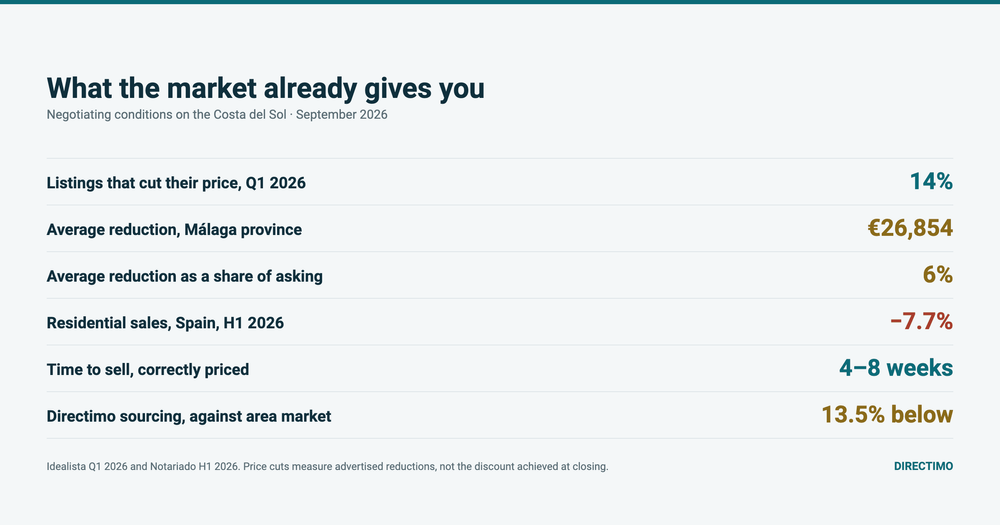
In the first quarter of 2026, 14% of Spanish for-sale listings cut their price, and the average reduction was 7% of the original asking price. In Málaga province the average cut was €26,854, or 6%.
That is what the market gives a patient buyer without any special skill. Everything below is about the difference between taking that and doing better.
The conditions in 2026 favour the buyer
Three things moved at once.
Volumes fell. Residential sales in Spain were down 7.7% in the first half of 2026 against the same period in 2025. Fewer competing buyers on each property.
Sellers moderated. Málaga asking prices rose 7.6% year-on-year in July 2026 against 13.1% nationally, while achieved prices continued to rise at around 9%. The gap between what sellers request and what they receive is narrowing, which is what a market with returning negotiation looks like.
Time on market lengthened outside the sweet spot. A correctly priced Costa del Sol property still moves in four to eight weeks. An overpriced one sits, and a listing that has sat is a listing with a motivated seller behind it.
Conditions favour a well-prepared buyer more than they did in 2024. Prices are still rising, so a buyer waiting for a fall will keep waiting.
The trap: the €4,272 against €3,019
Málaga province asking prices average about €4,272/m². Notarial deed prices average about €3,019/m². The difference is roughly 29%, and it is the single most misread number on this coast.
That gap is not a discount available to you. It exists because the two series measure different things:
- Deed data includes cheap inland stock that never appears on the portals.
- Deed data includes off-plan sales agreed one to two years earlier at older prices.
- Portal data over-represents active coastal listings, which are the expensive end.
Walking into a Marbella viewing and offering 29% below asking because of a provincial average will end the conversation.
Use notarial data to value a property. Use asking data to understand what you are negotiating against. They answer different questions — the full set of official values, and how each one is calculated, is in our guide to how to read Spanish property prices.
Where negotiating power actually comes from
Information. What comparable properties in that street actually completed at, not what similar ones are listed at. Deed comparables are obtainable and almost no private buyer asks for them.
Time. A buyer who can wait beats a buyer who booked flights for a viewing trip and wants to decide by Sunday. Sellers read urgency accurately.
Certainty. Proof of funds ready, NIE in hand, lawyer instructed, no chain, no mortgage condition, or a pre-approval already granted — see our mortgage guide for what a non-resident can actually borrow. A clean fast buyer is worth real money to a seller and can be traded for price.
The property's own position. How long it has been listed, whether the price has already been cut, why the owner is selling, whether there are community debts or works pending, whether the licence position is what the listing implies.
Who represents you. The listing agent is contracted by the vendor and paid a percentage of the vendor's price. Their duty and their incentive both run the other way. This is the structural point most international buyers miss, because in several northern European markets the agent's role is different.
Know exactly what you want first
Negotiation looks like a skill applied at the end. In practice most of the outcome is set before you make an offer, by how precisely you have defined what you are buying. A buyer with vague criteria views forty properties, gets tired, and pays asking for the one that felt right in August.
Settle these before you start:
The purpose. Holiday use, income, relocation or capital growth. Each points to a different property and they conflict more than buyers expect.
The area, to the neighbourhood. Not "Marbella" but which side, how far from the sea, which side of the road, walkable to what. Our geographic guide to the Costa del Sol sets out what each stretch costs and who it suits.
The building. Age, community fees you accept, facilities you will actually use, lift, parking, orientation, floor, terrace size, sea view or not — and which of these you would trade.
The apartment. Minimum built area, minimum bedrooms, layout you can live with, condition you will accept, renovation you are willing to run.
The budget, including costs. 9.5–10.5% on a resale and 13–14% on a new build, on top of the price. A buyer who has not done this negotiates on a number that is 10% wrong.
The deadline. When you need to move or start letting. This is what a seller will read from your behaviour, so know it before they do.
The discipline is the point. A buyer who can say "this one, at this number, or we move on" is negotiating. A buyer who is still deciding what they want is being sold to.
Establishing what a specific property is worth
Six checks, before any number is discussed:
- Comparable deeds in the same building or street, from notarial data.
- Days on market, and the listing's price history. Portals show when a price was cut.
- The nota simple — ownership, charges, the registered surface against what is advertised.
- Community accounts and fees, three years, plus any special assessment approved or pending.
- The statutes and minute book — including any prohibition on lodging use, which since April 2026 overrides a valid tourist licence.
- Planning and occupancy status, and whether any extension was authorised.
Anything that turns up here is both a reason to reduce the price and a reason to walk. Which of the two depends on whether it can be fixed.
What to negotiate besides the price
Price is the visible term and often not the most valuable one.
The completion date. Worth real money to a seller with a purchase of their own to fund.
Furniture and contents. On a holiday property, an inventory transfer can be worth €15,000–20,000 against a furnishing budget you would otherwise spend.
Community debts and pending works. Outstanding fees follow the property. A special assessment already approved but not yet levied is a cost you inherit. Both belong to the seller in the negotiation.
Repairs identified in due diligence. Either fixed before completion or priced into the offer.
Who pays what. Custom on the Costa del Sol assigns most costs to the buyer, plusvalía municipal to the seller. Custom is not law.
The deposit structure. Arras penitenciales prices withdrawal both ways: you lose the deposit, the seller returns double. Confirm which form you are signing, because other forms carry no such protection.
New build: what moves and what does not
Developers rarely cut the headline price, because a discount to one buyer resets the price list for the whole scheme and damages the valuations of units already sold.
What is negotiable:
- Which unit — floor, orientation, aspect, corner position. The difference between a good and a poor unit in the same building exceeds anything you would win on price.
- The furniture pack, often available at cost or included.
- Upgrades — kitchen specification, flooring, air conditioning, storage.
- The payment schedule, occasionally.
- Parking and storage, sometimes bundled rather than charged.
What to verify rather than negotiate: the bank guarantee covering every stage payment, the ten-year structural warranty, the delivery date and the penalty for delay, and the position on tourist letting at delivery.
Whether new build or resale suits your case is set out in our resale or new build guide.
The mistakes that cost the most
Viewing in August. The coast is at its most persuasive and its most expensive in the month when everyone visits. See it in February as well; you will own it in both months.
Arriving at a viewing trip unprepared. Four days, twelve properties, flights home on Sunday. Sellers and agents read that calendar accurately, and a buyer who has to choose before the flight has given away the strongest lever they had.
A viewing trip is for confirming a shortlist you built before you flew. That work happens in video sessions with someone on the ground, going through areas, buildings, floor plans, orientation and community accounts — and the most valuable output of those sessions is what you rule out. Six properties eliminated from a screen cost nothing. The same six eliminated on the fourth morning cost the trip.
Arrive with four or five properties ranked, a written list of what disqualifies a property, and the NIE, the bank account and the lawyer already in place. Then the days on the ground go to what a screen cannot show: the noise at the hour you would be there, the winter sun on the terrace, the walk to the shop, the state of the communal areas, the parking. And you can fly home without deciding, because a power of attorney means the offer and the completion do not require you to be here.
Using the seller's agent as your adviser. They are competent and they are paid by the other side.
Negotiating before due diligence. Every fact you find first is a term you can use. Every fact you find later is a problem you already own.
Paying for a licence that cannot be used. A tourist registration in a building whose statutes prohibit lodging use is worth nothing. Municipal position and statutes are in our rental rules guide.
Budgeting on the price rather than the total. Costs, furnishing, and roughly 1% of value a year to hold it.
Falling in love out loud. Enthusiasm is expensive at the point of offer.
When to walk away
When the statutes block what you bought it for. When the community accounts show a special assessment nobody mentioned. When the registered surface does not match the advertised one. When the seller will not move and the numbers only work at your price. When you cannot get a straight answer about the licence.
There is always another property on this coast. The buyer who knows that negotiates from a different position than the one who does not.
How Directimo works
Directimo represents the buyer, never the seller. Listing agents in Spain are contracted by the vendor and paid to protect the vendor's price. That is the whole reason this company exists.
We define the criteria with you, source on and off market, value the property against deeds rather than listings, run the due diligence before the offer, and negotiate on your side of the table. The properties we source average 13.5% below area market prices — not a discount we ask for at the end, but the result of finding the right property and knowing what it is worth before anyone talks about price.
We have completed more than 1,000 transactions since 2011, totalling over €300M in property sold.
Have someone on your side of the table: directimo.com/advisory-call
The full process is in our buyer's journey guide, the costs in our costs and taxes guide, and where the market is heading in our investment outlook.
Sources. Idealista — share of listings reducing price and average reduction by province, Q1 2026, published June 2026; asking prices, July 2026. Consejo General del Notariado — deed prices and residential sales volumes, Spain and Málaga province, 2025 and H1 2026. Spanish Supreme Court, April 2026 — community statutes and lodging use. Junta de Andalucía and municipal ordinances — tourist registration position, September 2026. Directimo Costa del Sol Market Report, September 2026, and Directimo transaction record.
Method. Price-reduction figures measure listings whose advertised price was cut, not the discount achieved at closing, which is not published. Asking and deed averages are not comparable as a discount: they cover different property mixes and different time windows. The 13.5% figure is the average position of properties Directimo sources against area market prices, measured across completed transactions.
This guide is market research, not investment, legal or tax advice. Every property is specific, and its position should be verified by an independent lawyer before any offer.