

Published September 2026 · Data verified September 2026
The European holiday-home market changed shape between 2023 and 2026, and the change was regulatory rather than economic. Demand held. What moved was the set of rules governing what an owner may do with the property afterwards.
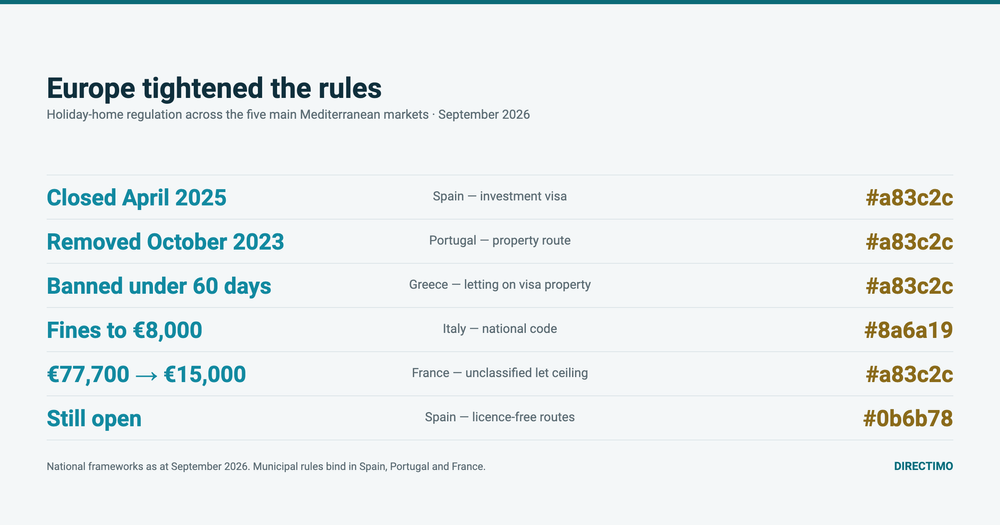
Three of the five main Mediterranean destinations closed or gutted their residence-by-investment routes. Four tightened short-term letting. One now bans it outright on the properties bought through its investment visa.
The five markets did not move in the same way. Some imposed national bans, some cut the tax advantage, one attached the restriction to its investment visa. Spain devolved the question to town halls, which leaves the position specific to an address and checkable before you buy — the practical difference this article sets out to establish.
Where each country stands
| Residence by property investment | Short-term letting | Where the pressure sits | |
|---|---|---|---|
| Spain | Closed April 2025 | Municipal caps, no national ban | Town halls, building by building |
| Portugal | Property route removed October 2023 | National registration, municipal limits | Registration and local caps |
| Greece | Open, €250,000–800,000 by zone | Banned under 60 days on investment-visa property | The visa itself |
| Italy | No property route | National code required, fines to €8,000 | Tax status and registration |
| France | No property route | 90 nights on a main residence, mayoral quotas | Tax allowances and energy rating |
Spain closed the visa and devolved the rest
Spain ended its golden visa entirely on 3 April 2025. Rather than separating property from the permit, the programme was abolished.
Short-term letting was left to municipalities, and they have used the power. On the Costa del Sol, Málaga city is closed to new tourist registrations until 2028 and registered stock across the province fell 6.6% in the year to May 2026. On the Costa Blanca, Alicante city, Jávea and Altea have capped registrations and Dénia limits them by zone.
Two features distinguish Spain from the rest of the list. There is no national ban — the position is set address by address, so a specific property either works or does not, and it can be established before you buy. And two letting routes need no tourist licence at all: mid-term contracts, and on the Costa Blanca any let of eleven days or more.
Since April 2026 a further condition applies to apartments: a registered prohibition on lodging use in the building's statutes overrides a valid tourist licence. Detached villas fall outside that rule.
Portugal removed property from the visa
Portugal struck every real estate route from its residence-by-investment programme in October 2023, and barred the surviving fund pathways from property involvement. Existing permit holders kept their permits and renewal rights. No new property-based applications are accepted.
Short-term letting continues under national registration with municipal containment zones in the pressured city markets.
Greece kept the visa and banned the letting
Greece is the outlier, and the detail matters to anyone comparing it with Spain.
The golden visa remains open at €250,000 to €800,000 depending on the zone, and property qualifies. Since 2024, however, property acquired through that route may not be let for under 60 days — on a platform or privately. The penalty is a €50,000 fine and revocation of the permit.
Long-term leasing of those properties stays fully legal. The restriction attaches to the investment visa, not to Greek property generally.
For a buyer whose plan combines residency with holiday letting, Greece removes that combination.
Italy made the code compulsory and split the tax rate
Every property let to tourists in Italy must now display a national identification code, physically on the building and in every online listing. Operating without one carries fines of up to €8,000, and failing to show it in an advertisement up to €5,000.
The flat tax on short-let income runs at 21% on the first property and 26% from the second onward. Letting more than two properties is treated as a business activity, with VAT registration and the obligations that follow.
Enforcement stepped up through the 2026 summer season, with coordinated checks by the tax police and local authorities.
France cut the tax advantage and handed power to mayors
France made the sharpest change to the economics.
| Before | Now | |
|---|---|---|
| Classified furnished let — revenue ceiling | €188,700 | €77,700 |
| Classified — tax allowance | 71% | 50% |
| Unclassified — revenue ceiling | €77,700 | €15,000 |
| Unclassified — tax allowance | 50% | 30% |
An unclassified furnished tourist let above €15,000 of revenue now falls outside the simplified regime entirely.
Alongside that: a main residence may be let to tourists for a maximum of 90 nights a year, down from 120, with a €15,000 penalty for breach. Registration becomes general across the country from 20 May 2026. Mayors can fine €10,000 for failure to register and €20,000 for a false declaration, and communes may set quotas and designate zones reserved for main residences.
Energy performance is now a condition of letting. New lets in pressured markets need at least an F rating, rising to E from 2028, and every tourist let must reach A to D by 2034. That last date is a capital expenditure deadline on older stock, and it is eight years away.
Demand did not fall
The regulatory tightening happened against rising demand, which is why it happened.
Spain received 58.1 million international tourists in the seven months to July 2026, up 4.6%, spending over €82 billion. Foreign buyers set a record of 97,300 property purchases in Spain in 2025. Spanish home sales reached roughly 705,000 in 2025, the highest since 2007.
Restriction of this kind is a response to scarcity, not to weakness. It reduces legal supply while demand continues, which is why an existing, valid, transferable letting right has been appreciating in every one of these markets.
Reading it as a buyer
The letting right is now part of the asset, and it is not automatic anywhere. In 2019 the question was whether the property was good. In 2026 the first question is what you are legally allowed to do with it, and the answer is specific to the address, the building and the municipality.
Scarcity favours existing rights. Wherever new registrations are capped, a property that already holds one carries a premium over an identical property that does not, and the gap widens as the cap holds.
Check the exclusions, not the headline. Greece's visa is open and its letting is closed. Italy's code is simple and its tax steps at the second property. France's allowance looks generous until you see the ceiling. Spain's position is municipal, which means it is verifiable in advance.
Fallbacks decide resilience. A property that only works as a tourist let is exposed to a single regulatory decision. One that also works mid-term or long-term is not.
How Directimo works
Directimo represents the buyer, never the seller. Listing agents are contracted by the vendor and paid to protect the vendor's price.
We verify the letting position for the specific address before you commit — the municipal regime, the registration status, the building's registered statutes — and model the fallback alongside the headline strategy. The properties we source average 13.5% below area market prices. We have completed more than 1,000 transactions since 2011, totalling over €300M in property sold.
Check what a specific property is allowed to do: directimo.com/advisory-call
Spain is compared with Portugal, Italy, Greece and France on tax, yield and buying process in our country guide. The national picture behind Spanish prices is in our Spain economy guide, and the five ways to structure a purchase in our investment strategies guide.
Sources. Spanish government — closure of the residence-by-investment programme, April 2025. Portuguese government — removal of real estate routes, October 2023. Greek legislation on residence by investment and short-term letting, 2024, including the 60-day threshold and the €50,000 penalty. Italian rules on the national identification code for tourist lets and the flat-tax rates, in force 2026. French legislation on furnished tourist lets — revenue ceilings, allowances, the 90-night limit, registration from 20 May 2026, mayoral powers and the energy performance timetable to 2034. INE — Spanish tourist arrivals and spending to July 2026, and registered tourist dwellings, May 2026. Consejo General del Notariado — Spanish transaction volumes and foreign purchases, 2025. Directimo Costa del Sol and Costa Blanca Market Reports, September 2026.
Method. Country positions are stated as at September 2026 and describe national frameworks; municipal rules vary within each country and are the binding constraint in Spain, Portugal and France. Greek letting restrictions described here attach to property acquired through the residence-by-investment route, not to Greek property generally. Tax figures are headline rates and allowances, before personal circumstances.
This article is market research, not investment, tax, legal or immigration advice. Rules in every country listed here change frequently and should be confirmed for the specific property and your own position before any commitment.