

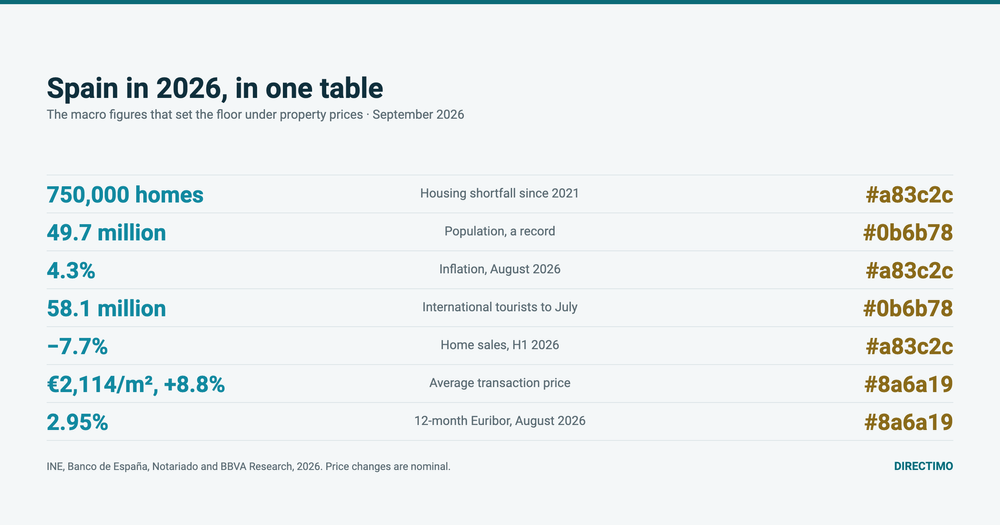
Spain is one of Europe’s strongest major economies in 2026.
Growth is being supported by population inflows, tourism, services, employment and domestic demand. For property buyers, this matters because these forces can support residential demand, rental depth and resale liquidity.
But there is one important distinction:
A strong economy supports real estate demand. It does not guarantee that every property, area or price will perform well.
For international buyers, the right question is not only:
“Is Spain growing?”
The better question is:
“Where does Spain’s growth translate into sustainable housing demand, rental demand and exit liquidity?”
Last reviewed: 7 July 2026
Jurisdiction: Spain
Important: this article is general information only. It is not investment, legal, tax or financial advice. Property performance depends on location, price, legal status, rental rules, financing and exit liquidity.
Quick Summary
- Spain is one of Europe’s strongest major economies in 2026.
- The European Commission forecasts Spanish GDP growth of 2.4% in 2026, before moderating to 1.9% in 2027.
- Goldman Sachs forecasts Spain to grow around 2.1% in 2026, about three times faster than the euro area forecast of 0.7%.
- Spain’s population reached 49.57 million on 1 January 2026.
- Spain exceeded 10 million foreign-born inhabitants for the first time.
- Spain received 96.8 million international tourists in 2025, after roughly 94 million in 2024.
- The Spanish government expects around 100 million international tourists in 2026.
- Spain’s Housing Price Index rose 12.9% year-on-year in Q1 2026, with used homes up 13.5% and new homes up 9.1%.
- The macro trend is supportive for real estate, but buyers should still focus on micro-location, price, legal status, rental rules and resale liquidity.
2026 key figures
| Indicator | Latest figure | Why it matters for property buyers |
|---|---|---|
| GDP growth forecast | 2.4% in 2026 | Supports confidence, employment and household formation |
| Euro area comparison | Spain forecast around 3x euro area growth by Goldman Sachs | Shows Spain’s relative outperformance |
| Population | 49.57 million on 1 January 2026 | Record population supports housing demand |
| Foreign-born residents | Over 10 million for the first time | Supports relocation, rental and international-resident demand |
| International tourists | 96.8 million in 2025 | Supports coastal economies, services and rental demand |
| 2026 tourism outlook | Around 100 million tourists expected | Keeps pressure on prime tourism and coastal markets |
| Summer 2026 tourism forecast | 43 million international tourists, +6% YoY | Indicates continued strong seasonal demand |
| Summer 2026 tourism revenue forecast | €64 billion, +10% YoY | Supports employment, services and local economies |
| Housing Price Index | +12.9% YoY in Q1 2026 | Confirms strong national price momentum |
| Used homes | +13.5% YoY in Q1 2026 | Resale market is currently growing faster than new homes |
| New homes | +9.1% YoY in Q1 2026 | New-build demand remains strong |
1. Why Spain stands out in 2026
Spain is outperforming many of Europe’s larger economies.
The main drivers are:
- population growth;
- immigration and labour-force expansion;
- strong tourism;
- competitive services exports;
- domestic consumption;
- investment supported by European recovery funds;
- improving productivity in some sectors;
- relatively resilient employment.
This makes Spain different from slower-growth European economies where weak demographics, lower consumption or industrial stagnation are weighing on demand.
For property buyers, this creates a more supportive backdrop than in many other European markets.
However, national growth should not be confused with automatic property appreciation.
Real estate remains local.
A well-located home in a liquid, supply-constrained area can benefit from Spain’s macro trend. A poorly located or overpriced property may not.
2. Population growth is one of the biggest housing drivers
Spain’s population reached 49.57 million on 1 January 2026.
That is important because housing demand is ultimately driven by people:
- people moving for work;
- people relocating for lifestyle;
- people retiring;
- people renting before buying;
- people buying second homes;
- people moving from abroad;
- people forming new households.
Spain also exceeded 10 million foreign-born inhabitants for the first time.
This matters directly for real estate because foreign-born residents are not evenly spread across the country. They tend to concentrate in specific markets:
- large cities;
- coastal provinces;
- airport-connected areas;
- international school corridors;
- retirement destinations;
- digital-nomad hubs;
- established expat communities.
For Directimo buyers, this is especially relevant in areas such as:
- Costa del Sol;
- Costa Blanca;
- Málaga;
- Alicante;
- Valencia;
- Madrid;
- Barcelona;
- the Balearic Islands;
- the Canary Islands.
Population growth does not affect every area equally. It matters most where jobs, services, infrastructure, lifestyle demand and housing supply constraints meet.
3. Immigration is supporting Spain’s labour market
Spain’s recent growth story is closely linked to migration.
Analysts have highlighted Spain’s ability to integrate a growing foreign population into the labour market faster than many other large European countries.
This has several economic effects.
First, it expands the labour force.
Second, it supports sectors with labour shortages, including:
- healthcare;
- hospitality;
- construction;
- logistics;
- technology;
- engineering;
- skilled trades;
- domestic services;
- professional services.
Third, it increases rental demand. Many new residents rent before buying, especially in large cities and coastal employment hubs.
Fourth, it supports year-round local economies. Areas with a large resident foreign population are less dependent on peak-season tourism alone.
This is why international-resident markets can be more resilient than purely seasonal resort markets.
For buyers, the practical question is:
Is the area supported only by holiday demand, or does it also have a growing resident population?
The second type usually has stronger long-term fundamentals.
4. Latin American migration is especially important
Spain has a particular advantage compared with other European countries: language and cultural proximity with Latin America.
Many migrants from Colombia, Venezuela, Peru, Argentina, Ecuador and other Latin American countries can integrate faster because they already speak Spanish and often have cultural or family ties.
This helps labour-market absorption.
It also supports demand for housing in urban and service-led markets.
This does not mean immigration removes Spain’s housing challenges. In fact, stronger population growth can increase pressure on already tight housing supply.
But from a property-demand perspective, it is a major structural driver.
5. Tourism remains one of Spain’s strongest economic engines
Tourism continues to be central to Spain’s economy.
Spain welcomed roughly 94 million international tourists in 2024.
In 2025, that increased to 96.8 million international tourists, a new record.
For 2026, the Spanish government expects around 100 million international tourists.
For summer 2026 alone, expectations are around:
- 43 million international tourists;
- +6% year-on-year;
- approximately €64 billion in tourism revenue;
- around +10% year-on-year revenue growth.
This supports:
- hospitality employment;
- restaurants;
- retail;
- airports;
- transport;
- short-stay accommodation demand;
- second-home demand;
- international visibility.
For coastal property markets, tourism can be a major advantage. It brings demand, liquidity and global recognition.
But tourism is not only positive.
In high-pressure locations, tourism can also bring:
- short-term rental restrictions;
- licensing pressure;
- community resistance;
- political intervention;
- higher operating costs;
- competition among rental properties.
This is why tourist demand must be underwritten carefully.
A strong tourist market is useful, but the property still needs the right location, legal rental route, community rules, pricing and operating assumptions.
6. Spain is no longer only a tourism story
Spain’s growth is not only about tourism.
The wider services economy is increasingly important.
This includes:
- technology;
- consulting;
- financial services;
- legal services;
- healthcare;
- education;
- logistics;
- hospitality;
- real estate services;
- remote-work infrastructure;
- professional services exports.
Goldman Sachs noted in 2026 that Spain’s economy is expected to grow significantly faster than the euro area, supported by productivity gains and structural resilience.
This matters for real estate because service-sector growth supports year-round demand.
For buyers, this can benefit:
- city apartments;
- commuter towns;
- family homes near schools;
- homes near healthcare and transport;
- long-term rental assets;
- mid-term rental properties;
- relocation-focused coastal areas.
The strongest property markets are usually not only beautiful. They also function year-round.
7. Productivity and services are improving Spain’s position
Spain’s recent performance is not only based on more people and more tourists.
Productivity has also improved in some areas.
Goldman Sachs has highlighted that Spain has recorded the highest productivity growth on a per-employee and per-hour basis among the EU’s four biggest economies since 2021.
This is relevant because Spain has historically struggled with low productivity compared with some northern European economies.
If productivity continues improving, it can support:
- higher wages;
- stronger household demand;
- more resilient employment;
- higher-quality services;
- stronger long-term economic growth.
For real estate, productivity matters indirectly.
A more productive economy can support better affordability, stronger employment and more stable year-round demand.
8. What this means for Spanish real estate
Spain’s economic growth supports real estate through several channels.
More residents
More people living in Spain means more demand for housing.
This affects both rental and purchase markets.
More foreign residents
Foreign-born residents support international communities, relocation demand and rental demand.
This is especially relevant in cities and coastal markets.
Stronger employment
A stronger labour market supports affordability and household formation.
It also supports demand in cities and year-round towns.
More tourism
Tourism supports short-stay demand, hospitality and second-home markets.
But in some areas it also increases regulation and political pressure.
More services activity
Services growth supports demand beyond summer tourism.
This is important for long-term rental, mid-term rental and relocation-focused property.
Limited housing supply
In many Spanish markets, demand is growing faster than housing supply.
This can support prices, but it also increases affordability pressure and regulatory risk.
9. House prices are rising strongly
Spain’s Housing Price Index rose 12.9% year-on-year in Q1 2026.
The split is important:
- used homes: +13.5% year-on-year;
- new homes: +9.1% year-on-year;
- quarter-on-quarter growth: +3.5%.
This confirms strong market momentum.
But it also increases the risk of overpaying.
For buyers, this means:
- do not assume old prices are still realistic;
- compare micro-locations, not only municipalities;
- verify comparable transactions;
- understand local supply;
- check rental rules;
- stress-test financing;
- avoid low-quality stock that only looks attractive because the market is rising.
A rising market rewards good selection. It does not protect buyers from poor due diligence.
10. Supply shortage is the key real estate constraint
Spain’s property market is not only rising because demand is strong.
It is also rising because housing supply is constrained in many locations.
This matters because limited supply can support prices in desirable areas, especially where demand comes from multiple sources:
- local residents;
- foreign residents;
- tourists;
- second-home buyers;
- investors;
- relocators;
- retirees.
However, supply shortage also creates risks:
- affordability pressure;
- political intervention;
- rental regulation;
- pressure on short-term rentals;
- resistance to foreign buyers in some cities;
- increased scrutiny of speculative demand.
For international buyers, the opportunity is not simply “Spain is short of homes”.
The opportunity is finding properties in locations where demand is durable and exit liquidity is broad.
11. Where macro growth matters most
| Market type | Why it may benefit | What buyers must check |
|---|---|---|
| Major cities | Jobs, services, rental demand | Affordability, supply, regulation |
| Airport-connected coastal areas | Foreign buyers, tourism, relocation | Seasonality, rental rules, liquidity |
| Year-round towns | Resident demand and services | Healthcare, schools, employment, transport |
| Premium coastal zones | Limited supply and international demand | Overpricing, views, access, resale depth |
| Family relocation corridors | Schools, healthcare, safety, services | Commute, school capacity, long-term demand |
| Tourist hotspots | Rental demand and global visibility | Licensing risk, community rules, saturation |
| Emerging value areas | Lower entry price and improving demand | Liquidity, infrastructure, resale depth |
The best areas usually combine more than one demand driver.
For example:
- tourism plus year-round residents;
- international schools plus airport access;
- lifestyle plus healthcare;
- beach access plus local services;
- limited supply plus strong resale demand.
12. What this means for Costa del Sol
Costa del Sol benefits from several macro trends at once:
- international buyer demand;
- tourism;
- relocation;
- premium lifestyle demand;
- Málaga’s growing services and technology economy;
- airport connectivity;
- international schools;
- strong brand recognition;
- limited supply in prime areas.
This supports both second-home and relocation demand.
But Costa del Sol is not one market.
Buyers should distinguish between:
- Marbella and the Golden Triangle;
- Málaga city;
- Estepona;
- Mijas Costa;
- Benalmádena;
- Fuengirola;
- family areas near schools;
- golf resorts;
- beachside apartments;
- new-build corridors;
- inland value locations.
Costa del Sol has strong fundamentals, but buyers still need to check price, supply, legal status, rental rules and exit liquidity.
13. What this means for Costa Blanca
Costa Blanca also benefits from Spain’s demographic and tourism trends, but in a different way.
Its strengths include:
- large international resident base;
- lower entry prices than many prime Costa del Sol areas;
- Alicante airport connectivity;
- retirement demand;
- second-home demand;
- year-round towns such as Alicante, Denia and parts of the northern coast;
- established international communities in the south;
- broad budget range.
Costa Blanca can be attractive for buyers who want value, lifestyle and liquidity at lower entry prices.
However, local selection is critical.
The difference between a liquid, year-round area and a seasonal or over-supplied area can be significant.
14. Why this matters for foreign buyers
Spain’s economic growth is relevant for foreign buyers because it supports several parts of the property thesis:
- more people need housing;
- more foreign residents want homes;
- tourism supports coastal services and rental demand;
- services growth supports year-round employment;
- airports and infrastructure support international mobility;
- limited supply supports prime locations;
- rising prices improve confidence, but also increase entry risk.
The strongest property cases are usually not based on one factor.
A good property should have several demand drivers:
- owner-use appeal;
- rental demand;
- resale liquidity;
- services nearby;
- legal clarity;
- good access;
- realistic pricing.
15. The risks buyers should not ignore
A strong national economy does not remove property risk.
Buyers should watch:
- affordability pressure;
- local overpricing;
- short-term rental restrictions;
- community rules;
- mortgage tightening;
- construction delays;
- weak resale liquidity in niche areas;
- poor energy efficiency;
- low-quality older stock;
- areas dependent only on peak-season tourism;
- political pressure in over-touristed cities;
- local supply pipeline.
The biggest mistake is buying the macro story without checking the property-level fundamentals.
16. Buyer checklist
Before using Spain’s economic growth as part of an investment case, ask:
- Is the area growing year-round or only seasonally?
- Is demand local, foreign, tourist or mixed?
- Is there enough resale liquidity?
- Are prices supported by comparable transactions?
- Is the property easy to rent legally?
- Is short-term rental licensing realistic?
- Are there schools, healthcare and services nearby?
- Is the area dependent on one buyer nationality?
- Is there new supply coming nearby?
- Would the property still make sense if price growth slows?
- Is the exit market broad enough?
- Does the property match the budget of future buyers?
- Is the legal status clean?
- Are community rules compatible with the intended use?
Good real estate decisions start with macro context, but they are won or lost at micro-location level.
Bottom line
Spain’s economy is one of Europe’s strongest growth stories in 2026.
That is positive for property demand.
GDP growth, population growth, immigration, tourism, services and limited housing supply all support the case for Spanish real estate.
But buyers should avoid one simple mistake:
Do not buy only because “Spain is growing”. Buy because the specific property, in the specific area, has durable demand, sensible pricing and clear exit liquidity.
Spain’s macro trend is supportive.
Property selection still matters more.
Sources: European Commission — Economic Forecast for Spain, May 2026 INE — Continuous Population Statistics, 1 January 2026 INE — FRONTUR Tourist Movements at Borders, 2025 Reuters — Spain expects around 100 million tourists in 2026, July 2026 INE — Housing Price Index, Q1 2026 Goldman Sachs Research — Why Spain’s Economy Is Growing Three Times Faster Than the Euro Area, June 2026 Wall Street Journal — Tourists and migrants helping Spain’s economic growth, January 2025


