

Published September 2026 · Data verified September 2026
Most buyers on the Costa del Sol and Costa Blanca think in terms of one decision: which property. There are five distinct ways to own and let it, and the choice between them changes the return more than the choice of apartment does.
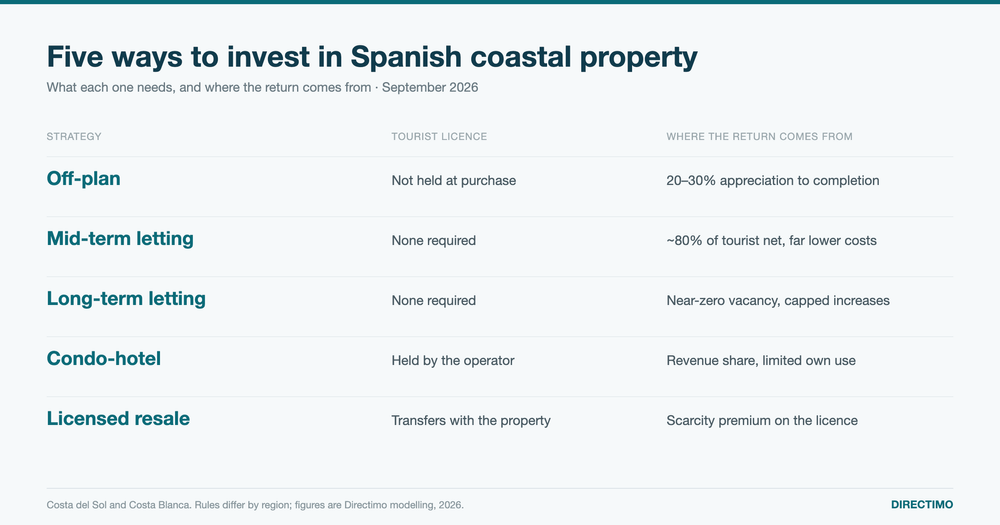
| Strategy | Tourist licence | Where the return comes from |
|---|---|---|
| Off-plan | Not held at purchase | 20–30% appreciation to completion |
| Mid-term letting | None required | Around 80% of tourist net, at far lower cost |
| Long-term letting | None required | Near-zero vacancy, capped increases |
| Condo-hotel | Held by the operator | Revenue share, limited own use |
| Licensed resale | Transfers with the property | Scarcity premium on the licence |
1. Off-plan
You pay a reservation fee of €6,000 to €10,000, then a deposit which together reaches 20–30% of the price, sometimes with staged payments of a further 10–20% during construction.
On a good project in a good area, bought at launch, typical appreciation to completion is 20–30%. That appreciation applies to the full value of the property while only about 30% of your capital is committed. Cases above 50% exist; we prefer to model conservatively.
Your deposits are protected by law. The developer must cover them with a bank guarantee or an insurance policy and hold them in a separate account. If the project is not completed, you recover your money with interest. Every new build also carries a ten-year structural warranty.
The practical rule: confirm the guarantee exists before any payment.
What to watch. The tourist licence does not exist when you sign. It is obtained after delivery, and if the town hall restricts the zone in the meantime, the letting plan can become impossible. The mid-term fallback below has to be part of the plan from the start.
There is also a pattern worth knowing, from our own transaction record. Around 60% of buyers who declare a mixed intention — personal use plus letting — end up using the property themselves, and may vote in the community against tourist-letting permissions. The community's actual composition at delivery can change the arithmetic even where the developer declared initial approval.
A small number of developers write consent to tourist letting into the contract at the point of sale. That is a strong signal of a building designed for investment.
2. Mid-term letting
This is the strategy that needs no licence, and the thresholds differ by coast.
Costa del Sol: from two months up to around eleven. Costa Blanca: from eleven days, which is far more flexible and includes long holiday stays.
Demand is constant. Northern Europeans winter in the south at living costs up to 30% below home. People relocating test an area before they buy. Remote professionals stay for a season. Marbella's municipal register counts 156 nationalities.
Gross income is lower than tourist letting. Net income reaches around 80% of the tourist net, and in optimised new developments as much as 95% — 4.0% against 4.2% in the same model. Booking and management costs are far lower, the tenant pays the utilities, and you can use the property yourself between contracts.
One measure to watch. A housing decree drafted in July 2026 would have capped seasonal contracts at twelve months and treated more than two consecutive contracts between the same parties as an ordinary residential tenancy. It was withdrawn before approval and nothing has been published, so the strategy is unaffected today. It bears directly on this fallback and is worth tracking.
3. Long-term letting
Vacancy is close to zero. Demand is high and the supply of modern, furnished homes is small.
In exchange, annual rent increases are capped by an official national index at roughly 2.4–2.5% in 2026, even if the market rises 30% over three years.
The usual answer is successive mid-term contracts, renegotiated at market price.
4. Condo-hotels
Also sold as apart-hotels, these are buildings constructed specifically for investors, and the legal framework exists on both coasts.
The building is licensed either as a hotel of at least four stars, or as tourist apartments rated three keys, which is the top category — keys are the apartment equivalent of hotel stars. You buy a unit; letting is handled by a single operating company on a contract of at least ten years, recorded at the land registry.
The ownership structure is what defines the category. A single operator runs the whole building, and your unit is let only through that operator.
Personal use is limited by law. These units have exclusive tourist use, and using them as a residence is a sanctionable offence. On the Costa Blanca the threshold is written into the law: more than four months of own use per year counts as residential use. On the Costa del Sol the cap sits in the operating contract, typically around two months a year.
Interests are aligned. The operator earns a percentage of revenue, so it maximises revenue, and the resale value stays tied to the yield produced.
What to watch. The operator's track record, and the conditions under which fixed costs can change. Changing the operator is a decision of the owners' community rather than an individual right, exercisable at the contractual windows once every ten years. Read the statutes and the termination clauses before you buy.
Avoid fixed-rent structures in place of a revenue share, which are common in older buildings. On a €300,000 unit with a fixed rent of €10,000 a year, the 3.33% gross yield caps the resale value.
Scarcity works in the owner's favour: these buildings are only 1–2% of the stock available for sale. There is no oversupply, and the unit resells as an investment product.
5. Resale with an existing licence
Resale offers better locations at lower prices, and renovation lifts both the yield and the value, particularly in prime locations.
On the Costa del Sol an existing licence keeps gaining value. New ones are progressively harder to obtain, legal supply is shrinking, and the transfer is straightforward — the licence passes with the property. The community's three-fifths approval applies only to starting a new activity, not to continuing an existing one. The building's own statutes still govern.
On the Costa Blanca an existing registration is a real advantage, and the conditions are re-confirmed on sale. That verification belongs before the offer.
A new home with an active licence is a valuable asset, and the best-located ones can be too expensive for yield. Run the full net calculation either way.
How to choose
If your horizon is short and you want capital growth, off-plan puts the least capital at risk for the appreciation you capture. Build the mid-term fallback into the plan.
If you want income without regulatory exposure, mid-term letting is the answer on both coasts, and the Costa Blanca gives you far more flexibility with its eleven-day threshold.
If you want the property to run itself, a condo-hotel removes the management question entirely, at the cost of using it yourself.
If you want the highest sustainable yield, a resale with an existing licence in a municipality that no longer issues them is the scarcest position available.
If you want stability above all, long-term letting has near-zero vacancy and the lowest cost, and you accept the cap on rent increases.
Your lawyer verifies the statutes, the licence status and the planning position before you sign anything.
How Directimo works
Directimo represents the buyer, never the seller. Listing agents in Spain are contracted by the vendor and paid to protect the vendor's price.
We model each of these five strategies against your budget and your horizon before you commit to a property, then verify the licence status and the municipal regime for the specific address. The properties we source average 13.5% below area market prices. We have completed more than 1,000 transactions since 2011, totalling over €300M in property sold.
Work out which strategy fits: directimo.com/advisory-call
Yield figures by market are set out in our Costa del Sol and Costa Blanca rental analyses.
The capital-growth outlook for each coast is set out separately in our Costa del Sol outlook and Costa Blanca outlook.
Sources. Directimo transaction record and net-yield modelling, 2023 to 2026. Junta de Andalucía and Generalitat Valenciana — tourist accommodation frameworks and condo-hotel categories. Spanish national tenancy law and the official rent-increase index for 2026. AirDNA and Idealista — the yield figures referenced.
Method. Appreciation and net-yield figures are Directimo internal estimates on the projects and properties we analyse, stated conservatively. Regional thresholds differ between the two coasts and are given separately throughout.
This guide is market research, not investment, tax or legal advice. Regional and municipal rules change frequently and should be confirmed for the specific property before any offer.