

Published September 2026 · Data verified September 2026
A European buyer looking south has five serious options: Spain, Portugal, Italy, Greece and the south of France, with Cyprus as a niche alternative. This guide assesses Spain against each of them on the factors that decide an international purchase — how safe the investment is, how the economy and geopolitics look, healthcare, schooling, climate, daily life and tax.
The short answer. Spain does not win every category. It is the only one of the five with no structural weakness, and a structural weakness is what makes a property hard to sell later.
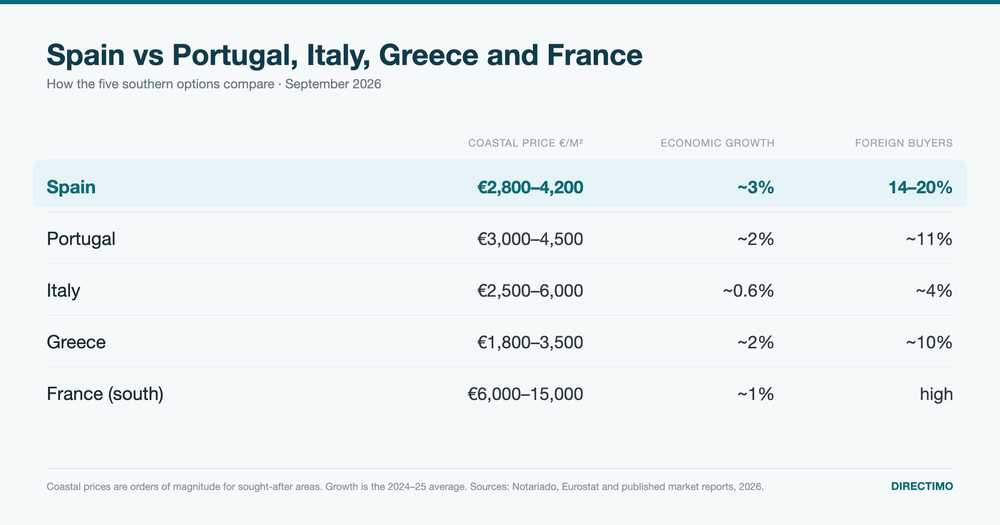
The comparison at a glance
| Spain | Portugal | Italy | Greece | France (south) | |
|---|---|---|---|---|---|
| Coastal price, good areas (€/m²) | 2,800–4,200 | 3,000–4,500 | 2,500–6,000+ | 1,800–3,500 | 6,000–15,000+ |
| Foreign buyer share | 14–20% nationally; over 50% in Alicante, ~43% in Málaga | ~10–12% | ~3–5% | ~10% | high on the Riviera |
| Economic growth, 2024–25 average | fastest large euro-area economy, ~3% | ~2% | ~0.5–0.7% | ~2% | ~1% |
| Mortgage for EU non-residents | 60–70% of value, routine | 60–70% | difficult, bureaucratic | limited | available, expensive |
| Life expectancy | highest in the EU, ~84 | ~82 | ~83.5 | ~82 | ~83 |
| Homicide rate per 100,000 | ~0.6–0.7, among the lowest in the EU | ~0.7 | ~0.5 | ~0.8 | ~1.1 |
| Golden Visa | ended April 2025 | ended for property, 2023 | n/a | active, €250–800k | n/a |
| Tax break for new residents | Flat 24% on salary for six years | Narrowed scheme, limited professions | Pay €200,000 a year on all foreign income | Pay €100,000 a year on all foreign income | None |
| Direct geopolitical risk | very low | very low | low | low to moderate | low |
Prices are orders of magnitude for sought-after coastal areas, not national averages. Spain's foreign-buyer share differs by official source: the notaries record a higher share than the land registry, because deeds capture foreign buyers more completely than registrations do. Figures for the other four countries come from market reports; no single European source publishes them on one basis.
Investment safety
Market size and liquidity. Spain has no rival here. Foreign buyers completed close to 97,500 purchases in 2025, an all-time record. At municipal level the concentration becomes striking: foreign buyers accounted for 73.6% of purchases in Calpe, 70.8% in Estepona, 68.6% in Jávea, 68.1% in Altea and 64.8% in Marbella. These are whole markets where the typical buyer is international.
Demand is also unusually diversified — Dutch, British, Belgian, Polish, German, French and American buyers all feature, and no single nationality dominates. Alicante has the most intensive transaction activity in Spain, at almost 26 sales per thousand residents per year.
In plain terms: when you want to sell, there is a buyer. In rural Italy or on a small Greek island, you can wait years.
Legal security. A notarial system plus a public, searchable land registry, and full freehold ownership for any EU citizen with no restrictions. A property's legal status can be checked for a few tens of euros before you make an offer.
Portugal is comparable. Italy is legally sound and bureaucratically slow. Greece has improved with a digital cadastre, though rural and island titles still need careful work. France is impeccable, at transaction costs of 7–8% and entry prices that change the conversation entirely.
Money paid for new-builds is protected by law. Few buyers know this, and it separates Spain from its neighbours. When you buy from a developer, the payments you make before completion must be secured by a bank guarantee or an insurance policy, and the developer must hold them in a dedicated account, separate from its operations. If the project is not completed or fails to obtain its occupancy licence, you recover your money with interest.
Every new build also carries a mandatory ten-year structural warranty, paid for by the developer. The system was forged in the 2008 crash, and the case law it produced now works in the buyer's favour. The practical rule: confirm the bank guarantee exists before any payment, because the protection only works if the mechanism is properly in place.
Financing. Spanish banks routinely lend EU non-residents 60–70% of value, at fixed rates that fell to 2.5–3% in 2026, with debt service capped at around 35% of net income.
That changes the arithmetic on a holiday home. At those rates, income from a mixed strategy — tourist letting in summer, medium-term through winter — can cover the mortgage in full. The property pays for itself in the years you only use it for a few weeks, and you keep it. Italy makes non-resident mortgages an obstacle course; Greece's credit market for foreign buyers remains thin.
What to weigh against this. Spanish transaction costs of 10–14% sit above Portugal at 8–10% and below Italy, which can exceed 15% once agency fees are counted. Rental regulation is volatile across all southern markets — Portugal froze urban short-let licences before Spain did, and Greece restricted Athens.
Economy and geopolitics
Spain is the euro area's positive story. It has grown faster than any other large European economy over 2024 and 2025, at roughly 3% a year, against stagnation in Germany and under 1% in France and Italy. Tourism is at record levels, second in the world by arrivals. The population is growing through immigration, in direct contrast to demographic decline in Italy, Greece and Portugal.
For a property investor, demography is destiny. Housing demand in Spain is rising structurally. In Italy it is falling.
Geopolitically, Spain sits in Europe's protected corner. NATO and EU member, as far from the eastern flank as the continent allows, no border with a conflict zone, and no meaningful dependence on Russian energy — Spain has Europe's largest LNG regasification capacity and one of its highest shares of renewable generation, with electricity prices often below the EU average.
The real risks are worth naming: chronic political fragmentation and minority governments, though with little practical effect on property rights; migration pressure on the southern route; and the grid vulnerability exposed by the Iberian blackout of April 2025, which was an infrastructure warning rather than a structural crisis.
By comparison, Greece carries latent tension with Turkey and exposure to eastern Mediterranean instability. Italy combines economic stagnation, public debt near 135% of GDP and falling demographics. Portugal is as geopolitically safe as Spain, with an economy six times smaller and one relevant coastal region — concentration rather than diversification.
Healthcare
Spain has the highest life expectancy in the European Union at around 84 years, and a health system ranked consistently among the world's most efficient. For residents, including European pensioners under the reciprocal arrangement, the public system is free and good. For everyone else, private cover is dense and inexpensive by Western European standards: comprehensive insurance from roughly €60–150 a month, with large networks running hospitals along the whole coast and multilingual staff in the international areas.
France matches Spain medically at a much higher cost of living. Italy is good but regionally uneven, with the north excellent and the south below average. Portugal's public system is visibly under strain and its private sector is thin outside Lisbon and the Algarve. Greece has good doctors and underfunded public infrastructure — on an island, a serious emergency means a helicopter to Athens.
For retirement buyers, who make up the largest share of the holiday-home market, healthcare is the first criterion. Spain is the rational answer.
Schooling
Spain has one of the densest international school networks in continental Europe, concentrated exactly where buyers want to be: the Costa del Sol between Marbella, Estepona and Mijas holds one of the highest concentrations on the continent, alongside Madrid, Barcelona, Valencia and good options on the Costa Blanca.
British, American, French and German curricula are all available, at typical fees of €6,000–15,000 a year — half the equivalent in Switzerland or the UK. Spanish universities are rising, and English-taught programmes have expanded quickly.
Portugal is strong but concentrated in Lisbon, Cascais and the Algarve. Italy has depth in Milan and Rome and little on its holiday coasts. Greece is effectively limited to Athens.
Climate, and climate risk
Southern and eastern Spain offer the best liveable climate in continental Europe: over 300 days of sun, winters spent outdoors, and — uniquely — internal variety. Arid and dry around Alicante, green Mediterranean in the Marina Alta and western Costa del Sol, subtropical in the Axarquía, cool Atlantic in the north for anyone escaping the heat.
Portugal has milder summers and wetter winters, with a cold ocean. Greece and southern Italy face increasingly brutal summers. The French Riviera is excellent with a shorter comfortable season.
The risk deserves the same clarity. Heatwaves are intensifying, drought is cyclical, and autumn storm events can be catastrophic — the Valencia floods of October 2024, with more than 220 deaths, were Europe's worst natural disaster of the decade.
What this means for a buyer is specific. Check the flood zone at plot level, with particular care in the Vega Baja and for properties built near the dry torrent beds that stay empty all year and turn violent in autumn rain. Many developments from the 1970s to the 1990s were built dangerously close to them.
Spanish home insurance includes cover for extraordinary risks through a national compensation scheme, which is a systemic advantage. Water security differs by region: the southern Costa Blanca has one of Europe’s most developed desalination networks behind it, while Andalusia is a few years further back. Climate risk does not disqualify Spain. It rewards the buyer who chooses the micro-location with open eyes.
Daily life
The familiar arguments — food, street safety, culture, 8,000 km of coast — need no defence. Three less-discussed points matter more.
Everyday infrastructure is world-class. Europe's most extensive high-speed rail network, a dense set of regional airports with low-cost connections across the continent, and near-universal fibre. Spain ranks consistently at the top of the EU for digital connectivity, ahead of Germany. For anyone working remotely, that is the infrastructure that decides it.
Settling in is straightforward. An open society, international communities that have existed for fifty years, and the administrative setup — tax number, town-hall registration, bank account — resolved in weeks rather than months.
And, honestly, about pace. Public administration is slow. Dealing with town halls and utility companies takes longer than you expect. In August the country runs at half speed. Anyone arriving from a Northern European efficiency culture needs to recalibrate.
Tax compared
As a non-resident with a holiday home, Spain sits mid-table. There is an annual return on imputed income, 19% on gains at exit for EU residents, and a low annual property tax — typically €300–800 a year for a coastal apartment, because it is calculated on cadastral value, well below market.
The contrast at the holding stage is sharper than most buyers expect. France charges property tax plus a second-home charge, with surcharges of up to 60% in pressured coastal areas — typically €2,000–4,000 a year combined for a Riviera apartment. Italy applies its second-home tax plus waste charges, typically €1,000–2,500 a year for a holiday house. Portugal is comparable to Spain. Greece is moderate.
As a tax resident, the map is more complex and rewards planning. Spain offers a flat 24% regime on employment income for six years, and applies wealth and solidarity taxes in most regions — with the notable exception of Andalusia and Madrid, which relieve them in full. Italy attracts large fortunes with a €200,000 annual flat tax on foreign income; Greece with a €100,000 non-dom regime; Portugal has sharply narrowed its former scheme.
The practical conclusion: for very large estates, Italy and Greece have more aggressive offers. For most real buyers, tax differences matter less than price, liquidity and lifestyle — and inside Spain, choosing the region matters more than choosing between Spain and its neighbours.
Spain's risks
Rental regulation is politically volatile, and the direction favours tenants and restricts tourist letting, which erodes yields. Affordability pressure can produce populist measures; current proposals target non-EU buyers only, which shows how politically sensitive the subject is. Climate risk is rising and is managed through micro-location choice. Transaction costs impose a long holding horizon. Political fragmentation is chronic, with no effect on property rights so far and recurring legislative gridlock.
None of these is unique to Spain, and none of them touches the fundamentals: record foreign demand, positive demographics, a growing economy and solid property law.
The verdict, by buyer
Yield investor → Spain, without debate. Liquidity, financing, rental demand, volume. Greece offers higher nominal gross yields with inferior liquidity and legal security.
Retirement → Spain, for healthcare, expat infrastructure and cost. Portugal remains credible for anyone who prefers the Atlantic and a quieter pace, with the caveat about its health system.
Relocating with a family, or working remotely → Spain. Schools, connectivity and real cities on the coast. No other southern option combines all three.
Large estates where tax optimisation leads → Italy and Greece deserve the analysis, with Spain and specifically Andalusia as the balanced answer: no regional wealth tax, and a liquid luxury market in Marbella.
Trophy asset and absolute prestige → the French Riviera remains the reference, at three to five times the price. Marbella is the only Iberian answer in the same conversation.
The conclusion. If southern European property were a portfolio, Spain would be the core position: the most diversified and most liquid exposure, with the best risk-return balance on the fundamentals that do not change — climate, demographics, property law, healthcare, and a hundred million tourists a year testing the product you own, free of charge.
Which coast then follows is a separate decision, and the numbers differ more than most buyers expect. Our guide to Costa Blanca vs Costa del Sol sets them side by side.
How Directimo works
Directimo represents the buyer, never the seller. Listing agents in Spain are contracted by the vendor and paid to protect the vendor's price.
We verify planning status at the town hall, read the community minute book for tourist-letting restrictions, confirm the property is free of debt at the Land Registry, and check the bank guarantees behind off-plan payments. We coordinate the tax number, the bank account, an independent bilingual lawyer, the notary and the handover, remotely from start to finish.
The properties we source average 13.5% below area market prices. We have completed more than 1,000 transactions since 2011, totalling over €300M in property sold.
Directimo is a buyer-first platform for international buyers across Europe's top vacation destinations, starting with the Costa del Sol and Costa Blanca.
Book a 25-minute strategy call: directimo.com/advisory-call Full market reports for each coast: directimo.com/market-reports
The five ways to own and let a Spanish coastal property are set out in our investment strategies guide, and the two Spanish coasts are compared directly in our decision guide.
How each of these countries has tightened its holiday-home and letting rules since 2023 is set out in our European regulation guide.
Sources. Consejo General del Notariado and Colegio de Registradores — Spanish transaction volumes and foreign-buyer shares, 2025 and 2026 series. INE — population, tourism and housing statistics. Eurostat and OECD — life expectancy, growth and crime comparisons. Idealista — Spanish asking prices. National tax authorities of Spain, Portugal, Italy, Greece and France — resident and non-resident regimes. Cross-country price and share figures are orders of magnitude drawn from published market reports, current as of July 2026.
Method. Spanish figures use registered deeds where available. Comparisons between countries have no single European source and should be re-checked before any decision. Residence tax regimes carry strict eligibility conditions and change frequently.
This guide is market research, not investment, tax or legal advice. Individual analysis with a tax adviser is essential before establishing residence anywhere discussed here.