

Published September 2026 · Data verified September 2026
The Costa Blanca and the Costa del Sol account for the majority of international holiday-home purchases in mainland Spain. They are marketed as interchangeable Mediterranean choices. In practice they differ in price level, tax rate, rental law, and the kind of return they produce.
The short answer. Costa Blanca gives you more property for the money, higher headline rental yields, and lower annual running costs. Costa del Sol gives you the stronger long-run appreciation record, a deep luxury resale market, and the infrastructure of a real city. Below €350,000, Costa Blanca usually wins on the numbers. Above €500,000, Costa del Sol usually wins on liquidity and growth.
The baseline numbers
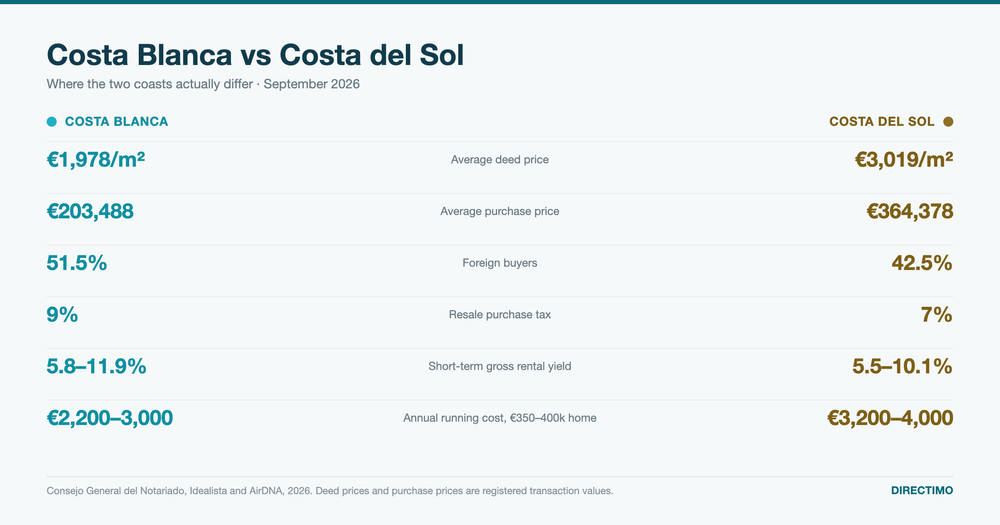
| Costa Blanca (Alicante) | Costa del Sol (Málaga) | |
|---|---|---|
| Deed price, average | €1,978/m², +9.3% in 2025 | €3,019/m², +8.4% in 2025 |
| Asking price, average | €2,759/m² | €4,272/m² |
| Average purchase price | €203,488 | €364,378 |
| Foreign buyer share | 51.5% — highest of any Spanish province | 42.5% |
| Median buyer age | 49 | 50 |
| Individual (non-corporate) buyers | 90.9% | 86.0% |
| Resale share of purchases | 87.8% | 85.4% |
| Resale purchase tax | 9% (11% above €1M) | 7% |
| New-build purchase tax | VAT 10% + stamp duty 1.4% | VAT 10% + stamp duty 1.2% |
| Total acquisition cost, resale | ~11% of price | ~9.5–10.5% of price |
| Total acquisition cost, new-build | ~13.5–15% | ~13–14% |
| Annual running cost, €350–400k home | €2,200–3,000 | €3,200–4,000 |
| Short-term rental yield, gross | 5.8–11.9% | 5.5–10.1% |
| Short-term rental yield, net operating | 2.9–6.0% | 2.8–5.0% |
| Days of sunshine | ~300 | ~320 |
Both price columns come from registered deeds, for the same period, before inflation. That is the comparison that holds.
On long-run growth. Over 2014–2025, Málaga ranks first among all fifty Spanish provinces for house-price growth after inflation, at +5.2% a year in real terms. No provincial figure for Alicante is published on the same basis, so the two cannot be set side by side over that window. What can be said about Alicante with the same confidence: foreign buyers became the largest buying group in the province for the first time on record, and prices are at their highest level since the series began.
Reading deed prices against asking prices. Deeds cover every completed sale, including inland stock and off-plan contracts agreed one to two years earlier. Portals show what sellers are asking today, weighted toward coastal listings. Use deeds to judge value. Use asking prices to judge your negotiating position.
Why the two coasts look so different
The physical contrast follows from two planning models set in the 1950s and 1960s.
Costa Blanca built outward. Benidorm went vertical by design: a 1956 plan chose high towers with space between them and a wide public beach, and it still produces the longest season and the highest hotel occupancy in Spain. Everywhere else the coast spread horizontally into urbanizaciones — hundreds of self-contained developments of townhouses, bungalows and low apartment blocks. In the far north, strict low-density zoning around Jávea and Moraira protected the pine hillsides and produced a landscape of private villas.
The buyer base followed: Northern and Central European, middle to upper-middle income, and unusually spread across nationalities. The Dutch lead at 13.1%, then the British at 10.5%, Poles at 8.5%, Belgians at 8.4% and Germans at 6.9%.
Costa del Sol built along a line. The coast is a narrow strip pinned between the Sierra Blanca and the sea. Flat beachfront land ran out early, so development climbed into the foothills as gated golf communities. Marbella's identity was set deliberately in the 1950s around the Marbella Club and later Puerto Banús, and the luxury layer has compounded ever since.
The buyer base is wealthier and, above €1M, increasingly global. British buyers lead at 13.4%, then the Dutch at 11.4%, Poles at 7.0%, Swedes at 6.8% and Germans at 6.3%, with American and Middle Eastern buyers growing fastest in the prime segment.
Eight sub-markets, not two coasts
Neither coast behaves as a single market. Each divides into four, and the differences inside a coast are larger than the differences between coasts.
Costa Blanca
South (Vega Baja) — Torrevieja, Orihuela Costa, Guardamar, Pilar de la Horadada. Flat, dense and affordable. This is where the construction happens: the Vega Baja accounted for 1,972 of the province's 3,418 housing starts in the first quarter of 2026, with Torrevieja alone at 1,281. Salt lagoons, large commercial centres, a heavy concentration of golf. The most international population in Spain.
Centre — Alicante city, San Juan, El Campello, Santa Pola. A working provincial capital with a beach, an airport twenty minutes away and year-round rental demand that does not depend on tourism. The strongest gross rental yields on the coast sit here.
Lower North — Benidorm, Finestrat, Villajoyosa, La Nucía, Altea. Benidorm is the most efficient tourism machine in Europe. Two engines keep it full for more of the year than anywhere else in Spain: British mid-market demand, and Spanish domestic demand including the state-subsidised winter programme. The return comes from occupancy at moderate nightly rates.
Upper North (Marina Alta) — Calpe, Benissa, Moraira, Jávea, Dénia. Green, rocky and expensive: €3,400–5,000+/m², with sea-view villas from €700,000 into the millions. Very little developable land remains, which protects values. This is also the gastronomic centre of the Spanish east coast — Dénia is a UNESCO City of Gastronomy, and the area holds the highest concentration of Michelin stars on either coast, including a three-star and a two-star house. Dutch, Belgian, German and Swiss buyers dominate.
Costa del Sol
West — Marbella, Benahavís, San Pedro, Nueva Andalucía. Spain's prime resort market, running 27 km from Nueva Andalucía to Elviria with the Golden Mile as its core, where deed prices reach €11,463/m². Trophy assets, branded residences, and the deepest luxury resale market in mainland Spain. In the prime segment, 84–95% of purchases complete in cash, which insulates values from interest-rate moves.
Far West — Estepona, Casares, Manilva. The coast's main new-build pipeline and its strongest recent performer. Estepona is the only Costa del Sol municipality where asking-price growth is still accelerating, and its planning policy actively supports development. The risk to watch is volume: a lot of stock is delivering at once in a few micro-locations.
Centre — Mijas, Fuengirola, Benalmádena, Torremolinos, Málaga city. The highest rental yields on the coast, and the strictest licensing. Málaga city is the reason: 25,000 professionals across more than 700 companies at Málaga TechPark, including Google's cybersecurity centre and Vodafone's European R&D hub, produce year-round demand from relocating professionals that needs no tourist licence at all.
East (Axarquía) — Rincón de la Victoria, Torre del Mar, Torrox, Nerja, Frigiliana. The most Spanish and least expensive face of the province. Subtropical agriculture, cliff coves, whitewashed villages. It is also absorbing demand displaced from the saturated west: registered tourist stock in Frigiliana grew 13.4% over the year while Marbella's fell 11.9%.
Sotogrande appears in some Costa del Sol listings but sits in Cádiz province, under different provincial statistics.
What your budget buys
| Budget | Costa Blanca | Costa del Sol |
|---|---|---|
| €200–300k | New-build 2-bed apartment with pool, Vega Baja | 1–2 bed resale in an older complex, Manilva or Casares |
| €350–450k | 3-bed villa with private pool, Rojales or Finestrat | New-build 2-bed with resort facilities, Mijas or Estepona |
| €500–800k | Sea-view villa in Calpe, or a luxury apartment in Jávea | Contemporary 2–3 bed in Marbella East or San Pedro |
| €1–2.5M | Frontline or panoramic villa, Moraira or Altea Hills | Villa in Nueva Andalucía, or a Golden Mile frontline apartment |
Rental returns
Both coasts are measured the same way here: annual short-term rental revenue from platform data, divided by asking price per square metre for a 90 m² apartment, for the twelve months to June 2026.
| Gross | Net operating | |
|---|---|---|
| Costa Blanca | 5.8–11.9% | 2.9–6.0% |
| Costa del Sol | 5.5–10.1% | 2.8–5.0% |
Costa Blanca's top end is higher, and it is higher for a structural reason: the denominator is smaller. Alicante city, El Campello, Santa Pola and Benidorm lead there. On the Costa del Sol, Málaga city, Rincón de la Victoria, Torrox, Mijas and Nerja lead.
Net operating yield applies a 50% operating-cost allowance and comes before income tax, financing and your personal tax position.
By market
Costa Blanca
| Market | Gross | Net operating |
|---|---|---|
| Alicante city | 11.9% | 6.0% |
| El Campello | 8.5% | 4.3% |
| Santa Pola | 7.9% | 4.0% |
| Benidorm | 7.8% | 3.9% |
| Altea | 7.5% | 3.8% |
| Calpe | 6.9% | 3.4% |
| Finestrat | 6.8% | 3.4% |
| Jávea | 6.4% | 3.2% |
| Villajoyosa | 6.3% | 3.1% |
| Orihuela Costa | 6.3% | 3.1% |
| Teulada-Moraira | 6.1% | 3.1% |
| Dénia | 6.1% | 3.1% |
| Pilar de la Horadada | 5.8% | 2.9% |
Rental revenue rose in all thirteen Costa Blanca markets over the year, between 3.9% and 34.5%, while active listings fell in twelve of the thirteen. Supply is contracting while demand grows.
Costa del Sol
| Market | Gross | Net operating |
|---|---|---|
| Málaga capital | 10.1% | 5.0% |
| Rincón de la Victoria | 7.7% | 3.9% |
| Torrox | 7.5% | 3.7% |
| Mijas | 7.3% | 3.7% |
| Nerja | 7.2% | 3.6% |
| Estepona | 7.1% | 3.6% |
| Torremolinos | 7.1% | 3.6% |
| Manilva | 6.9% | 3.5% |
| Casares | 6.8% | 3.4% |
| Frigiliana | 6.8% | 3.4% |
| Marbella | 6.7% | 3.3% |
| Fuengirola | 6.7% | 3.3% |
| Torre del Mar | 6.6% | 3.3% |
| Benalmádena | 6.5% | 3.3% |
| Benahavís | 5.5% | 2.8% |
Active listings fell across almost every Costa del Sol market over the year, and registered tourist stock across Málaga province fell 6.6%.
Resale and new-build behave differently
These figures describe the general market, which is mostly resale stock. New-build behaves differently in both directions: acquisition costs of around 13–14% against 9.5–10.5% for resale, and materially higher nightly rates where the development has facilities. A modern apartment with pool, gym and concierge achieves €173 a night against €101 for equivalent space without them. New-build yields have to be modelled property by property, against the specific facilities, specification and micro-location.
Four worked models — Costa del Sol
These are underwriting models on real Costa del Sol properties. They show what property selection is worth, which is the part of the return an owner actually controls.
| Model | Cost basis | Gross | Net after tax | Total with 6% appreciation |
|---|---|---|---|---|
| Standard new-build, 1-bed | €340,000 (€400,220 all-in) | 7.4% | 2.9% | 8.9%/yr |
| Optimised new-build with facilities, 2-bed | €350,000 (€416,550 all-in) | 10.5% | 4.2% | 10.2%/yr |
| Renovated resale, Marbella East, 3-bed | €400,000 (€487,200 all-in) | 9.6% | 4.3% | 10.3%/yr |
| Same optimised unit, mid-term letting | €350,000 (€416,550 all-in) | 7.2% | 4.0% | 10.0%/yr |
Net after tax includes acquisition taxes and fees, furnishing, a 50% operating-cost allowance and 19% non-resident income tax for EU and EEA residents. The gap between the first and second rows is the difference between a property bought without yield criteria and one bought with them: €101 a night against €173.
Equivalent Costa Blanca models are in the Costa Blanca market report.
The rental rules, and why they decide strategy
This is the largest practical difference between the two coasts, and the one most buyers discover too late.
Costa Blanca. A stay of ten days or fewer is a tourist let and needs a licence. From eleven days, it becomes a seasonal rental under ordinary tenancy law and needs no tourist licence at all. That single line makes the two-week to three-month market — remote workers, winter residents, buyers testing the area — legally straightforward.
The trade-off: a Costa Blanca licence lasts five years and must be renewed, and it does not pass automatically to a buyer. A listing advertised "with licence" is worth less here than the phrase suggests.
Costa del Sol. The threshold is two months. A three-week stay that is a licence-free seasonal let on the Costa Blanca is a licensed tourist activity here.
The trade-off runs the other way: a Costa del Sol registration does not expire, and it transfers with the property when you sell. With new licences frozen or restricted in several municipalities and legal supply down 6.6% over the year, an existing registration has become a scarce asset — and the clearest argument for buying resale rather than new-build.
Three checks, either coast. The town hall decides whether tourist use is allowed at that address. The regional register decides whether the unit can be advertised. And the building's own registered statutes can prohibit tourist use outright — a prohibition that stands even where a valid licence exists, and even where the property has been let for years. Your lawyer reads the statutes and the community minute book before you sign anything.
Where the restrictions currently bite: Málaga city has frozen new registrations until 2028; Fuengirola requires an independent street entrance; Alicante city has capped new licences; Jávea set a municipal ceiling in 2026; Altea applies district quotas.
Taxes and running costs
Buying. On a €400,000 resale you pay €28,000 in transfer tax in Málaga and €36,000 in Alicante. Costa del Sol saves you €8,000 at the point of purchase. Costa Blanca gives most of it back through a lower entry price for equivalent space.
Owning. Andalusia applies a 100% regional relief on wealth tax, so the regional charge is zero; the national solidarity levy only reaches net Spanish assets above €3M. The Valencian Community applies its wealth tax from lower thresholds. For a holiday home this rarely matters. For someone taking Spanish tax residency with substantial assets, it can outweigh every other difference in this guide.
Andalusia also relieves inheritance and gift tax by up to 99% for spouses, children and parents.
If you own as a non-resident and leave the property empty, you owe an annual imputed-income tax of roughly 0.15% of the purchase price — about €600 a year on a €400,000 home. From 2026 this moves from quarterly filings to a single annual return each April.
Borrowing. Spanish lenders finance EU and EEA non-residents to 70% of value, and 60–70% for non-EU buyers, at fixed rates around 2.8–3.5% for strong profiles. Debt service is capped at roughly 35% of verified net income. A pre-approval in hand carries real weight in negotiation in this market.
Getting there, and living there
| Costa Blanca | Costa del Sol | |
|---|---|---|
| Airport | Alicante-Elche, 12.4M passengers Jan–Jul 2026 (+9.6%), 145 routes. Valencia serves the Marina Alta as a second option | Málaga, 16.27M passengers Jan–Jul 2026 (+7.9%), 162 destinations, 64 airlines, plus long-haul |
| Rail to Madrid | 2h 15m | 2h 30m, plus direct services to Barcelona and Seville |
| Coastal rail | Light rail from Alicante to Benidorm, Calpe and Dénia | Commuter rail from Málaga to the airport, Torremolinos and Fuengirola |
| International schools | 30+ | 40+, one of the densest concentrations in continental Europe |
| Motorway | Toll-free across the province | Free coastal road, with a parallel toll motorway that costs more in summer |
| Michelin dining | Highest concentration on either coast, in the Marina Alta | Broadest luxury hospitality, concentrated in Marbella |
Marbella, a town of over 160,000, still has no railway station. The coastal line stops at Fuengirola.
Water
This has become a standard due-diligence question, and both coasts answer it well in 2026.
Costa del Sol. The drought declaration for the Andalusian Mediterranean basins ended in April 2026 and all three Málaga systems returned to normal. Provincial reservoirs stood at 83.3% of capacity in late August 2026, against 52.0% a year earlier and a ten-year average of 45.1%. No water restriction applies to building licences in any Costa del Sol municipality.
Costa Blanca. The Segura basin stood at 53.7% in late August 2026, more than double its 2025 level and its strongest position in over a decade. The southern Costa Blanca also has the most developed desalination network in Europe behind it, including the Torrevieja plant at 120 hm³ a year — the largest on the continent — which makes urban supply there structurally less exposed to rainfall than the headline reservoir figure suggests.
Which coast fits you
Choose Costa Blanca if your total budget is under €350,000 and you want maximum space for it; you want current rental income and the eleven-day letting model that works without a tourist licence; you want lower annual costs; you are buying for retirement on a European pension; or you want either the flat, walkable resort towns of the south or the green cliffs and coves of the Marina Alta.
Choose Costa del Sol if your budget is above €400,000–500,000 and resale liquidity matters; you want exposure to the province with the strongest inflation-adjusted growth record in Spain; you are relocating with children and international schooling decides it; golf, marinas or the premium social scene are part of why you are buying; you are taking Spanish tax residency with significant assets; or you want the year-round professional rental demand that Málaga's technology sector produces.
How Directimo works
Directimo represents the buyer, never the seller. Listing agents in Spain are contracted by the vendor and paid to protect the vendor's price.
We verify planning status at the town hall, read the community minute book for tourist-letting prohibitions, confirm the property is free of debt at the Land Registry, and check the bank guarantees behind off-plan payments. We coordinate the NIE, the bank account, an independent bilingual lawyer, the notary and the handover, remotely from start to finish.
The properties we source average 13.5% below area market prices. We have completed more than 1,000 transactions since 2011, totalling over €300M in property sold.
Directimo is a buyer-first platform for international buyers across Europe's top vacation destinations, starting with the Costa del Sol and Costa Blanca.
Book a 25-minute strategy call: directimo.com/advisory-call Full market reports for each coast: directimo.com/market-reports
Yield figures market by market are set out separately for the Costa del Sol and the Costa Blanca, and the capital-growth case for each coast is in our Costa del Sol outlook and Costa Blanca outlook. Running costs on both coasts are compared in our cost of living guide.
How the community of owners and the urbanisation around a property work in practice is set out in our municipios and communities guide.
Sources. Consejo General del Notariado — deed prices, buyer profiles and foreign-buyer shares, May 2025 to April 2026. Banco de España — real house-price growth by province, June 2026. INE — registered tourist dwellings and housing starts, 2026. Idealista — asking prices, August 2026. AirDNA — short-term rental revenue and listings, June 2026. Aena — passenger traffic, January to July 2026. Junta de Andalucía and Confederación Hidrográfica del Segura — water status, August 2026. Regional tax authorities of Andalusia and the Valencian Community — transfer tax, stamp duty and wealth tax. Directimo net-yield modelling.
Method. Gross rental yield is annual short-term rental revenue divided by asking price per square metre times 90 m² built, excluding purchase taxes and fees. Net operating yield applies a 50% operating-cost allowance. Both are screening ratios, taken before income tax, financing and personal tax position. Price growth figures are nominal and drawn from registered deeds unless labelled as real.
This guide is market research, not investment, tax or legal advice. Tax rates and municipal rental rules change frequently and should be confirmed for the specific property and municipality before any offer.