

Published September 2026 · Data verified September 2026
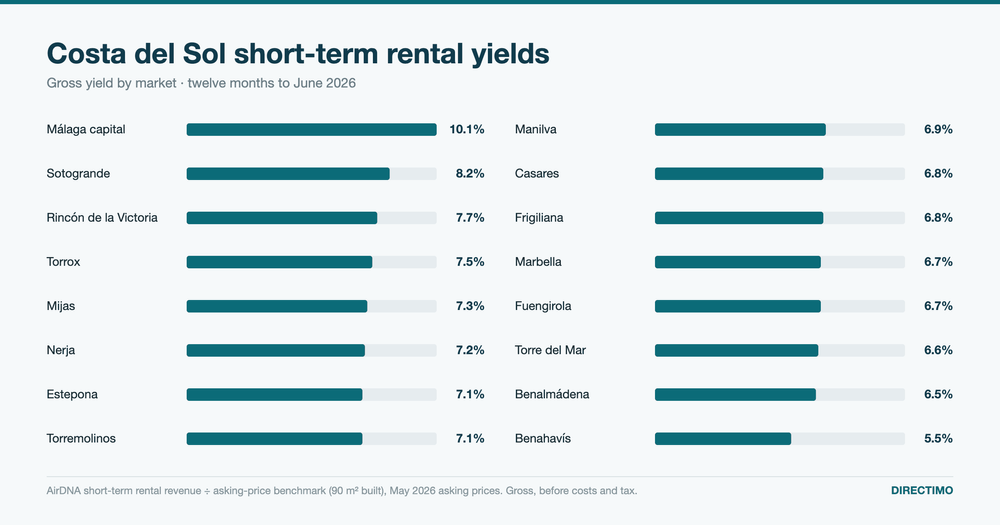
Costa del Sol short-term rental yields range from 5.5% to 10.1% gross across the coast's sixteen main markets. The spread between them is wide, and the highest number on the table is rarely the one an investor can actually reach. This analysis sets out what each market returns, what an owner keeps after costs and tax, and which municipalities still issue new tourist licences.
How these yields are calculated
Gross yield here means annual short-term rental revenue per apartment, divided by a purchase benchmark of the local asking price per square metre multiplied by 90 m² built. Revenue data comes from AirDNA, which tracks Airbnb and VRBO-style platform activity, for the twelve months to June 2026. Asking prices are from May 2026, matched to the same window.
Asking prices are used deliberately. Live investment opportunities are sourced from asking-price inventory, so this keeps the denominator conservative against deed prices, which run lower. The figures exclude purchase taxes and fees.
Net operating yield applies an assumed 50% operating-cost load. It is shown before income tax, financing and the buyer's personal tax position.
Short-term rental yields by market
| Zone | AirDNA revenue | €/m² | Benchmark (90 m²) | Gross | Net op. | Listings y/y |
|---|---|---|---|---|---|---|
| Málaga capital | €34,071 | 3,755 | €337,950 | 10.1% | 5.0% | +0.5% |
| Sotogrande (Cádiz) | €28,131 | 3,789 | €341,010 | 8.2% | 4.1% | −17.9% |
| Rincón de la Victoria | €23,756 | 3,422 | €307,980 | 7.7% | 3.9% | −11.6% |
| Torrox | €20,993 | 3,123 | €281,070 | 7.5% | 3.7% | −12.3% |
| Mijas | €24,622 | 3,733 | €335,970 | 7.3% | 3.7% | −10.0% |
| Nerja | €24,876 | 3,860 | €347,400 | 7.2% | 3.6% | −7.7% |
| Estepona | €27,694 | 4,307 | €387,630 | 7.1% | 3.6% | +1.8% |
| Torremolinos | €25,790 | 4,032 | €362,880 | 7.1% | 3.6% | −3.7% |
| Manilva | €19,196 | 3,091 | €278,190 | 6.9% | 3.5% | −22.9% |
| Casares | €22,259 | 3,611 | €324,990 | 6.8% | 3.4% | −27.6% |
| Frigiliana | €20,380 | 3,337 | €300,330 | 6.8% | 3.4% | −7.9% |
| Marbella | €33,540 | 5,581 | €502,290 | 6.7% | 3.3% | −10.1% |
| Fuengirola | €27,118 | 4,509 | €405,810 | 6.7% | 3.3% | −3.2% |
| Torre del Mar / Vélez-Málaga | €19,974 | 3,371 | €303,390 | 6.6% | 3.3% | −9.8% |
| Benalmádena | €24,167 | 4,122 | €370,980 | 6.5% | 3.3% | −5.5% |
| Benahavís | €26,733 | 5,389 | €485,010 | 5.5% | 2.8% | −14.3% |
Three of these names cover more ground than they suggest. Sotogrande sits in Cádiz province and its figure covers all of San Roque. Mijas blends Mijas Costa with the inland village. Torre del Mar and Vélez-Málaga combine a busy coastal strip with a cheaper inland town. Each of the three holds different price and yield profiles inside one label.
Resale and new-build behave differently
These figures describe the general market, which is mostly resale stock. The denominator is the local asking price per square metre, and asking-price inventory is dominated by resale. New-build sits differently on both sides of the calculation: acquisition costs of around 13–14% against 9.5–10.5% for resale, and materially higher nightly rates where the development has facilities. New-build yields have to be modelled property by property, against the specific facilities, specification and micro-location.
Supply is contracting across the coast
Active short-term listings fell in fourteen of the sixteen markets over the year. Registered stock confirms the same direction: Málaga province held 45,176 registered tourist dwellings in May 2026, down 6.6% year on year, with capacity down 10.8%.
The steepest declines are in the western municipalities — Casares at −27.6%, Manilva at −22.9%, Sotogrande at −17.9%. Only Estepona and Málaga capital added listings, and both by under 2%.
Fewer competing units supports occupancy and nightly rates for owners already operating. It also makes an existing licence progressively harder to replace.
Occupancy and seasonality
Coast-wide occupancy averaged around 72% across the first half of 2026 and reached approximately 90% in July, up 1.6 percentage points on July 2025.
Seasonality remains pronounced in the tourist segment. July and August carry rates well above the annual average with occupancy in the high eighties to low nineties. June and September hold rates above average with strong occupancy. November through March sees rates fall and occupancy drop toward the middle of the range, with Christmas and New Year producing a short premium peak.
Beachfront and amenity-rich properties outperform consistently, carrying an additional 0.5 to 1.5 percentage points of yield over comparable inland stock.
Comparing the three rental strategies
| Rental type | Gross | Net after tax | Demand | Tourist licence | Flexibility |
|---|---|---|---|---|---|
| Short-term (tourist) | 5.5–10.1% | 2.8–3.5% typical | Very high, seasonal | Required | High |
| Short-term, optimised | up to 10.5% | 4.2–4.3% | Very high | Required | High |
| Mid-term (2–11 months) | ~7.2% | 2.5–4.0% | High, steady | Not required | Good |
| Long-term (12+ months) | 4–6% | 2.5–3.5% | Very high | Not required | Low |
Net after tax applies all acquisition and operating costs plus 19% income tax for EU and EEA residents, calculated on total acquisition cost.
The gap between the typical and the optimised short-term figures is the return on property selection. A well-selected property bought against clear yield criteria targets approximately 4.5% net, and the best documented cases reach 4.2 to 4.3%. A standard resale bought without those criteria typically returns around 3% net.
Facilities account for much of that gap. A modern apartment in a development with pool, gym and concierge achieves €173 a night against €101 for equivalent space without them.
Including capital appreciation at a conservative 6% a year, total return runs 8.4% to 10.3% annually before financing. Málaga's real long-run appreciation rate is 5.2%, and the Golden Triangle has grown 9.1% over the last twelve months.
The rent-increase cap on long-term lets
Annual rent increases on a main-residence lease are capped by an official national index, set by design at or below inflation. That cap sits at approximately 2.4 to 2.5% in 2026, however fast market rents climb.
Tourist and seasonal lets fall outside the cap. Successive mid-term contracts, renegotiated at market price, are the common alternative for owners who want rent to track the market.
Where new licences are available
A short-term rental needs regional registration, and the municipality decides whether tourist use is permitted at that address at all. Positions differ sharply along the coast.
| Municipality | Position, September 2026 | Risk |
|---|---|---|
| Málaga city | City-wide freeze on new registrations to August 2028; a second freeze on tourist apartments on residential land to July 2029 | High |
| Fuengirola | Independent street entrance required; around 600 existing registrations flagged for review | High |
| Manilva | Ordinance in preparation; high saturation and the province's steepest listings decline | High |
| Rincón de la Victoria | Buildings must be uniformly residential or tourist; independent access required | Medium-high |
| Mijas | No ordinance, among the most saturated markets; community statutes decide | Medium-high |
| Benalmádena | Zone caps under study, none in force | Medium-high |
| Marbella | No general moratorium; conversion of ground-floor commercial premises to tourist use prohibited | Medium |
| Estepona | No moratorium; planning policy actively pro-development | Medium |
| Torremolinos, Benahavís, Casares | No tourist-licence restriction identified | Medium |
| Eastern Axarquía | The most flexible part of the coast; Nerja and Frigiliana are among the few markets still growing | Medium-low |
Two points matter for anyone buying with rental income in mind.
An existing registration transfers with the property when it is sold, and it does not expire. In Málaga city that makes an already-registered apartment the only viable route, and it cannot be replaced at any price before 2028.
A national registration number is no longer required. The regional registration is the operative one.
What overrides a valid licence
A building's registered community statutes can prohibit tourist use. Where they do, the prohibition stands even though the property holds a valid licence, and even where the property has been let to tourists for years.
This is the layer most often missed. The licence is visible on a listing; the statutes are not. Your lawyer reads the statutes and the community minute book before you sign anything.
The mid-term opportunity in Málaga city
Málaga capital produces the highest gross yield on the coast at 10.1% and has the strictest licensing regime on it. For buyers who cannot obtain a tourist registration there, mid-term letting of two to eleven months is the working alternative.
The tenant base is real and growing. Málaga TechPark hosts more than 25,000 professionals across 700-plus companies, including Google's cybersecurity centre, Vodafone's European R&D hub, Oracle, Ericsson and Capgemini. Relocating professionals and corporate placements need furnished apartments for months at a time.
Mid-term lets need no tourist licence, sit outside the moratorium, and hold low vacancy at premium monthly rates. Around 7.2% gross is achievable, with 2.5 to 4.0% net after tax.
How to read these numbers
The headline yield is where the analysis starts. Three checks turn a table figure into an achievable return.
Can the property hold a licence? Municipal position, building type, independent access and community statutes all have to align. Any one of them can block the operation.
Does the property fit the strategy? Studios and one-bedroom apartments of 50 to 70 m² produce the highest yield per square metre for short-term letting. Two-bedroom apartments of 80 to 100 m² attract the strongest overall demand. For long-term and mid-term, two and three-bedroom apartments of 90 to 120 m² near international schools and transport draw the most reliable tenants.
What does the net look like on your tax position? The 19% rate applies to EU and EEA residents. Non-residents from outside the EU pay 24% and cannot deduct expenses, which changes the arithmetic materially.
Whether a specific property can legally be let to tourists is decided by the rules in our Costa del Sol rental rules guide. The capital-growth side of the return is in our Costa del Sol investment outlook, and the five ways to structure a purchase are in our investment strategies guide.
Whether new build or resale suits the strategy is compared in our resale or new build guide.
What the tax actually takes from that income, worked through on a real example, is in our rental income tax guide.
Sources. AirDNA — short-term rental revenue and listings, June 2026. Idealista — asking prices, May 2026. INE — registered tourist dwellings and bed capacity, Málaga province, May 2026. Junta de Andalucía — regional tourist registration framework. Municipal ordinances as published by each town hall, September 2026. Directimo Costa del Sol Market Report, September 2026, and Directimo net-yield modelling.
Method. Gross yield is annual short-term rental revenue divided by the local asking price per square metre times 90 m² built, excluding purchase taxes and fees. Net operating yield applies a 50% operating-cost allowance covering management, cleaning and turnover, platform fees, utilities, repairs, maintenance and local charges, and is unlevered and before income tax. Municipal licence positions change frequently and are stated as at September 2026.
This analysis is market research, not investment or tax advice. Municipal positions on tourist licensing change frequently and should be confirmed for the specific address before any offer.