

Published September 2026 · Data verified September 2026
Andalucía is the lowest-spending region in Spain. The average household there spent €12,197 per person in 2025, 13.3% below the national average of €14,066. The Comunitat Valenciana, which contains the whole of the Costa Blanca, sat at €13,704, or 2.6% below.
Read those INE figures for what they are: a record of what Spanish households spend. Prices are part of it, and local incomes are the other part. A northern European arriving with a foreign pension or a remote salary keeps their own spending habits, so the survey gives you a direction rather than a budget.
Two numbers decide the real one. The fixed annual cost of owning the property is calculable to within a few hundred euros before you buy. The variable cost of living in it depends on how you live.
What the property costs to hold each year
Buyers underestimate this because it is invisible during the search and arrives in full the year after completion. It runs whether you are in the property or not.
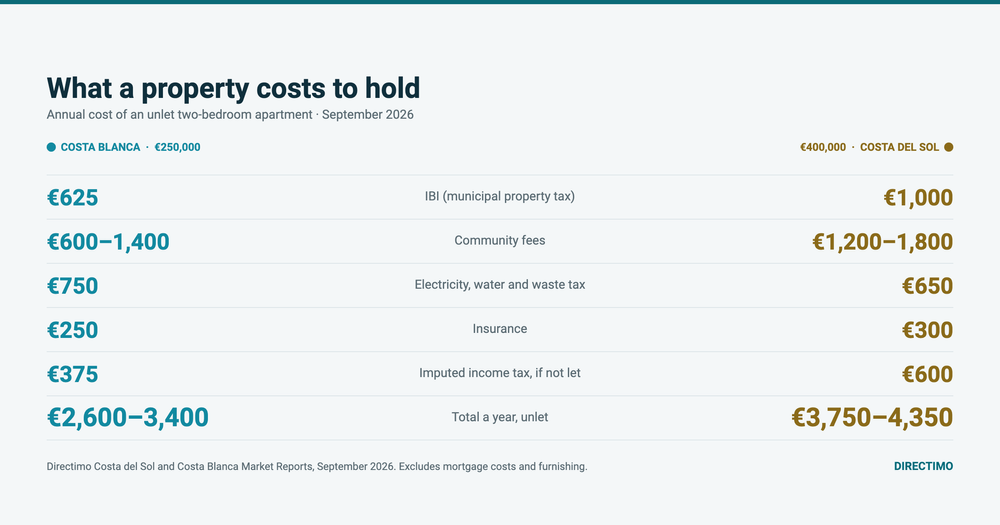
The table compares a two-bedroom apartment on each coast, occupied under six months a year: €400,000 on the Costa del Sol, €250,000 on the Costa Blanca. Those are typical values in each market.
| Item | Costa del Sol, €400,000 | Costa Blanca, €250,000 |
|---|---|---|
| IBI (municipal property tax) | ~€1,000 | ~€625 |
| Community fees | €1,200–1,800 | €600–1,400 |
| Electricity, standing charge and basic use | ~€350 | ~€360 |
| Water | ~€150 | ~€240 |
| Waste tax | ~€150 | ~€150 |
| Insurance | ~€300 | ~€250 |
| Running costs | €3,150–3,750 | €2,225–3,025 |
| Imputed income tax, if the property is not let | ~€600 | ~€375 |
| Total, unlet | €3,750–4,350 | €2,600–3,400 |
| As a share of purchase price | 0.9–1.1% | 1.0–1.4% |
Purchase costs on each coast are set out in our Costa del Sol costs and taxes guide and our Costa Blanca costs and taxes guide.
Imputed income tax applies on both coasts. It is a national tax on any second home that is neither your main residence nor let, so the Costa Blanca carries it exactly as the Costa del Sol does — the figure is smaller only because the property is.
The two coasts sit within half a percentage point of each other. Holding cost tracks the value of the property, so the coast that costs less to buy into costs less to hold, in euros.
Community fees have the widest spread on the list. A block with a pool, a gate and a gardener sits at the bottom of these ranges. A resort development with a spa, a gym, 24-hour security and landscaped grounds runs at three or four times those figures, and the top Costa del Sol schemes go well beyond that. Request the last three years of community accounts while you are still deciding.
Villas change the arithmetic. Community fees fall or disappear, and pool maintenance, garden, private security and a larger IBI bill replace them — usually at a higher total.
How IBI and imputed income are estimated
Both are calculated on the property's cadastral value rather than its market price, and you will not know the cadastral value until you own the home. Expressing them as a share of the purchase price is a working approximation: IBI at roughly 0.25% and imputed income at roughly 0.15% a year, assuming a cadastral value around half of market, which is typical on both coasts.
IBI is a municipal rate of about 0.4–0.6% applied to cadastral value, and each town hall sets its own. Two similar apartments twenty minutes apart can carry bills that differ by several hundred euros. The imputed tax is 1.1% or 2% of cadastral value, taxed at 19% for EU and EEA residents and 24% for everyone else.
Both are confirmed for the specific property before purchase.
Electricity and water
A Spanish electricity bill has two halves. One is what you use. The other is potencia contratada, a standing charge for the capacity you have contracted, payable whether the property is occupied or empty. Holiday-home owners routinely contract more capacity than they need and pay for it twelve months a year.
Prices moved in 2026 for reasons unrelated to consumption. Network tolls and system charges were updated in January and added an estimated 4.1% to bills. The wholesale price averaged €71.17/MWh in January 2026, against €61.90/MWh across 2024 — above the level of two years ago and far below the peaks of 2022.
Winter is where the age of the building decides the bill. Stock built before roughly 2010 has no central heating. January and February run on portable electric heaters or reverse-cycle air conditioning, and those two bills can double. New developments built to the current energy code work differently: most install an aerothermal heat pump, often with underfloor heating, covering heating, cooling and hot water from one system. A heat pump delivers the same warmth for roughly a third of the electricity a resistive heater uses, so a well-insulated new apartment costs far less to keep warm in January than the older block beside it. Air conditioning in July and August is the same equation from the other direction.
Water is inexpensive by northern European standards and metered by the municipality. Where a development has communal irrigation, part of that consumption arrives through the community fee instead.
Healthcare: three routes
Public cover through employment or self-employment. Social security contributions give the same access as any Spanish resident, at no separate charge.
Public cover bought directly — the convenio especial. Legal residents who are not contributing and hold no reciprocal entitlement can buy access to the public system in most regions at €60 a month under 65 and €157 a month at 65 and over. Prescriptions sit outside it, which is the main gap to plan around.
Private insurance. Premiums quoted in 2026 run roughly €80–160 a month in your thirties and forties, €130–220 in your fifties, and €180–300 or more from sixty onward. Policies with a co-payment per visit come in 15–30% below those figures. Pre-existing conditions and waiting periods are where the fine print matters.
Pensioners from another EU or EEA state, and from the UK, who register an S1 with Spanish social security receive public cover paid for by the state that pays their pension. That is the largest single cost difference between a retired buyer and a working-age one, and eligibility is worth confirming before you build a budget.
Many residents run both: public cover for anything serious, private for speed of appointment. Our healthcare guide sets out how the two systems interact and which hospitals serve each coast.
Food, transport and daily spending
What you buy decides what groceries cost here. A weekly shop built around Spanish produce, fish and local brands costs a fraction of the northern European equivalent. The same shop rebuilt from imported northern European brands, at the specialist supermarkets both coasts have, closes most of that gap.
Restaurants work the same way. A neighbourhood menú del día at lunch remains one of the best-value meals in Europe. Seafront dining in Marbella, Puerto Banús or Moraira is priced for the visitors it serves.
Running a car is the line that most often breaks a budget drawn up at home. Fuel averaged €1.774 a litre for petrol and €1.773 for diesel in early September 2026, above the level most people carry in their heads and above several of the countries buyers arrive from. Insurance, the annual ITV inspection, municipal vehicle tax and parking add to it.
Public transport reduces that cost in some places and not in others, for structural reasons rather than fares. The Costa del Sol has a commuter rail line, the C1, running from Málaga airport through Torremolinos and Benalmádena to Fuengirola; living on it removes the need for a second car. West of Fuengirola — Marbella, Estepona — there is no train, and a car is essential. On the Costa Blanca the TRAM light rail links Alicante to El Campello, Benidorm and on to Dénia, covering a long stretch of the northern half. The southern zone around Orihuela Costa and the inland urbanisations is car-dependent.
Cost differences between the two coasts
The differences sit in everything that scales with property value and with the profile of the people around you.
The Costa del Sol is more expensive, concentrated in the Marbella–Benahavís–Estepona triangle. Higher property values carry higher IBI and higher community fees. The service economy is priced for an international clientele, and international schooling, golf membership, private healthcare and domestic help all cost more than the coastal average because the demand behind them is wealthier. Outside that triangle — Fuengirola, Torremolinos, Vélez-Málaga, the Axarquía — costs come down materially.
The Costa Blanca is cheaper across most of its length, with the Marina Alta as the exception. Jávea, Moraira and Altea carry Costa del Sol-level costs on a smaller scale. Alicante city, Torrevieja, Santa Pola and the southern urbanisations are among the least expensive places on either Spanish coast to run a household, which is why the retired northern European population there is the largest in Spain.
The two coasts are compared in full, on price, yield, climate and access, in our decision guide.
What costs more here than at home
Heating and cooling, for the reasons above. Budget for two expensive quarters rather than one mild year.
Imported food and household brands, if you want to keep eating what you ate.
International schooling, if the Spanish state system is not the plan. Costa del Sol fees in particular are set by an international market. We cover the schools on both coasts, with fee ranges, in a separate guide.
Cars, both to buy and to run.
Flights home in August, the month everyone else also wants to travel.
The costs of owning without living here
A property used part of the year and not let still generates an annual tax bill. Imputed income tax runs at roughly 0.15% of purchase price a year — about €600 on a €400,000 apartment and €375 on a €250,000 one. The owner files it; nothing is withheld at source. Enforcement has tightened, and most buyers leave it out of the budget they draw up before purchase.
Letting the property changes the picture. EU and EEA residents pay 19% on net income with costs deductible. Non-EU residents pay 24% on gross with no deductions. From 2026, non-resident rental declarations moved from four quarterly filings to a single annual one between 1 and 20 April.
Wealth tax differs between the two regions, and at higher values that difference is material. Andalucía applies 100% relief, so the regional charge is zero. The Comunitat Valenciana applies no relief but sets the highest exempt threshold in Spain at €2M, with a further €300,000 for a main home; the state default of €700,000 applies where the regional threshold does not. In both regions the national solidarity levy applies above €3M. Which threshold applies to you depends on your residency position, and your tax adviser confirms it.
Three budgets
A retired couple, apartment on the southern Costa Blanca, owned outright. The property costs €2,600–3,400 a year to hold. An S1 covers healthcare. Spending is groceries, a car, a social life and one or two flights home. This is the profile the southern Costa Blanca is built around, and the cheapest version of coastal Spain. The tax, healthcare and residency side is in our guide to retiring to Spain.
A family relocating to the Costa del Sol with school-age children. School fees dominate the list and can exceed the annual cost of holding the property several times over. Two cars, a larger home, higher community fees. Choose the school first; the location and most of the budget follow from it.
A remote professional in Alicante or Málaga city. Rent or a smaller apartment, no car where the location allows it, private insurance until residency and contributions settle. The lowest fixed cost of the three, and the easiest to unwind.
Owners who leave a property empty between visits add key-holding, an alarm and occupation cover to the annual figure — the reasons and the costs are in our guide to squatting and what owners actually face.
How Directimo works
Directimo represents the buyer, never the seller. Listing agents in Spain are contracted by the vendor and paid to protect the vendor's price.
Before you commit to a property we confirm its cadastral value and the municipal IBI rate, pull the community's accounts and the last three years of fees, and put the full annual holding cost in front of you alongside the purchase price. The properties we source average 13.5% below area market prices. We have completed more than 1,000 transactions since 2011, totalling over €300M in property sold.
Get the real annual cost for a specific property: directimo.com/advisory-call
Daily life on each coast is compared in our lifestyle guide, and the purchase costs that come before any of this are in our costs and taxes guide.
Whether an apartment or a villa suits how you will use the property, and what each costs to run, is compared in our apartment or villa guide.
Sources. INE, Encuesta de Presupuestos Familiares 2025 — household spending by autonomous community. Idealista and OMIE — 2026 network tolls and wholesale electricity prices. Geoportal, Ministerio para la Transición Ecológica — fuel prices, 2 September 2026. Spanish social security — convenio especial rates. Private insurance premiums as quoted by brokers operating on both coasts, 2026. Directimo Costa del Sol and Costa Blanca Market Reports, September 2026 — annual holding cost models. Agencia Tributaria — non-resident income tax and filing calendar.
Method. Holding costs are modelled on a two-bedroom apartment occupied under six months a year, at €400,000 on the Costa del Sol and €250,000 on the Costa Blanca. IBI and imputed income tax are expressed as a share of purchase price assuming a cadastral value around half of market value; both are confirmed per property before purchase. INE figures record actual household expenditure and are not price indices.
This guide is market research, not tax, legal or financial advice. Municipal rates, community fees and tax thresholds change and should be confirmed for the specific property and your own residency position before you commit.