

Published September 2026 · Data verified September 2026
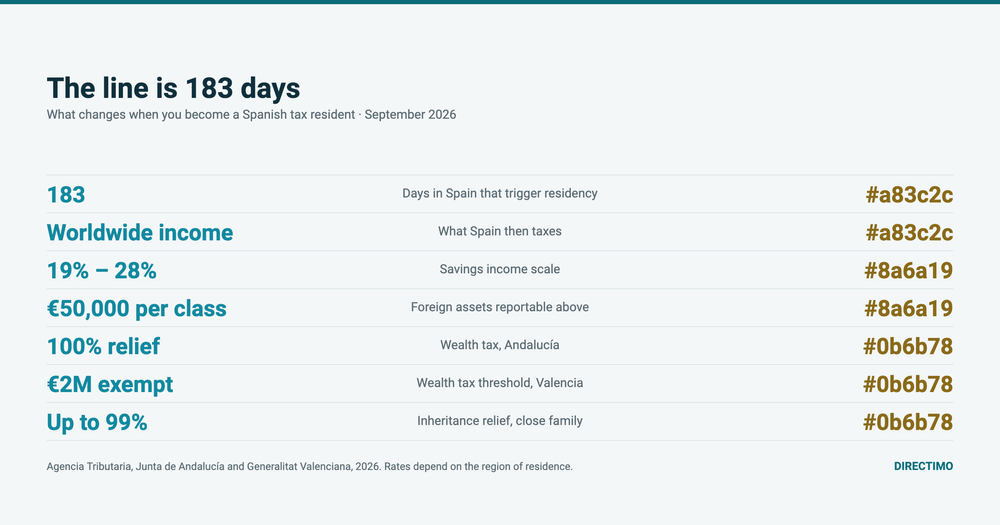
Spending more than 183 days in Spain in a calendar year makes you a Spanish tax resident, and a Spanish tax resident declares worldwide income to Spain. Every other question below follows from which side of that line you are on.
Three ways you become tax resident
Any one of these is enough.
More than 183 days in Spain during the calendar year. Days are counted across the year, not consecutively, and temporary absences count towards the total unless you prove tax residency elsewhere.
Your main economic interests are in Spain. Your business, your work or the bulk of your assets sit here.
Your spouse and minor children live here. This one is presumed unless you rebut it, and it catches people who commute while the family settles.
There is no partial year. You are resident for the whole calendar year or not at all.
Resident against non-resident
| Non-resident | Tax resident | |
|---|---|---|
| What Spain taxes | Spanish-source income only | Worldwide income |
| Rental income | 19% on net for EU/EEA, 24% on gross for others | Added to your general income |
| Unlet second home | Imputed income tax, ~0.15% of value | Same, on properties other than your main home |
| Capital gain on sale | 19% | 19% to 28%, by band |
| Annual return | One filing, 1–20 April | Full income tax return |
| Foreign assets | Nothing to report | Report above €50,000 per class |
| Wealth tax | Spanish assets only | Worldwide assets |
What a resident actually pays
Income tax combines a state scale and a regional scale, so the total depends on where you live.
General income — employment, pensions, business profit, and net rental income. Combined rates run from roughly 19% on the first band to about 47% at the top. Andalucía sits at the lower end of the Spanish range; the Comunitat Valenciana runs slightly higher at the upper bands.
Savings income — interest, dividends, and capital gains — is taxed on its own scale: 19% to €6,000, 21% to €50,000, 23% to €200,000, 27% to €300,000, and 28% above that. It does not stack onto your general income.
Property sold at a gain falls in the savings scale. So does the gain on a property you sold in your home country after becoming resident here, which is the timing point most people miss.
Foreign pensions
This is where retired buyers most often get the answer wrong, and the answer depends on what kind of pension it is.
Private and company pensions are treated as employment income and taxed in Spain, added to your general income at the rates above.
Public and civil-service pensions — paid for service to a state, its regions or its municipalities — are generally taxed only in the paying country under the double tax treaty. Spain may still take them into account when setting the rate applied to your other income, so they can raise your Spanish bill without themselves being taxed here.
State retirement pensions from most countries are treated as private pensions and taxed in Spain.
Two practical points. Your pension provider will normally ask for a Spanish tax residency certificate before applying treaty treatment, and until they have it they may keep withholding at home. And the most common error is not filing a Spanish return at all, on the belief that tax already paid abroad settles the matter. The return is required either way; the treaty is applied inside it, not instead of it.
The full healthcare position for retirees, including the S1 that removes the largest single cost, is in our healthcare guide.
Wealth tax, and where you live decides it
Andalucía applies 100% relief. The regional wealth tax charge is zero.
The Comunitat Valenciana applies none, but sets the highest exempt threshold in Spain at €2M, with a further €300,000 for a main home.
Where a regional threshold does not apply, the state default of €700,000 does.
In both regions the national solidarity levy applies above €3M, and payments of regional wealth tax reduce it.
Reporting foreign assets: modelo 720 and 721
A Spanish tax resident must report foreign assets when any of three classes exceeds €50,000: bank accounts, securities and rights, and real estate. Cryptocurrency is reported separately on modelo 721, on the same threshold.
The deadline is 31 March for the previous year.
Once you have filed, you file again only when a reported class rises by more than €20,000, or when you dispose of something you previously declared.
The penalty regime changed after a 2022 European court ruling struck down the automatic fines of €5,000 per item and the 150% proportional sanction as disproportionate. Failures now fall under ordinary tax penalties. The obligation itself is unchanged, and the information is exchanged between tax authorities anyway.
Inheritance and succession
Both regions are among the cheapest in Spain for passing property to close family, and both arrive there by combining an allowance with a credit.
| Andalucía | Comunitat Valenciana | |
|---|---|---|
| Credit for close family | 99% of the tax due | 99% of the tax due |
| Per-heir allowance | €1,000,000 | €100,000 |
| Main home | 99% of value, no cap, held 3 years | 95% of value, capped at €150,000, held 5 years |
| Siblings and collaterals | No general credit | 25% from June 2026, 50% from June 2027 |
| In force since | January 2022 | May 2023 |
Close family means descendants, adoptees, spouses and ascendants. On a typical family estate both regions produce a bill at or near zero.
The change worth noting is in the Comunitat Valenciana, where siblings and other collateral relatives receive relief for the first time from June 2026, at 25%, rising to 50% in June 2027. Andalucía still gives them nothing.
Two things matter more than the rate. The structure of ownership at purchase determines what happens later, and changing it afterwards is a taxable transfer. And an EU regulation lets you elect the succession law of your nationality in your will, which is what most northern European owners want, because Spanish forced heirship allocates shares differently from the law they know.
That election is made in the will, before it is needed.
A warning about tax-efficient products
Retired buyers arriving in Spain are routinely offered Spanish-compliant investment bonds and similar wrappers, presented as the way to hold capital tax-efficiently as a resident.
Some are legitimate and suit some situations. Many carry entry charges, annual charges and surrender penalties that exceed the tax they save, and they are sold by advisers paid a commission on placement rather than a fee for advice.
Establish your tax position first, with someone paid to advise rather than to sell. Then decide whether a product improves it.
Settle this before you move
Count the days, properly. Residency is decided by a calendar-year total, and the year you move is usually the year it turns on you.
Model the year of the move. Selling a property at home, taking a lump sum, or realising a gain is a different tax event depending on which side of the line it falls.
Get the residency certificate early. It unlocks treaty treatment on pensions and foreign income.
Establish what is reportable. Accounts, securities and property abroad above €50,000 per class.
Write the will with the nationality election.
Check the regional position where you will actually live, because wealth tax and inheritance relief differ between Andalucía and the Comunitat Valenciana.
Your lawyer and a Spanish tax adviser confirm all of this against your own circumstances before you move.
How Directimo works
Directimo represents the buyer, never the seller. Listing agents in Spain are contracted by the vendor and paid to protect the vendor's price.
We coordinate the tax number, the bank account and an independent bilingual lawyer, and we make sure the tax position is understood before a purchase rather than after it. The properties we source average 13.5% below area market prices. We have completed more than 1,000 transactions since 2011, totalling over €300M in property sold.
Talk through your situation: directimo.com/advisory-call
The special regime for people moving to Spain for work is covered separately in our Beckham Law guide. Purchase costs and the taxes that follow ownership are in our costs and taxes guide, and the annual cost of holding a property in our cost of living guide.
People moving to Spain to work may qualify for a special regime that changes all of this, set out in our Beckham Law guide.
Sources. Agencia Tributaria — tax residency criteria, resident and non-resident income tax, savings income scale, foreign pension treatment, modelo 720 and modelo 721 thresholds and deadlines. Court of Justice of the European Union, 2022 — the ruling on modelo 720 penalties. Junta de Andalucía and Generalitat Valenciana — regional wealth tax, inheritance credits, per-heir allowances and main-home reductions, and the Valencian relief for siblings from June 2026. EU succession regulation — election of national law in a will. Double tax treaties concluded by Spain — pension taxing rights.
Method. Combined income tax rates depend on the region of residence and are given as ranges; the exact scale is set annually and regionally. Pension treatment described here follows the standard pattern in Spain's double tax treaties, and individual treaties differ. Thresholds are stated per class of asset and per person.
This guide is market research, not tax or legal advice. Tax residency and its consequences depend entirely on your own circumstances and should be confirmed with a Spanish tax adviser before you move.