

Published September 2026 · Data verified September 2026
Spain has a housing shortage of roughly 750,000 homes accumulated since 2021, and the Bank of Spain expects it to keep widening. That single number explains more about Spanish property prices than any other statistic, and it is the reason a market with falling transaction volumes is still producing record prices.
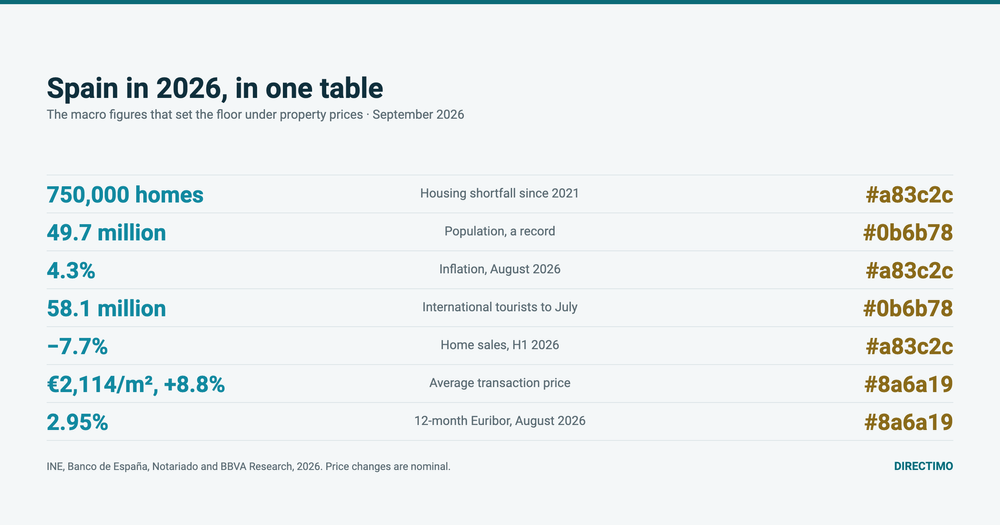
Spain in 2026
| Indicator | Latest reading | Source and period |
|---|---|---|
| GDP growth | +2.8% in 2025, +2.4% forecast 2026 | National accounts |
| Population | 49.7 million, a record | INE, April 2026 |
| Foreign-born residents | Above 10 million, a first | INE, 2026 |
| Unemployment | 9.9%, below 10% since 2008 | INE |
| Inflation | 4.3% | INE, August 2026 |
| International tourists | 58.1 million to July, +4.6% | INE Frontur, 2026 |
| Tourist spending | Over €82 billion to July | INE Egatur, 2026 |
| Home sales | ~705,000 in 2025, highest since 2007 | Notariado |
| Home sales, H1 2026 | −7.7% year on year | Notariado |
| Average transaction price | €2,114/m², a record | Notariado, June 2026 |
| Price change | +8.8% | Notariado, June 2026 |
| Housing shortfall | 750,000 homes since 2021 | Banco de España, June 2026 |
Spain grew faster than the eurozone average in 2025 and is forecast to do so again in 2026. Unemployment below 10% has not happened since before the financial crisis.
Inflation at 4.3%, and what it does to an owner
Spanish inflation reached 4.3% in August 2026. Three consequences matter to anyone holding property here.
Real returns are lower than they look. A property appreciating 8.8% in nominal terms is gaining about 4.5% in real terms. Every yield figure quoted anywhere, including ours, is nominal unless it says otherwise.
Long-term landlords are squeezed. Annual rent increases on a main-residence lease are capped by an official index set at roughly 2.4–2.5% for 2026. With inflation at 4.3%, a long-term let loses close to two points of real income a year, every year, while costs rise at the full rate. That is the arithmetic behind the shift towards mid-term letting, which sits outside the cap.
Running costs climb faster than the rent. Community fees, insurance, maintenance and utilities track inflation. The rent, on a capped contract, does not.
Population growth is the housing driver
Spain passed 49.7 million residents in April 2026, a record, and more than 10 million residents are foreign-born for the first time in the country's history.
Household formation runs at roughly 223,000 new households a year. Construction remains well below that. Housing starts rose 12.7% in the first quarter of 2026 to their highest level in eighteen years, and even that is far short of what the gap requires.
The Bank of Spain put the accumulated shortfall at 750,000 homes since 2021 and expects it to widen. BBVA Research puts it at approximately 885,000 by 2027.
A shortage of this size does not resolve in a cycle. It is the structural floor under Spanish property values, and it is why price falls in Spain have historically come from credit shocks rather than from oversupply.
Tourism at a record, again
Spain received 58.1 million international tourists in the seven months to July 2026, up 4.6%, who spent more than €82 billion. Full-year 2025 spending reached €134.7 billion, up 6.8% on 2024.
For a coastal property owner this matters in two directions. It supports short-term rental demand and nightly rates. It also drives the political pressure behind municipal restrictions on tourist letting, which have spread across both Spanish coasts in eighteen months.
Money is more expensive than a year ago
The European Central Bank raised rates in June 2026, its first increase in almost three years, and held in July. The deposit facility sits at 2.25% and the main refinancing rate at 2.40%.
The twelve-month Euribor averaged 2.95% in August 2026, against 2.11% a year earlier.
Lending has not contracted. New mortgages on dwellings grew 10.8% year on year in June 2026. Lenders have become more selective on second homes, and non-resident terms remain around 70% loan to value.
What this means for a buyer
Volumes and prices have decoupled. Sales fell 7.7% in the first half of 2026 while prices kept rising. Fewer transactions are completing, at higher prices, with a rising share going to international and cash buyers. This is a market clearing its stock selectively rather than one losing demand.
Negotiation has returned. In the first quarter of 2026, 14% of Spanish for-sale listings cut their price, by an average of 7%.
Forecasts point up, more slowly. BBVA Research forecasts +12.0% for Spain in 2026 and +5.7% in 2027, reconfirmed in August 2026.
No nationality surcharge exists. The 100% transfer tax on non-EU, non-resident buyers announced in January 2025 was never introduced.
The coasts behave differently from the country. National averages include inland markets with very different dynamics. Coastal volumes move more sharply than coastal prices, and micro-location decides more of the outcome than the national trend does.
What could change the picture
Rates. The June increase ended a cutting cycle. A further rise, or a long hold, compresses what leveraged buyers can pay.
Regulation. Price growth well above wage growth generates political pressure. Municipal restrictions on tourist letting are the first expression of it and they are spreading.
Construction. If starts continue rising from the current base, the shortfall narrows slowly. Nothing in the data suggests it closes this decade.
Foreign demand concentration. Spanish coastal demand is spread across many source countries, which makes it resilient to a slowdown in any one of them. A broad European recession is a different matter.
How Directimo works
Directimo represents the buyer, never the seller. Listing agents in Spain are contracted by the vendor and paid to protect the vendor's price.
We work from notarial deed data rather than portal asking prices, model the full holding cost and the exit before you commit, and verify the licence and statutory position for the specific address. The properties we source average 13.5% below area market prices. We have completed more than 1,000 transactions since 2011, totalling over €300M in property sold.
Talk through what this means for your budget: directimo.com/advisory-call
How the national picture translates into each coastal market is set out in our Costa del Sol outlook and Costa Blanca outlook, and Spain is compared with Portugal, Italy, Greece and France in our country guide.
How the rest of Europe has tightened its holiday-home rules over the same period is in our European regulation guide.
Sources. INE — population April 2026, foreign-born residents, unemployment, consumer price index August 2026, Frontur international arrivals and Egatur tourist spending to July 2026. Banco de España, Annual Report 2025 published June 2026 — the accumulated housing shortfall and household formation. BBVA Research — shortfall projection to 2027 and price forecasts reconfirmed 10 August 2026. Consejo General del Notariado — transaction prices and volumes, 2025 and H1 2026. European Central Bank — policy rates, June and July 2026. Banco de España — twelve-month Euribor, August 2026. Idealista — share of listings reducing price, Q1 2026. Ministerio de Industria y Turismo — tourist spending, 2025 full year.
Method. Price changes are nominal unless stated as real. Real figures subtract consumer price inflation. Transaction prices are notarial deed data covering completed sales and run below portal asking prices. Forecasts are third-party and reproduced as published, not as Directimo projections.
This article is market research, not investment, tax or financial advice. National indicators describe the country and not any individual property or coastal market.