

Published September 2026 · Data verified September 2026
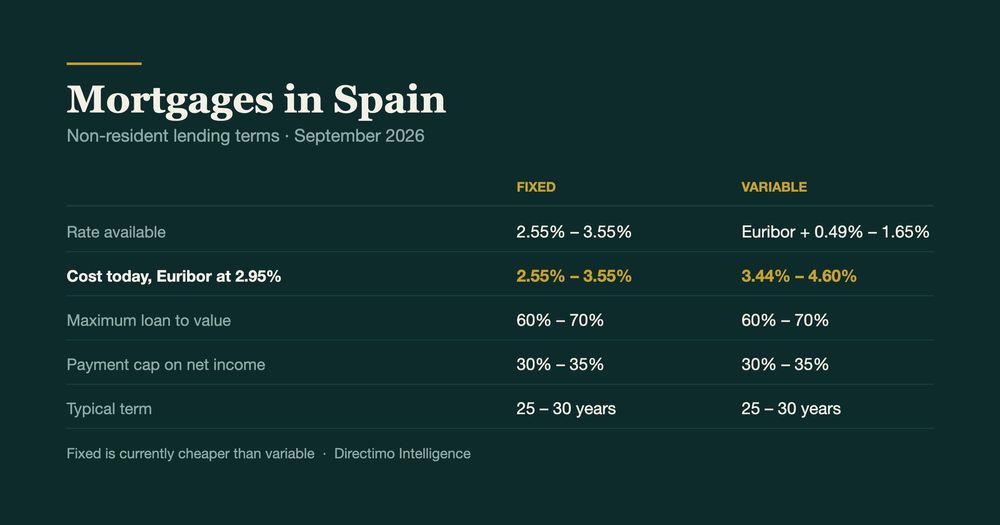
A non-resident buying in Spain can normally borrow 60% to 70% of the purchase price, over 25 to 30 years, with the monthly payment capped at around 30–35% of net income. Fixed rates in September 2026 sit between 2.55% and 3.55%.
Fixed is currently cheaper than variable, which reverses the advice most buyers arrive with.
What you can borrow
| Non-resident | Spanish tax resident | |
|---|---|---|
| Maximum loan to value | 60–70%, occasionally 80% | Up to 80% |
| Debt service cap | 30–35% of net income | 30–35% of net income |
| Typical term | 25–30 years | 25–30 years |
| Age at final payment | Usually 70 to 75 | Usually 70 to 75 |
The loan is calculated on the lower of the purchase price and the bank's valuation, which matters when a valuation comes in below the agreed price.
The debt service test counts your existing commitments too — a mortgage at home, car finance, maintenance obligations. Banks work from net income after tax in your own country.
Rates in September 2026
| Range available | |
|---|---|
| Fixed | 2.55% to 3.55% |
| Variable | Euribor + 0.49% to + 1.65% |
| Mixed | Fixed 3 to 20 years, then Euribor + 0.50% to + 1.60% |
The twelve-month Euribor averaged 2.95% in August 2026, against 2.11% a year earlier. A variable at Euribor plus 0.79% therefore costs about 3.74% today, above most fixed offers.
That is the point worth pausing on. Buyers usually assume variable is the cheaper entry and fixed is the safety premium. At current levels the fixed rate is lower on the day you sign, and it removes the rate risk as well. A variable only wins if Euribor falls materially and stays down, and the European Central Bank raised rates in June 2026 for the first time in almost three years.
Bonifications, and what they cost
The lower end of each range is a bonified rate, available only if you take other products from the bank. Typically: salary or pension paid into the account, home insurance, life insurance, sometimes a pension plan or a card with minimum annual spend.
Each product carries its own price. A bonification worth 0.30% on the rate is not worth having if the insurance the bank sells costs more than the same cover elsewhere.
Two checks. Price the bank's insurance against the open market, and confirm whether the rate reverts if you cancel a product later.
What taking a mortgage costs you
Spanish law moved most mortgage costs to the lender in 2019. The bank now pays stamp duty on the loan deed, the notary, the land registry and the processing agent.
You pay:
- The valuation, typically €300–600
- An arrangement fee where one applies, from zero to about 1% of the loan
- Your own life and home insurance, if you choose the bonified route
That is materially less than buyers expect, and it is one of the few costs in a Spanish purchase that has moved in the buyer's favour.
The valuation
The bank instructs a certified valuer. Two outcomes matter.
Valuation at or above the price. The loan is calculated on the price.
Valuation below the price. The loan is calculated on the valuation, and the shortfall comes out of your own funds. On a €400,000 purchase with a 70% loan, a valuation at €370,000 reduces the loan by €21,000, which you find in cash.
That risk sits with you, and it is a reason to have the mortgage assessed before the deposit contract rather than after.
Currency of income
Earning in a currency other than the euro tightens everything. Banks apply a haircut to foreign-currency income, often 20% or more, before the affordability test. Some restrict LTV further, and lending policy also varies by nationality — see our guide for non-EU buyers.
Under European rules a borrower paid in another currency has the right to convert the loan or to a warning mechanism if the exchange rate moves against them by more than 20%. Ask which applies before signing.
The documents
- Passport and NIE
- Last two or three years of tax returns from your own country
- Three to six months of payslips, or the equivalent for the self-employed
- Six to twelve months of bank statements
- Employment contract or company accounts
- A statement of existing debts
- The deposit contract for the property
Everything is normally required with a sworn translation, and the same pack covers the money-origin and identity checks run by the lawyer and the notary. Assemble it before you make an offer, because the pack takes longer to gather than the bank takes to decide.
The process, and how long it takes
| Stage | Typical duration |
|---|---|
| Indicative assessment on your figures | A few days |
| Full document submission | 1–2 weeks, mostly your side |
| Valuation | 1–2 weeks |
| Formal offer and binding offer | 1–2 weeks |
| Mandatory reflection period before signing | 10 days |
| Total | 6–10 weeks |
The ten-day reflection period is fixed by law and cannot be shortened. Build it into the completion date in the deposit contract.
Bank direct or broker
Direct works if you have a relationship with a bank that lends to non-residents, and it avoids a fee.
A broker compares across lenders, knows which banks are currently active in non-resident lending and on what terms, and handles the paperwork. Fees run around 0.5% of the loan, or a fixed amount.
Lenders have become more selective on second-home financing during 2026, and the banks that are competitive on non-resident lending change from quarter to quarter. That is the argument for someone who tracks it.
Settle this before you offer
Get an indicative assessment first. It takes days and it tells you what you can actually buy.
Treat the pre-approval as a negotiating asset. A buyer with financing arranged is worth a real discount to a seller, and 2026 is a year when sellers are negotiating.
Model the payment at a higher rate, not the rate you are quoted. On a variable, ask what the payment becomes if Euribor returns to 4%.
Check the valuation risk in the areas you are considering, particularly where asking prices run well above deed prices.
Diarise the ten-day reflection period when you agree the completion date.
Your lawyer reviews the mortgage deed alongside the purchase deed before you sign either.
How Directimo works
Directimo represents the buyer, never the seller. Listing agents in Spain are contracted by the vendor and paid to protect the vendor's price.
We arrange the indicative assessment early, so the search runs against a real budget rather than an assumed one, and we coordinate the bank, the valuation and the lawyer alongside the purchase. The properties we source average 13.5% below area market prices. We have completed more than 1,000 transactions since 2011, totalling over €300M in property sold.
Find out what you can borrow: directimo.com/advisory-call
The full cost of a purchase is in our costs and taxes guide, the process stage by stage in our buyer's journey guide, and where the market stands in our Spain economy guide.
Sources. Spanish lender offers to non-residents as published, September 2026 — fixed and variable rates, differentials, loan-to-value and term limits. Banco de España — twelve-month Euribor, August 2026. European Central Bank — policy rate decisions, June and July 2026. Spanish mortgage legislation in force since 2019 — allocation of notary, registry, stamp duty and agency costs to the lender, and the ten-day reflection period. European rules on foreign-currency mortgage borrowers.
Method. Rate ranges describe offers available to non-residents in September 2026 and change frequently; bonified rates require other products from the same bank and the net benefit depends on what those products cost. Loan-to-value and affordability limits are lender policy rather than law and vary by bank, nationality and income profile.
This guide is market research, not financial or mortgage advice. Terms depend on the lender, the property and your own circumstances, and should be confirmed with the bank and an independent adviser before you commit.