

Published September 2026 · Data verified September 2026
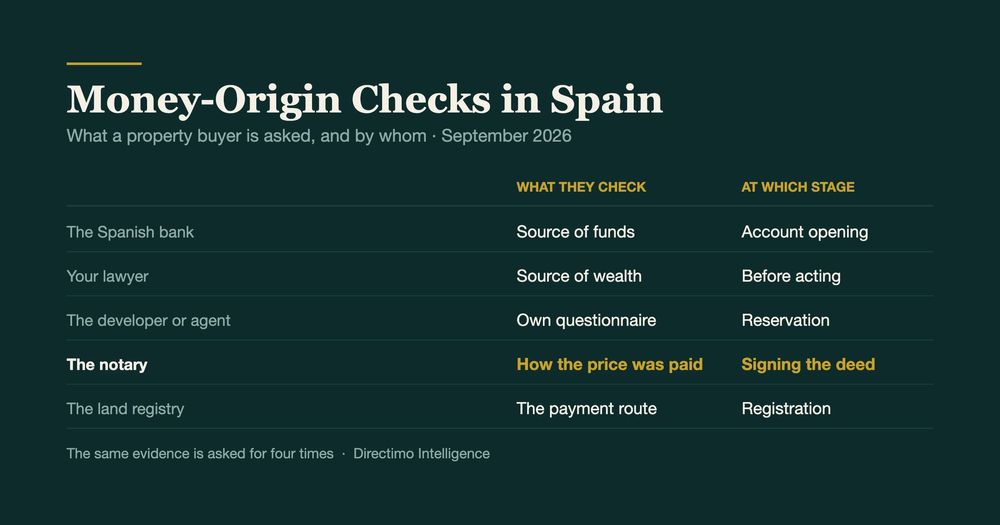
Every property purchase in Spain runs an identity and money-origin check on the buyer. The bank, the lawyer, the seller's professional and the notary each carry their own duty to do it, and they do not share the work — you will be asked for the same documents more than once.
The industry calls this AML and KYC — anti-money-laundering and know-your-customer. In practice it means proving who you are and where the purchase money came from.
Blocked purchases are rare. Delayed ones are common, and the cause is nearly always the same: the money reached the account faster than the paperwork explaining where it came from.
What is actually being asked
Three separate questions, and buyers who prepare for one are caught by the others.
Who you are. Passport, NIE, address, tax residence.
Where this money came from. The specific funds for this purchase — the sale, the account, the transfer.
How you built your wealth. The longer picture. Career, business, inheritance, investments.
The third is the one people are unprepared for. A buyer can show that €400,000 arrived from their own savings account and still be asked how a savings account came to hold €400,000.
Who asks, and for what
| Who | Why they ask | What they typically need |
|---|---|---|
| The Spanish bank | To open the account and move the completion funds | Passport, NIE, proof of address, non-residency certificate, income evidence, source of funds |
| Your lawyer | To act for you at all | Identity, source of funds, source of wealth, public-office declaration |
| The developer or selling agent | To sign a reservation or private contract | Their own questionnaire, identity, source of funds, beneficial owner if a company buys |
| The notary | To authorise the deed | Identity, and a full record of how every euro of the price was paid |
The same evidence is required four times, on four separate timetables. Assemble one complete pack and reuse it.
Source of funds: what to produce
| Source of funds | Documents normally required |
|---|---|
| Salary savings | Payslips, employment contract, tax return, bank statements showing the savings accumulating |
| Self-employment income | Tax returns, business accounts, quarterly filings, business bank statements |
| Company dividends | Company accounts, corporate tax return, dividend certificate, bank statement showing receipt |
| Sale of property | Sale deed, completion statement, bank statement showing the proceeds, tax proof where relevant |
| Sale of shares or investments | Broker statement, sale confirmation, bank statement showing the proceeds |
| Inheritance | Will or inheritance deed, probate or adjudication documents, bank statement showing receipt, tax proof |
| Gift or donation | Gift deed or declaration, donor's identity, proof of transfer, the donor's own source of funds, tax proof |
| Bank loan | Loan agreement, bank approval, transfer evidence |
| Private loan | Signed loan agreement, lender's identity, the lender's source of funds, transfer proof |
| Crypto converted to euros | Exchange records, wallet history, acquisition evidence, tax reporting where relevant |
| Purchase through a company | Incorporation documents, registry certificate, beneficial owner declaration, accounts, tax returns |
Every institution sets its own bar. Prepare more than the minimum asked for, because a second request typically adds two to three weeks.
Buying through a company
If a company, foundation or trust is the buyer, the beneficial owner has to be identified — any individual who ultimately owns or controls more than 25%, or who controls the entity by other means. Spain holds this in a central register, and the notary confirms the declaration against it before authorising the deed.
Two consequences. Layered structures across several countries take substantially longer to clear, and a structure where no individual can be identified will not complete.
If you hold or held public office
Buyers who hold a senior public position, or who did recently, face a deeper check — as do their spouses, children, parents and close business associates. The same applies to senior figures in international organisations.
It means more documentation and a longer approval chain: the origin of wealth is confirmed in more detail, and the file is signed off at a higher level inside the bank or the firm. Declare it at the first conversation; raised midway through, it restarts the approval.
Cash: what you can and cannot pay
| Situation | Cash limit |
|---|---|
| Any payment where the seller is a business — a developer, an agency | €1,000 |
| The same, where the buyer is an individual not tax resident in Spain | €10,000 |
| A private sale where neither side acts as a business | No statutory limit |
| Carrying cash into or out of Spain | Must be declared at €10,000 or more |
| Moving cash inside Spain | Must be declared at €100,000 or more |
Exceeding a limit costs 25% of the excess, charged to both payer and recipient.
In a normal purchase cash plays no part at all: deposits, stage payments and the completion price move by bank transfer or bank cheque. Bank transfers sit outside the declaration rules entirely, whatever the amount.
What the notary writes in the deed
The notary records how the price was paid: the date of each payment, the instrument used, and the account numbers on both sides. Copies of cheques are attached to the deed.
If the parties will not identify the payment route, the notary still authorises the deed but records the refusal and reports it. The land registry then will not register you as the owner. You get a provisional entry valid for sixty days to correct it.
Keep every transfer receipt from the reservation onwards, and pay from an account in your own name. Funds arriving from a third party's account are the most common cause of a deed being held up at this stage.
What actually delays purchases
Money that appears without a history. A large deposit landing shortly before completion, with no document behind it.
Payment from someone else's account. A parent, a company, a partner. Every one of those needs its own explanation and its own evidence.
Transfers routed through a third country that has nothing to do with you or the seller.
Missing sworn translations. Documents not in Spanish are normally required in certified translation.
Documents that contradict each other. An address on the bank statement that does not match the one on the passport application form.
Crypto with no acquisition trail. Converted funds are accepted; the purchase history behind them has to exist.
Translations and certification
Foreign documents are generally needed in Spanish, translated by a sworn translator. Public documents from outside the EU usually need an apostille as well. Neither is expensive and both take time, so start them alongside the search rather than after an offer is accepted.
How long it takes
| Stage | Typical duration |
|---|---|
| Assembling your own document pack | 1–3 weeks, entirely your side |
| Bank account opening and checks | 1–2 weeks |
| Lawyer's onboarding | A few days |
| Developer or agency questionnaire | A few days |
| Enhanced review, where it applies | 2–4 weeks on top |
Run this in parallel with the search and it adds nothing to the purchase timeline. Started after the private contract is signed, it pushes the completion date out by two to four weeks.
What changes in 2027
From 10 July 2027 a single set of European rules replaces the national versions, and one €10,000 cash ceiling applies across all twenty-seven member states. Buyers who purchase in more than one country will meet the same questions and the same thresholds everywhere.
A second change lands in 2029, when authorities across the EU gain linked access to property registers showing who ultimately owns each property. A buyer with documented funds in their own name will see no difference in what is asked. Layered ownership structures become considerably easier for authorities to trace.
Before you start
- Move the purchase money into your own account early — six to twelve months ahead where you can — and leave it there.
- Use one account for the purchase, so the trail is a single line rather than five.
- Collect the evidence for the source of funds now, in one folder, in the order of the table above.
- Get the sworn translations done before you need them.
- Declare any public office, yours or a close relative's, at the first conversation.
- Pay from your own name. If someone else is funding part of the purchase, tell your lawyer before the money moves, not after.
How Directimo works
Directimo represents the buyer, never the seller. Listing agents in Spain are contracted by the vendor and paid to protect the vendor's price.
We tell you at the outset exactly which documents the bank, the lawyer and the seller's side will each want, so the pack is assembled once and used four times. We coordinate the bank account, an independent bilingual lawyer, the notary and the handover remotely. The properties we source average 13.5% below area market prices. We have completed more than 1,000 transactions since 2011, totalling over €300M in property sold.
Get the document list for your own situation: directimo.com/advisory-call
The purchase process stage by stage is in our buyer's journey guide, the full cost of buying in our costs and taxes guide, and what a lender needs from you in our mortgage guide.
Sources. Spanish anti-money-laundering legislation and the guidance of the Spanish financial intelligence unit on obliged professionals. Agencia Tributaria — cash payment limits, the declaration of means of payment thresholds for movements into, out of and within Spain, and the penalty regime. Spanish mortgage and registry legislation — the notary's record of means of payment and the registry consequence of omitting it. Spanish central register of beneficial ownership. European Union anti-money-laundering package — single cash ceiling and harmonised rules from 10 July 2027, interconnected access to property registers from 10 July 2029. Source-of-funds document requirements as applied by Costa del Sol developers and by Martínez-Echevarría Abogados, whose standard buyer questionnaire informed the document table. Directimo transaction record.
Method. Document requirements are set by each bank, developer and law firm within a common legal framework, so the table describes what is asked in practice rather than a fixed statutory list. Cash limits are stated as in force in September 2026. Timelines describe purchases handled by Directimo and lengthen where a company structure, a private loan or a public-office connection is involved.
This guide is market research, not legal or tax advice. Your lawyer confirms what applies to your own file before any money moves.