

Published September 2026 · Data verified September 2026
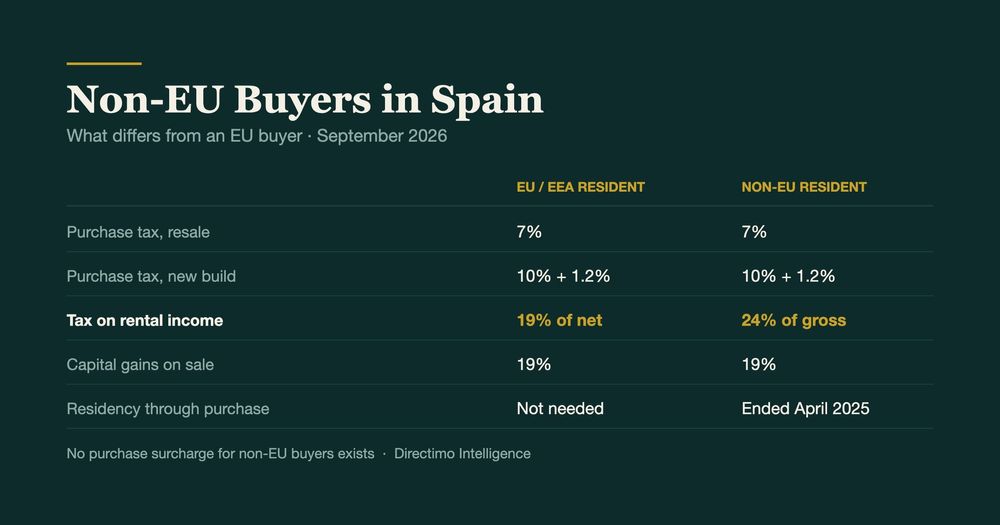
A buyer from outside the European Union pays exactly the same taxes to buy a property in Spain as a Spanish or an EU buyer: 7% transfer tax on a resale in Andalusia, or 10% VAT plus 1.2% stamp duty on a new build. There is no purchase surcharge for non-EU nationality, and none has been enacted.
Four things do differ, and only one of them is a tax: the rate on rental income, residency, how long you can stay without it, and one permit that applies to rural land in parts of the Costa Blanca.
What is identical
| Non-EU buyer | |
|---|---|
| Right to buy | Full. No permission needed for an urban property |
| Purchase costs, resale | 9.5–10.5% of the price |
| Purchase costs, new build | 13–14% of the price |
| Annual holding cost | About 1% of value — IBI, imputed income tax, community fees, insurance, utilities |
| Capital gains tax on sale | 19%, the same rate as an EU seller |
| Withholding on sale | 3% of the price, recoverable |
| Inheritance | Regional reliefs apply on the same basis as for residents, including Andalusia's relief of up to 99% between close family |
| Wealth tax | Andalusia applies 100% relief on the regional charge |
The inheritance position changed, and older guidance still circulating online has not caught up. Since 2018, residents of countries outside the EU claim the same regional reliefs as anyone else.
The full cost breakdown is in our costs and taxes guide.
The 100% tax proposal, and where it stands
In January 2025 the Spanish government announced a housing package that included a state surcharge on property purchases by non-resident buyers from outside the EU, framed as up to 100% of the transfer tax base.
Where it has got to, as of September 2026:
- The measure was put before Congress and has never been debated, read or voted on.
- It was absent from the housing package the government published in January 2026.
- It has no parliamentary majority. The minority government needs support it does not have from either direction — one bloc considers it ineffective on housing supply, another considers it too weak.
- Legal advice raised a straightforward obstacle: free movement of capital under EU treaties applies to third countries as well, which is the same principle that gave non-EU buyers access to the regional inheritance reliefs.
Two details of the proposal as drafted, for anyone modelling it. It attached to transfer tax, so a new build bought from a developer sat outside it entirely, being taxed under VAT. And it applied to non-resident buyers only, so a buyer taking Spanish tax residence fell outside it.
No such tax exists. There is no timetable, and no draft in progress. Foreign purchases in Spain fell 9.7% in 2025, and the analysis attributes most of that to the ending of the golden visa rather than to this proposal.
What actually costs more: tax on rental income
This is the real financial difference, and it is large enough to change which properties make sense.
| EU or EEA resident | Non-EU resident | |
|---|---|---|
| Rate | 19% | 24% |
| Base | Net income, costs deductible | Gross income, no deductions |
On a property earning €20,000 a year gross with €7,000 of running costs — community fees, IBI, insurance, management, repairs:
| Taxable base | Tax | Kept | |
|---|---|---|---|
| EU or EEA resident | €13,000 | €2,470 | €10,530 |
| Non-EU resident | €20,000 | €4,800 | €8,200 |
A difference of €2,330 a year, or 11.7% of gross rent. On a ten-year hold, €23,300.
It is set by tax residence rather than nationality, so a non-EU national who becomes Spanish tax resident is taxed as a resident. And in June 2026 the European Commission expanded an infringement procedure against Spain over the denial of income reductions to non-residents. If Spain amends the law, non-resident returns improve. There is no timetable.
Yields by market are in our rental yields analysis.
Residency: the golden visa ended in April 2025
Buying a property no longer creates a route to residency. The €500,000 investment visa closed to new applications on 3 April 2025. Permits already issued keep their validity and can be renewed while the investment still exists.
Two routes remain for a non-EU national who wants to live in Spain, and neither depends on buying:
| Non-lucrative visa | Digital nomad visa | |
|---|---|---|
| Who it suits | Retirees, people living on passive income — see our guide to retiring to Spain | Remote employees and freelancers with clients outside Spain |
| Income required | €28,800 a year, plus €7,200 per dependant | About €2,850 a month, with additions per dependant |
| Work in Spain | Not permitted | Permitted for the qualifying activity |
| Tax | Spanish resident rates | Special regime available at 24% on Spanish employment income up to €600,000, for six years — see our Beckham Law regime |
Owning a property does not qualify you for either, but it supports the application by evidencing accommodation.
How long you can stay without residency
Ninety days in any rolling 180-day period, across the whole Schengen area, for most non-EU nationalities. That covers a second home used for holidays and long weekends. It does not cover wintering in Spain from October to April, which is the plan a large number of buyers arrive with.
Settle this before choosing a property, because the answer changes what you should buy and where.
The military permit on rural land
This rule is little known, and it lands specifically on parts of the Costa Blanca.
Non-EU nationals buying rustic land in designated areas of defence interest need authorisation from the Ministry of Defence before the purchase can be registered in their name. More than 1,500 municipalities fall inside these zones, including parts of southern Alicante and Murcia, the islands, and stretches of the Galician and Cádiz coasts.
What matters in practice:
- Consolidated urban areas are outside it. An apartment or a villa on urban land is unaffected, which covers the large majority of purchases on both coasts.
- It bites on country properties, fincas and plots on rustic land.
- Authorisation takes two to six months, so it belongs in the timetable from the start.
- Without it, the property cannot be registered in your name, whatever the deed says.
EU and Schengen nationals are exempt. British buyers came back inside the rule after Brexit, regardless of whether they live in Spain.
Your lawyer establishes the land classification before the offer.
Mortgages
Broadly the same terms as any non-resident: 60–70% loan to value, payment capped near 30–35% of net income, 25 to 30-year terms. Some lenders are more restrictive on particular nationalities, and income earned outside the euro is discounted by around 20% before the affordability test. Rates and the full process are in our mortgage guide.
What to settle before you buy
- Your tax residence, now and in five years. It sets the rental rate and the inheritance position.
- The letting plan, priced at 24% on gross if you will stay non-resident, so the modelled yield matches the one you actually keep.
- Whether you need to be in Spain more than 90 days in 180, and which visa route that implies.
- The land classification of anything rural, and the permit timeline if it applies.
- Succession, since the rules of your own country and Spain's can both apply and the ownership structure at purchase determines the position later.
How Directimo works
Directimo represents the buyer, never the seller. Listing agents in Spain are contracted by the vendor and paid to protect the vendor's price.
We model the numbers for your own tax residence before you commit, check the land classification and the permit position, and coordinate the tax number, the bank account, an independent bilingual lawyer, the notary and the handover remotely. The properties we source average 13.5% below area market prices. We have completed more than 1,000 transactions since 2011, totalling over €300M in property sold.
Get the figures for your own residency: directimo.com/advisory-call
The purchase process stage by stage is in our buyer's journey guide, and the checks every buyer goes through in our proof of funds guide.
Sources. Agencia Tributaria — non-resident income tax rates and bases for EU/EEA and third-country residents, capital gains tax, and the withholding on sale. Junta de Andalucía — transfer tax, wealth tax relief and inheritance reliefs. Spanish Supreme Court, 2018 — access of third-country residents to regional inheritance and gift reliefs. Spanish legislation ending the investor residence permit, in force 3 April 2025, and current requirements for the non-lucrative and digital nomad routes, including the 2026 IPREM and minimum wage references. Spanish defence legislation and its implementing regulation — authorisation for non-EU acquisition of rustic land in areas of defence interest. Congreso de los Diputados — status of the proposed state surcharge on non-EU non-resident purchases, September 2026. European Commission — infringement procedure on non-resident income reductions, June 2026. Registradores and Notariado — foreign purchase volumes, 2025.
Method. The rental example uses a gross rent of €20,000 and running costs of €7,000, which is a typical ratio on a let coastal apartment; the difference scales with the cost ratio and is larger where costs are higher. Purchase-cost percentages are stated on the deed price. Visa income thresholds are indexed and change annually. The list of municipalities in areas of defence interest is fixed by regulation and is confirmed per property.
This guide is market research, not legal, tax or immigration advice. Your position depends on your nationality, your tax residence and the specific property, and should be confirmed by an independent lawyer before any offer.