

Published September 2026 · Data verified September 2026
When a listing says "Orihuela Costa", buyers reasonably ask what that is. A town? A district? A suburb? None of those. It is a 16 km string of residential developments on the coast, administered by a town 30 km inland that many of its residents have never visited.
Spanish coastal territory is organised in layers that do not match how most countries divide their land, and the layer you buy in decides three things: which taxes you pay and at what rate, whether you can let the property to tourists, and who maintains the street outside your door.
The three layers that matter
The municipio is the town hall. It sets your annual property tax rate, the waste charge, planning rules, and — decisively for investors — whether tourist letting is permitted at your address. Two properties five kilometres apart can sit in different municipios and face completely different rules.
Spain has a lot of them. Alicante province has 141 municipios across 5,817 km²; Málaga has 103. Villages of two hundred people run their own budget and their own town hall. Nothing is aggregated upward.
The núcleo or pedanía is the settlement inside the municipio. Large municipios subdivide: Alicante province has over 350 pedanías, with Elche alone holding 31 and Orihuela 23. In Málaga, the 103 municipios contain roughly 370 distinct population centres. Benalmádena is the clearest example — Benalmádena Costa, Benalmádena Pueblo and Arroyo de la Miel are three functionally separate places under one town hall.
The urbanización is where you actually live, and it has no equivalent in most European countries.
What an urbanización is
An urbanización is a residential complex built from scratch, usually for foreign buyers, over the last five decades. Some are the size of small towns, with their own shopping centres, pharmacies and bus routes, while legally belonging to a town hall elsewhere.
Alicante province has more than 400 along its 218 km of coast and over 1,500 across the province. Coastal town halls like Jávea, Calpe and Dénia each administer between 20 and 50 of these satellite neighbourhoods.
Spain keeps no official register of urbanizaciones, so any total is an estimate. For the western Costa del Sol the realistic figure is 500 to 700. The model differs from Alicante's: Marbella has two main centres, Marbella and San Pedro Alcántara, with the rest of its population spread across 150 to 200-plus urbanizaciones organised into five districts — a scale large enough that the town hall runs a dedicated department for them. Mijas follows the Alicante pattern with over 100 alongside its three centres, where Calahonda and Riviera del Sol function as towns in their own right. Benahavís is the extreme case: a historic village of around 2,000 people administering luxury developments including La Zagaleta at 900 hectares.
The difference in one line: Alicante has many small and mid-sized urbanizaciones spread horizontally for mid-budget buyers. Málaga has fewer, larger, denser ones, more integrated into the urban fabric and weighted toward the premium segment.
The layers above the town hall
Three structures sit above the municipio. Buyers rarely deal with them directly, and all three affect the property.
The provincial council funds infrastructure and services for smaller municipios that cannot afford them alone.
The comarca is a historic geographic subdivision with no legal personality — Marina Alta, Marina Baixa and Vega Baja in Alicante; the Axarquía in Málaga. You will meet these names constantly in listings and market statistics, because they are how the market segments itself.
The mancomunidad is a voluntary association of municipios for shared services. The Mancomunidad Costa del Sol Occidental, for example, manages the water supply for the Marbella–Estepona axis. When water policy changes, it changes at this level, not at the town hall.
Why the model exists
Urbanizaciones exist because there is a resident foreign population of several hundred thousand people to house.
Alicante is the most international province in Spain: 23.3% of its population — 464,601 people out of nearly two million — holds no Spanish citizenship. Málaga follows at around 18%, with its foreign population tripled over two decades.
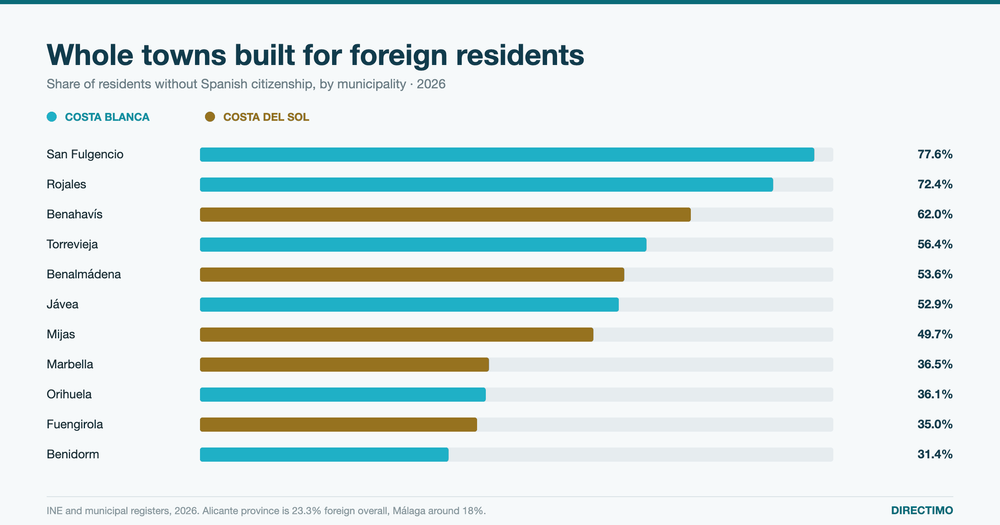
At municipal level the proportions become striking.
| Municipality | Coast | Foreign residents |
|---|---|---|
| San Fulgencio | Costa Blanca | 77.6% |
| Rojales | Costa Blanca | 72.4% |
| Benahavís | Costa del Sol | ~62% |
| Torrevieja | Costa Blanca | 56.4% |
| Benalmádena | Costa del Sol | 53.6% |
| Jávea | Costa Blanca | 52.9% |
| Mijas | Costa del Sol | 49.7% |
| Marbella | Costa del Sol | 36.5% |
| Orihuela | Costa Blanca | 36.1% |
| Fuengirola | Costa del Sol | ~34–37% |
| Benidorm | Costa Blanca | 31.4% |
Percentages vary between sources depending on year and method — municipal register against census. Marbella records 36.5% on its 2026 municipal register against roughly 31% at the 2021 census, and the two counts differ by over 13,000 people. Official figures understate reality either way, because thousands of effective residents never register at all.
The trend is accelerating. Of the roughly 7,000 residents Marbella gained in 2025, more than 90% were foreign: the Spanish population grew by about 500, the foreign population by over 6,300.
The two coasts share the intensity and differ in profile. Costa Blanca leads on volume, with entire municipalities built for mid-budget foreign buyers — San Fulgencio and Rojales are effectively British and German towns with Spanish town halls, and British residents alone number over 70,000 in the province. Costa del Sol concentrates at the premium end: Benahavís at around 62% foreign, Marbella's register listing 156 distinct nationalities, and areas of Mijas such as La Cala operating commercially in English.
Residents and buyers are different measures
The figures above count who lives in these municipalities. Who buys produces sharper numbers still.
Notarial data for 2025 shows foreign buyers accounting for 73.6% of home purchases in Calpe, 70.8% in Estepona, 68.6% in Jávea, 68.1% in Altea and 64.8% in Marbella. At provincial level, foreign buyers overtook Spanish buyers in Alicante for the first time on record.
These markets are bought, transaction by transaction, by foreigners.
What this means when you buy
You pay two administrations. Inside an urbanización the body that actually runs your surroundings is the comunidad de propietarios — the owners' association. It has far more power than a building committee elsewhere in Europe: it manages private roads, shared pools, gardens and security. You pay annual property tax to the town hall, and a community fee to the association that can run from a few hundred to several thousand euros a year depending on facilities.
Before you make an offer, read what the community fee covers, what the association has in reserve, and what maintenance is scheduled. A low fee on a complex with an ageing pool plant is a deferred bill, not a saving.
The rules change at the municipal boundary. Property tax rate, waste charge, planning rules and tourist-letting permission are all set by the municipio. Two apartments a short drive apart can have completely different tax bills and completely different rental options.
Distance from the town hall shows. Residents of Orihuela Costa have complained for decades that their taxes fund the inland town. When you assess an area, look past the beach and the price per square metre at how present the administration is: street lighting, cleaning, road surfaces, how quickly things get repaired.
The community statutes can override a licence. An urbanización's registered statutes can prohibit tourist letting, and that prohibition stands even where the property holds a valid regional licence. Your lawyer reads the statutes and the minute book before you sign anything.
What the towns are like out of season
Torrevieja, Calpe and Jávea triple in population over the summer. Between 20% and 47% of their residents are permanent, so hospitals, water networks and transport are sized for the peak.
In the low season these towns run at 40 to 50% of capacity, with shops, restaurants and clinics open. Both coasts function in February.
The villages behind the coast
A dense network of historic inland villages sits behind both coastlines, and it raises the value of the whole area.
On the Costa del Sol, the mountains preserved the white villages: Málaga province holds 25 to 30 authentic ones, including Frigiliana, Mijas Pueblo, Casares, Gaucín, Ojén and Ronda above the El Tajo gorge.
On the Costa Blanca, the equivalent is the mountainous interior of the Marina: Guadalest, a fortress village perched above a turquoise reservoir and among the most visited in Spain; Altea, with its white old town and blue-domed church; plus Polop, Tárbena and the wine villages of the Jalón valley. All within 20 to 40 minutes of the beach.
Two of them are unusual enough to be worth knowing. Júzcar, in Málaga province, was painted entirely blue in 2011 to promote a film. The plan was to repaint it white afterwards, but visitor numbers rose from about 9,000 to 95,000 a year and residents voted in a referendum to keep the colour. Copyright now prevents the village from marketing itself under the film's name, so it trades as La Aldea Azul, the Blue Village. Villajoyosa, on the Costa Blanca, has painted its fishermen's houses in bright colours for generations, so that crews could recognise their own home from the sea.
For a buyer this matters commercially. Proximity to a well-kept historic village is a factor in price and in rental demand.
Three things to check before you offer
Which municipio. It sets your tax rate and decides whether you can let to tourists at all.
Which comarca. It positions you in the market and explains the price level around you.
Which urbanización or núcleo. It sets your community costs and determines how well your immediate surroundings are run.
All three are checked before the offer.
How Directimo works
Directimo represents the buyer, never the seller. Listing agents in Spain are contracted by the vendor and paid to protect the vendor's price.
We verify planning status at the town hall, read the community minute book for tourist-letting restrictions and pending works, confirm the property is free of debt at the Land Registry, and check the bank guarantees behind off-plan payments. We coordinate the tax number, the bank account, an independent bilingual lawyer, the notary and the handover, remotely from start to finish.
The properties we source average 13.5% below area market prices. We have completed more than 1,000 transactions since 2011, totalling over €300M in property sold.
Directimo is a buyer-first platform for international buyers across Europe's top vacation destinations, starting with the Costa del Sol and Costa Blanca.
Book a 25-minute strategy call: directimo.com/advisory-call Full market reports for each coast: directimo.com/market-reports
What a community can and cannot decide about tourist letting is set out in our Costa del Sol rental rules guide. Community fees sit inside the full annual holding cost in our cost of living guide, and the purchase side is in our costs and taxes guide.
Sources. INE — population, foreign resident shares and population centres, 2025 and 2026 series. Municipal registers of Marbella and other named municipalities, 2026. Consejo General del Notariado — municipal foreign-buyer shares, 2025. Provincial councils of Alicante and Málaga — municipal and pedanía counts. Mancomunidad Costa del Sol Occidental — shared water services.
Method. Spain keeps no official register of urbanizaciones, so totals for them are estimates from municipal sources and market reporting. Foreign resident percentages differ between the municipal register and the census; both are cited where they diverge.
This guide is market research, not investment, tax or legal advice. Municipal rules and community statutes should be confirmed for the specific property before any offer.