

Published September 2026 · Data verified September 2026
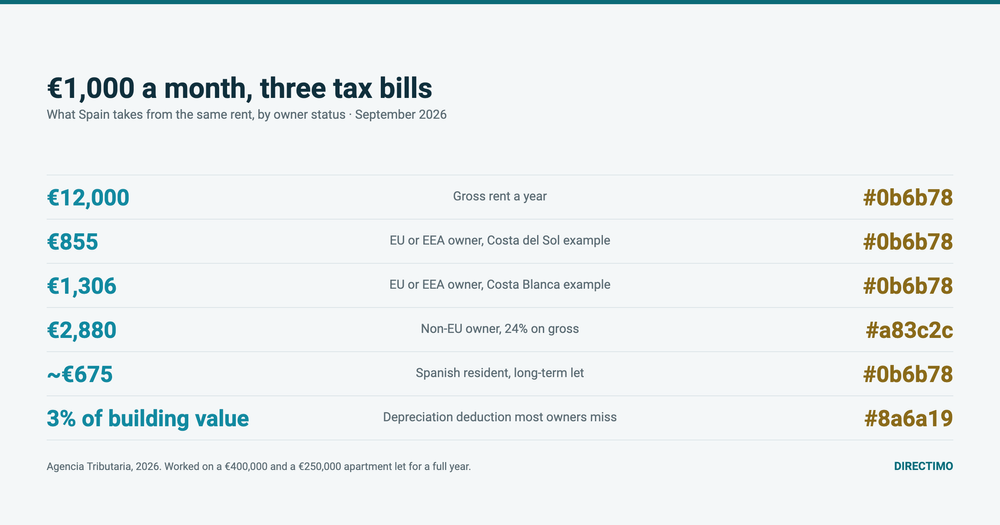
A property let at €1,000 a month produces €12,000 a year gross. What reaches you ranges from about €9,100 to €11,150 depending on one thing: your tax residence.
| Owner | How Spain taxes it | Tax on €12,000 |
|---|---|---|
| EU or EEA resident, non-resident in Spain | 19% on net, expenses deductible | €855–1,306 |
| Non-EU resident | 24% on gross, nothing deductible | €2,880 |
| Spanish tax resident, long-term let | Net, less a 50% reduction, at your marginal rate | ~€675 |
A non-EU owner pays roughly three times what an EU owner pays on the same rent from the same property.
The calculation, coast by coast
Same rent, two typical properties. Deductions scale with the value of the property, so the answer differs.
| Deductible item | Costa del Sol, €400,000 | Costa Blanca, €250,000 |
|---|---|---|
| IBI | €1,000 | €625 |
| Community fees | €1,500 | €1,000 |
| Insurance | €300 | €250 |
| Repairs and maintenance | €500 | €400 |
| Management, 5% | €600 | €600 |
| Depreciation, 3% of building value | €3,600 | €2,250 |
| Total deductions | €7,500 | €5,125 |
| Net income | €4,500 | €6,875 |
| Tax at 19% | €855 | €1,306 |
| Effective rate on gross rent | 7.1% | 10.9% |
The higher-value property carries the lower tax bill on identical rent, because IBI, community fees and depreciation all scale with what the property is worth.
Note what €1,000 a month means in each case. On the Costa del Sol property it is a 3.0% gross yield. On the Costa Blanca one it is 4.8%.
What you can deduct, and what you cannot
Deductible: IBI, community fees, insurance, repairs and maintenance, management and agency fees, utilities you pay yourself, legal and accountancy costs, and mortgage interest.
Depreciation at 3% a year on the building value, excluding land, calculated on the higher of acquisition cost or cadastral value. This is the largest single deduction for most owners and the one most often left out.
Not deductible: capital repayments on a mortgage, improvements that add value rather than maintain it, and your own time.
Pro-rated: where the property is let for part of the year only, deductions are apportioned to the days actually let. A tourist let standing empty for four months deducts eight months of costs, not twelve.
The 50% reduction, and who gets it
A Spanish tax resident letting a property as someone's main home reduces net rental income by 50% before tax.
Higher tiers exist:
| Reduction | Condition |
|---|---|
| 90% | Property in a designated pressured zone, with rent cut at least 5% against the previous contract |
| 70% | Pressured zone with a tenant aged 18 to 35, or the property offered to a public housing body |
| 60% | Renovation completed in the two years before the letting |
| 50% | Standard, on contracts signed since May 2023 |
Contracts signed before May 2023 keep the previous 60% rate for their term.
Non-residents do not get any of this. The reduction applies to Spanish tax residents, which is the gap the European Commission is challenging — it expanded an infringement procedure against Spain in June 2026 over the denial to non-residents of reductions available to residents. If Spain amends the law, non-resident net returns improve. There is no timetable.
Tourist lets get no reduction at all, on any of the tiers. The reduction attaches to letting a dwelling as a main residence.
Tourist letting changes the arithmetic
Three things happen when the same property is let to tourists rather than to a tenant.
No 50% reduction, even for a Spanish resident.
Deductions are pro-rated to occupied days, and tourist occupancy is seasonal.
Services can turn it into a business. Providing daily cleaning, linen changes or a reception service makes the income business activity rather than rental income, taxed at marginal rates and potentially inside VAT. Classification follows what you actually do, not what the contract calls it. That threshold is covered in our tourist apartment tax guide.
Filing
Non-residents file once a year, between 1 and 20 April, covering the previous year. That replaced four quarterly filings from June 2026.
Spanish residents include rental income in the ordinary annual return.
An unlet second home still generates imputed income tax, at roughly 0.15% of purchase price a year, which is separate from anything above.
Three ways owners lose money on this
Forgetting depreciation. On the Costa del Sol example it is €3,600 a year of deduction, worth €684 in tax. Owners who file without it overpay every year, and the claim requires knowing the cadastral breakdown between land and building.
Filing as non-EU when you are EU. The difference between 19% on net and 24% on gross is the single largest variable in the table above.
Treating gross yield as income. A 4.8% gross yield on the Costa Blanca example becomes 3.9% after this tax alone, before operating costs, vacancy and the annual holding cost of the property.
How Directimo works
Directimo represents the buyer, never the seller. Listing agents in Spain are contracted by the vendor and paid to protect the vendor's price.
We model the net return after tax on your own residency position before you commit, rather than quoting a gross yield. The properties we source average 13.5% below area market prices. We have completed more than 1,000 transactions since 2011, totalling over €300M in property sold.
Model the net return on a specific property: directimo.com/advisory-call
Your lawyer and a Spanish tax adviser confirm the position for your own circumstances before you rely on it.
Yields by market are in our Costa del Sol and Costa Blanca analyses, and what becoming a Spanish tax resident changes is in our tax residency guide.
Sources. Agencia Tributaria — non-resident income tax rates for EU/EEA and third-country residents, deductible expenses, the 3% depreciation rule, the reduction on residential letting and its enhanced tiers, and the annual filing calendar from June 2026. European Commission — infringement procedure on reductions denied to non-residents, expanded June 2026. Directimo Costa del Sol and Costa Blanca Market Reports, September 2026 — property values and holding costs used in the worked examples.
Method. Worked examples use a €400,000 Costa del Sol apartment and a €250,000 Costa Blanca apartment, both let for a full year at €1,000 a month. Depreciation assumes a cadastral value around half of market with the building representing about 60% of it; the actual figure comes from the cadastral record for each property and changes the result. The Spanish resident figure assumes a 30% marginal rate. Effective rates are stated on gross rent and exclude operating costs, vacancy, and the annual cost of holding the property.
This guide is market research, not tax advice. The outcome depends on your residency, the property's cadastral values and your own circumstances, and should be confirmed with a Spanish tax adviser.