

Published September 2026 · Data verified September 2026
Four Costa Blanca municipalities now cap new tourist registrations, and more than 18,000 registrations were cancelled across Spain during 2025 for falling short of current requirements. Altea's registered stock has fallen by around a quarter since its zone limits came in.
Three approvals are needed and you need all three. The one that stops most applications is the municipal compatibility certificate, and since 2024 a Valencian registration expires after five years and must be renewed.
Three layers, and any one can stop the operation
| Layer | Who decides | What it establishes |
|---|---|---|
| Municipal compatibility certificate | The town hall | That tourist use is permitted at that specific address under current zoning |
| Registration in the Valencian tourism register | The Generalitat Valenciana | That the property is licensed to operate, for five years |
| The building's community | The owners | That the statutes and the community permit lodging use |
A listing that says "with tourist licence" is describing the second layer. The question to answer before you offer is whether all three align for that specific property.
The compatibility certificate is where applications stop
Before a property can be registered, the town hall must certify that tourist use is compatible with the planning classification of that address. Municipalities that want to limit tourist rental use this step, which is why a town hall can be described as open and still refuse most applications.
Ask for the certificate itself. A property that already holds one has cleared the hardest step.
Community approval, since April 2025
Starting a new tourist letting activity in an apartment building requires the approval of three-fifths of the owners, representing three-fifths of the ownership quotas. The same majority can prohibit it, and can impose a surcharge of up to 20% on the community fees of units used for tourist letting.
Properties already operating before that rule are not affected by it. Detached villas and whole buildings under single ownership fall outside it.
Read the statutes and the minute book before the offer. A registered prohibition on lodging use overrides a valid registration, and no vote is needed to enforce one that already exists.
Registrations now expire
A Valencian tourist registration is valid for five years and must be renewed. Registrations predating August 2024 renew by August 2029. Renewal is assessed against the rules in force on the renewal date, whatever applied when it was first granted.
That matters when you buy. A registration with four years left is a different asset from one with eight months left in a municipality that has since tightened its position.
Ask for the registration date, and calculate the renewal date before you value the licence.
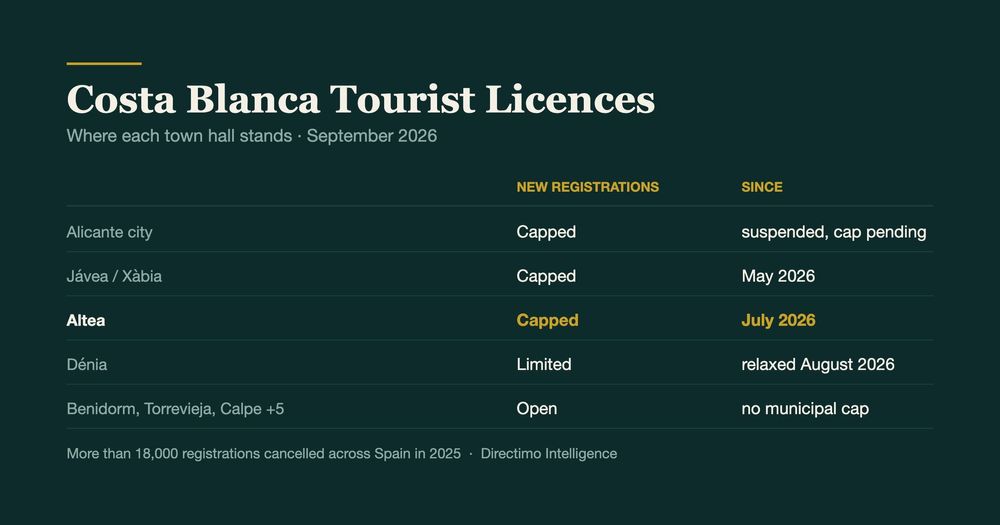
Where the town halls stand
| Municipality | New registrations | What applies |
|---|---|---|
| Alicante city | Capped | Suspended while a permanent per-district limit is finalised. Buy with a registration already in place |
| Jávea / Xàbia | Capped | Municipal ceiling set in May 2026, allocated by neighbourhood, with little headroom left |
| Altea | Capped | Zone-by-zone limits in force since July 2026; registered stock has fallen by around a quarter |
| Dénia | Limited | Rules relaxed in August 2026, with more allowance in high-demand zones. Montgó, Les Marines and Les Rotes unrestricted |
| Benidorm | Open | No municipal cap; regional rules and building statutes apply |
| Torrevieja | Open | No cap. The province's largest registered stock and deepest resale market |
| Calpe, Orihuela, Guardamar, Santa Pola, Moraira, Benissa | Open | No municipal cap, and the compatibility certificate is still required |
Prices and character by zone are in our Costa Blanca geographic guide. Municipal positions change quickly — Jávea capped in May 2026, Altea in July, and Dénia loosened in August. Confirm the position for the specific address before you rely on it.
What the enforcement figures show
More than 18,000 registrations were cancelled across Spain during 2025 alone, where properties fell short of current requirements. The legal market is being tidied at the same time as several municipalities cap it.
Altea's registered stock has fallen by around a quarter since its zone limits came in. Alicante city is suspended pending a permanent per-district cap.
The consequence for price. A property that already holds a compatibility certificate and a live registration, in a building whose statutes permit lodging use, is becoming scarce in the capped municipalities. In Alicante city and Jávea it cannot readily be replaced. Properties that carry one command a premium over identical properties that do not, and that gap is likely to widen.
The national registration number was annulled
A national short-term rental registration framework introduced in 2024 required every advertised property to obtain a number through the Property Registry. The Supreme Court annulled that requirement in May 2026, on the grounds that the state had duplicated registers that belong to the regions.
The Valencian registration is the operative one. Platforms still report letting data to the national digital window, and owners no longer need a separate national number.
What transfers to you, and what does not
Transfers with the property: the Valencian registration itself, with its remaining validity. That asymmetry between the two routes is set out in our guide to resale or new build on the Costa Blanca.
Verified separately: the building's statutory position, the municipal compatibility for that address, whether the community has resolved anything since, and the renewal date.
If tourist letting is not available
Two routes stay open and neither needs a tourist licence.
Mid-term letting, from roughly two months up to eleven. Demand comes from northern Europeans wintering in the south, people testing an area before buying, and remote professionals. Net income reaches around 80% of the tourist net at far lower operating cost, and the tenant pays the utilities.
Long-term letting, with near-zero vacancy and annual increases capped by an official national index at roughly 2.4–2.5% in 2026.
Any property bought partly for income should be modelled on the fallback as well as the headline strategy, because the fallback is what applies if the licence route closes. Yields by market are in our Costa Blanca rental yields analysis.
Before you make an offer
Six checks, in this order:
- The compatibility certificate. Does one exist for that address, and will the town hall issue one?
- The registration. Does the property hold one, and when does it expire?
- The statutes. Do the building's registered statutes contain any prohibition on lodging or hospedería use?
- The minute book. Has the community resolved anything about tourist letting, or imposed a surcharge?
- The technical requirements. Does the property meet the current equipment and habitability standards for registration?
- The numbers on the fallback. What does the property return on mid-term or long-term letting if tourist use is unavailable?
Your lawyer verifies all six before you sign anything.
How Directimo works
Directimo represents the buyer, never the seller. Listing agents in Spain are contracted by the vendor and paid to protect the vendor's price.
We check the compatibility position for the specific address, the registration and its remaining validity, and the building's statutes and minute book before you commit, and we model the mid-term fallback alongside the tourist case. The properties we source average 13.5% below area market prices. We have completed more than 1,000 transactions since 2011, totalling over €300M in property sold.
Check licence feasibility for a specific property: directimo.com/advisory-call
The purchase process is in our Costa Blanca buyer's journey, the full cost of buying and holding in our Costa Blanca costs and taxes guide, and the equivalent rules on the other coast in our Costa del Sol rental rules guide.
Sources. Directimo Costa Blanca Market Report, September 2026 — municipal licence status by town hall, registration cancellations and renewal deadlines. Generalitat Valenciana — the tourist accommodation framework introduced in 2024: the municipal compatibility certificate, registration in the regional register, five-year validity and renewal. Spanish legislation in force since April 2025 — the three-fifths community majority for new tourist letting activity and the community fee surcharge. Spanish Supreme Court, May 2026 — annulment of the national single registration procedure for short-term rentals. Tribunal Superior de Justicia de la Comunitat Valenciana, February 2026 — municipal moratoria on tourist licences. Municipal ordinances and caps as published by each town hall, September 2026.
Method. Municipal positions are stated as at September 2026, are reviewed quarterly, and change quickly: three of the seven entries in the table moved between May and August 2026. The practical test at any address is whether the town hall will issue a compatibility certificate, which is assessed case by case. The cancellation figure is national and covers registrations withdrawn for failing current requirements, so it reflects enforcement as well as policy.
This guide is market research, not legal, tax or investment advice. The position for a specific property depends on its address, its building and its municipality, and should be confirmed before any offer.