

Published September 2026 · Data verified September 2026
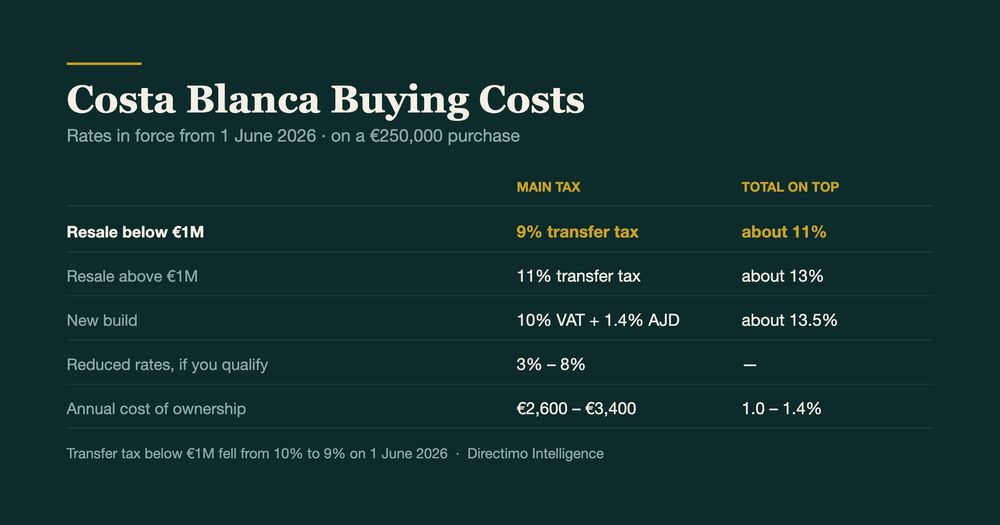
Buying costs on the Costa Blanca come to roughly 11% of the price on a resale below €1,000,000, about 13% on a resale above it, and about 13.5% on a new build. Those percentages sit on top of the purchase price and are paid from your own funds. A mortgage does not cover them.
The transfer tax fell on 1 June 2026, from a flat 10% to 9% below €1,000,000. On a €300,000 purchase that is €3,000 less than a buyer paid in the spring.
The three routes, side by side
| Resale below €1M | Resale above €1M | New build | |
|---|---|---|---|
| Transfer tax (ITP) | 9% | 11% | — |
| VAT (IVA) | — | — | 10% |
| Stamp duty (AJD) | — | — | 1.4% |
| Notary and registry | ~0.55% | ~0.5% | ~0.55% |
| Lawyer, plus VAT | €1,500–3,000, or ~1% | €1,500–3,000, or ~1% | €1,500–3,000, or ~1% |
| Practical budget | about 11% | about 13% | about 13.5% |
On a €250,000 resale that is roughly €27,500. On a €250,000 new build, about €33,500. The two routes are compared in full in our guide to resale or new build on the Costa Blanca.
Add 0.5–1% if you use a mortgage, for the valuation and any arrangement fee. Add €15,000–20,000 to furnish a one or two-bedroom apartment to letting standard.
What changed on 1 June 2026
Three things, all in the buyer's favour:
- Transfer tax on a resale below €1,000,000 fell from 10% to 9%. Above that threshold it is 11%.
- Reduced rates were widened for main-residence buyers in several categories, down to 3% in some cases.
- Inheritance relief was extended to siblings, nephews, aunts and uncles at 25%, rising to 50% from 1 June 2027. Close family already had 99%.
Reduced rates exist, and rarely apply to a second home
Transfer tax drops to between 3% and 8% for buyers under 35 on lower incomes, large families, single-parent families, buyers with a recognised disability, and officially protected housing. Stamp duty on a new build drops to 0.1% for the same categories.
Every one of them requires the property to be your main residence in Spain. A holiday home or an investment property pays the general rate. Ask only if you are relocating permanently and fall into one of those categories.
What each line is for
Transfer tax or VAT. A resale from a private seller carries transfer tax. A new build from a developer is a first transfer, so VAT applies instead, at 10%, with stamp duty charged on the deed at 1.4%.
Notary and registry. Fixed by official scale. The notary authorises the deed; the registry records you as owner.
Lawyer. An independent lawyer, instructed and paid by you. Pricing splits by area: fixed fees of €1,500–€3,000 plus VAT are usual in the south, around Torrevieja, Orihuela Costa and the Vega Baja, while firms in the north — Jávea, Moraira, Dénia, Altea — commonly charge around 1% of the price, which follows the higher values there. On a €900,000 villa the two models are thousands apart, so confirm which one you are being quoted before instructing. This is the line buyers are most tempted to cut and the one that protects the rest.
Gestoría, around €300–400, where one handles the tax filings and registration.
Valuation, required if you borrow, typically €300–600.
Power of attorney, if you complete without travelling — a few hundred euros through the notary.
The tax base is not always the price
Transfer tax is charged on the higher of the price you pay and the Cadastre's reference value. Negotiate below the reference value and the tax is still calculated on that value.
On a property with a reference value of €250,000 bought at €225,000, the 9% is charged on €250,000, giving €22,500 against the €20,250 the price alone would produce. The reference value is public and free to consult, and it belongs in the budget before you make an offer. How it works is in our guide to reading Spanish property prices.
The annual cost of ownership
A €250,000 two-bedroom apartment, used under six months a year and not let:
| Item | Annual |
|---|---|
| IBI, the municipal property tax | ~€625 |
| Community fees | €600–1,400 |
| Electricity, standing charge and basic use | ~€360 |
| Water | ~€240 |
| Waste tax | ~€150 |
| Insurance | ~€250 |
| Running costs | €2,225–3,025 |
| Imputed income tax, because it is not let | ~€375 |
| Total | €2,600–3,400, or 1.0–1.4% of value |
IBI and imputed income tax are calculated on the property's cadastral value. The cadastral value typically sits at around half of market or below, and both figures are confirmed per property before purchase.
The household side — food, cars, insurance, healthcare — is in our cost of living guide.
If you let the property
| EU or EEA resident | Non-EU resident | |
|---|---|---|
| Rental income | 19% on net, costs deductible | 24% on gross, no deductions |
| Capital gain on sale | 19% | 19% |
| Withholding when you sell | 3% of price, recoverable | 3% of price, recoverable |
Since June 2026, non-resident rental declarations are a single annual filing between 1 and 20 April; the four quarterly filings ended.
Whether a property can be let to tourists at all depends on the municipality and the building — the position by town hall is in our Costa Blanca rental rules guide.
Wealth and inheritance
Wealth tax applies whether or not you become resident: a resident is assessed on worldwide assets, a non-resident only on assets held in Spain. The Valencian Community charges nothing below €2,000,000 of net assets. A separate national levy applies above €3,000,000 of Spanish assets, and regional reliefs do not reduce it.
Inheritance between close family — children, spouse, parents — carries a 99% relief in the Valencian Community, plus a €100,000 reduction on the taxable base and a further 95% relief on a main residence up to €150,000 where it is held for five years. Since 1 June 2026 siblings, nephews, aunts and uncles receive 25%, rising to 50% from 1 June 2027.
Owners from countries where succession works differently should take advice before completion, because the structure of ownership at purchase determines the position later. The full position is in our inheritance and succession guide.
If you borrow
Non-residents borrow up to around 70% of the price, with the payment capped near 30–35% of net income. Fixed rates ran 2.55% to 3.55% in September 2026, currently below variable. Spanish law moved stamp duty, the notary and the registry on the loan deed to the lender in 2019, so the borrower pays the valuation and any arrangement fee. Full detail in our mortgage guide.
When you eventually sell
Capital gains tax at 19% on the gain, calculated on the deed values in and out, with acquisition costs and documented improvements deductible. Keep every invoice from the day you complete.
The 3% withholding. The buyer retains 3% of the price and pays it to the tax office on account of your gain. If your actual liability is lower, you reclaim the difference.
Plusvalía municipal, a local tax on the increase in land value, paid by the seller.
Agency fees, typically 3–5% plus VAT, paid by the seller.
The full sale process, with a worked example of what a seller nets, is in our guide to selling as a non-resident.
What your lawyer checks before you sign
- Title and encumbrances at the land registry.
- Community debts, which attach to the property and pass to you.
- Planning and licence status — that the building is legal, any extension was authorised, and the occupancy certificate exists.
- The community statutes, including any prohibition on lodging use.
- The land classification, since rustic land carries restrictions urban land does not, and buyers from outside the EU can need Ministry of Defence authorisation in parts of southern Alicante.
- The deposit contract — what happens to your money if either side withdraws.
- For a new build — the developer's bank guarantee covering your stage payments, and the ten-year structural warranty.
Your lawyer verifies all of this before any money moves.
How Directimo works
Directimo represents the buyer, never the seller. Listing agents in Spain are contracted by the vendor and paid to protect the vendor's price.
We put the full cost of a purchase in front of you before you commit — acquisition costs, the reference value, the annual holding cost and the tax position for your own residency — and we coordinate the tax number, the bank account, an independent bilingual lawyer, the notary and the handover, remotely from start to finish. The properties we source average 13.5% below area market prices. We have completed more than 1,000 transactions since 2011, totalling over €300M in property sold.
Get the full cost on a specific property: directimo.com/advisory-call
The process stage by stage is in our Costa Blanca buyer's journey, the areas and their prices in our Costa Blanca geographic guide, and the same costs on the other coast in our Costa del Sol costs and taxes guide.
Sources. Generalitat Valenciana — transfer tax, stamp duty, reduced rates and their qualifying conditions, in force from 1 June 2026 under the 2025 regional tax law. Generalitat Valenciana — inheritance and gift tax relief for close family, the extension to siblings and other relatives from 1 June 2026, and the wealth tax exempt minimum. Agencia Tributaria — non-resident income tax rates and bases, capital gains, the 3% withholding, the imputed income calculation and the non-resident filing calendar. Dirección General del Catastro — the reference value as the minimum taxable base. Consejo General del Notariado and the Colegio de Registradores — notary and registry scales. Banco de España — non-resident lending conditions, 2026. Directimo Costa Blanca Market Report, September 2026.
Method. Percentages are stated on the deed price and exclude furnishing, renovation and financing. Notary, registry and lawyer costs vary with the price and the complexity of the transaction and are given as typical ranges; lawyer fees on this coast are usually a fixed amount. The annual cost example uses a €250,000 two-bedroom apartment occupied under six months a year, with IBI and imputed income tax assuming a cadastral value around half of market; both are confirmed per property before purchase.
This guide is market research, not legal or tax advice. Rates and reliefs change, and your position depends on your tax residence and personal circumstances. Confirm both for the specific property before any offer.