

Published September 2026 · Data verified September 2026
Costa Blanca sales volumes fell in the first half of 2026 while prices kept rising. Transactions in Alicante province came in at 25,085, down 7.6% on the same period a year earlier, and the average price per square metre went up anyway. That divergence is the thing to understand before committing capital to this coast in 2026.
Then momentum returned. In June 2026 the Comunitat Valenciana was one of only four Spanish regions where sales grew, up 7.9%, while the national market fell 4.0%. New mortgage lending in the region rose 11.6%, the fastest in Spain.
The market in numbers
| Indicator | Alicante province |
|---|---|
| Average transaction price | €1,978/m² |
| Average purchase amount | €203,488 |
| Sales, last twelve months | 52,847 |
| Price change, 2025 | +9.3% |
| Sales, H1 2026 vs H1 2025 | −7.6% |
| Foreign buyers | 51.5% |
| Second-hand share | 87.8% |
| Apartments | 71.0% |
| New-build | 12.2% |
| Median buyer age | 49 |
These are notarial transaction prices — what people actually paid at the deed — rather than asking prices on portals. The gap between the two matters, and asking prices on this coast run well above deed prices in the towns with the most new-build inventory.
A year of consolidation after a record year has usually meant better negotiating conditions, with values holding. Coastal volumes always move more sharply than coastal prices.
Who is buying, and what that means at exit
More than half of all purchases in Alicante province are made by foreign buyers, spread across ten nationalities, with no single country dominating.
| Buyer nationality | Share of foreign purchases |
|---|---|
| Netherlands | 13.1% |
| United Kingdom | 10.5% |
| Poland | 8.5% |
| Belgium | 8.4% |
| Germany | 6.9% |
A market driven by five or six countries is more resilient than one driven by one, because a slowdown in a single home market does not remove the buyer pool. That is a resale argument as much as a demand argument.
The buyer profile behind those figures explains why this market has held its footing through three interest-rate cycles: median age 49, nine purchases in ten made by individuals rather than companies, average surface 103 m², seven purchases in eight resale rather than new-build. These are people buying somewhere to spend part or all of the year, funded mainly from savings rather than leverage.
Nationality mix varies sharply by town. Moraira, Jávea, Torrevieja, Benidorm, Alicante city and Orihuela Costa each have a different profile, and the one that matters is the one for your specific location.
Financing changed during 2026
The European Central Bank raised rates in June 2026, its first increase in almost three years, and held in July. The twelve-month Euribor averaged 2.95% in August 2026, against 2.11% a year earlier.
Lenders have become more selective on second-home financing. Mortgage pre-approval before making an offer carries more weight than it did a year ago, and non-resident terms remain around 70% loan-to-value. Set against that, regional mortgage lending grew faster than anywhere else in Spain during 2026, so credit is available to buyers who prepare for it.
Where supply is genuinely constrained
Scarcity on this coast is concentrated in the north. Buildable coastal land in the Marina Alta is limited by topography and by planning protection, and no Costa Blanca municipality appears among Spain's most active for new building permits. New premium product largely sells off-plan, and price in Jávea, Moraira, Benissa Costa, Cumbre del Sol and Altea Hills is set by view, orientation, plot and access rather than by square metres alone.
The southern half behaves differently. The Vega Baja and the Orihuela Costa corridor have land, active developers and a steady flow of new coastal apartments. That supports entry pricing and volume, and it also means a specific development can face direct competition from the next one along when you come to sell.
Liquidity at exit
Rental income is one half of the return. The other half is whether you can sell, at what speed and to whom.
| Exit profile | Markets | What sets the price |
|---|---|---|
| Deep and liquid | Torrevieja, Alicante city, Benidorm, Orihuela Costa, Dénia, Calpe | Broad buyer pool, constant transaction flow |
| Liquid but price-sensitive | Santa Pola, Villajoyosa, Guardamar | Sells at the right price, slower above it |
| Selective | Moraira, Jávea, Altea Hills, Benissa Costa | Fewer buyers, each one specific. View and plot decide |
| Niche | Cumbre del Sol, high-end Altea Hills villas | Small pool, long marketing periods, wide price outcomes |
A property in a selective market is not a worse asset. It is one whose exit needs a longer horizon and a realistic price, and that has to be in the plan from the start rather than discovered at the point of sale.
Rental income, before you underwrite it
Short-term gross yields across the coast's main markets screen at 5.8% to 11.9% on a standardised 90 m² basis, and a 50% operating-cost allowance takes that to 2.9–6.0% net operating. Those figures, market by market, are in our Costa Blanca rental yields analysis.
Four checks decide whether any of it applies to a specific property: whether the municipality is still issuing registrations, whether the building's registered statutes permit lodging use, whether the compatibility certificate exists, and whether the registration is current and renewable. Any one of them can block the operation, and a registration under the current regime does not transfer automatically to a buyer. The rules are set out in full in our tourist rental rules guide.
The Costa Blanca also has a mid-term route that needs no registration at all: a let of eleven days or more falls outside tourist rental law. That fallback belongs in the underwriting of any property bought partly for income.
Risks specific to this coast
Municipal licence policy is moving faster here than anywhere in Spain. Alicante city, Jávea and Altea have capped new tourist registrations, Dénia limits them by zone, and further ordinances are in preparation. A municipality that was open last season may be capped this one.
Water. The Segura basin held 53.7% of capacity in late August 2026, more than double its level a year earlier and its best position for that date in over a decade. It remains one of Spain's structurally driest basins, and the Tajo–Segura transfer stays under review. No restriction currently applies to building licences in Alicante province, and water is a live regional question rather than a settled one.
Desalination is what separates this coast from the headline. Torrevieja operates one of the largest desalination plants in Europe at 80 hm³ a year, with an authorised expansion to 120 hm³ costing €108.5M, and the Alicante plants add capacity alongside it. That infrastructure supplies urban and tourist demand independently of the transfer, which is why the political argument over the Tajo–Segura is an agricultural question first and a residential one second. For a buyer, the water risk to a coastal home is lower than the state of the basin on its own suggests.
Non-resident tax treatment is under EU challenge. Brussels is pressing Spain to extend resident-level rental income deductions to non-residents. If Spain amends the law, non-resident net yields improve. There is no timetable, so it belongs in the upside case rather than the base case.
Micro-location. Two apartments a kilometre apart, one with a sea view and walkable services and one behind the main road, do not behave like the same asset at resale even when the €/m² looks similar.
New-build concentration in the south. A development that competes with three similar schemes within a few kilometres has a harder exit than the brochure suggests.
Scenarios to 2030
Base. Continued international demand, moderate price growth, and depth in the liquid locations. Supported by constrained northern supply, retirement and relocation demand, year-round infrastructure and a wide price ladder.
Upside. Faster rate cuts, a broadening foreign buyer base, continued scarcity of premium northern supply, and resolution of the non-resident deduction question in buyers' favour.
Downside. Financing costs staying where they are, affordability pressure, tighter short-term rental rules, oversupply in a specific new-build area, or a purchase in a weak micro-location. A weak outcome here does not require a market crash — flat prices, higher running costs and slow resale are enough to erase a modelled return.
What to underwrite
| Group | Items |
|---|---|
| Getting in | Purchase price, acquisition costs of roughly 11% resale or 13.5–15% new-build, financing cost, furnishing |
| Holding | Community fees, IBI, imputed income tax or income tax on rent, insurance, utilities, maintenance, management, vacancy |
| Getting out | Resale buyer pool, expected marketing period, capital gains tax, agency cost, the 3% buyer withholding |
Gross yield is a screening ratio. The number that decides the investment is the net return you keep after all three groups, and whether the property resells to a defined buyer.
The premium villa corridor in the north is analysed separately in our premium north analysis.
How Directimo works
Directimo represents the buyer, never the seller. Listing agents in Spain are contracted by the vendor and paid to protect the vendor's price.
We model the net return and the exit before you commit: the deed prices actually achieved in that street, the municipal licence position for that address, the community's statutes and accounts, and who the realistic future buyer is. The properties we source average 13.5% below area market prices. We have completed more than 1,000 transactions since 2011, totalling over €300M in property sold.
Model a specific property: directimo.com/advisory-call Full Costa Blanca market report: directimo.com/market-reports
The two Spanish coasts are compared side by side in our decision guide.
How Spain compares with Portugal, Italy, Greece and France on tax, yield and process is set out in our country comparison. How urbanisations and communities of owners work, and what they can decide, is in our municipios and communities guide.
The national picture behind these figures is in our Spain economy guide.
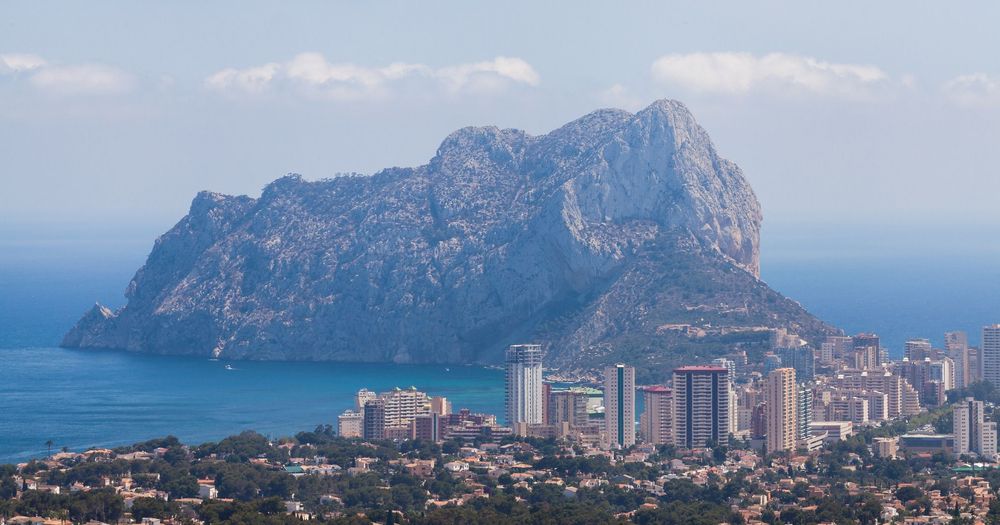
Sources. Consejo General del Notariado — transaction prices, volumes and buyer profile, Alicante province, 2025 and H1 2026. INE — regional sales and mortgage lending, June 2026. European Central Bank and Banco de España — policy rate and twelve-month Euribor, August 2026. Confederación Hidrográfica del Segura — basin storage, late August 2026. Acuamed and MITECO — Torrevieja desalination capacity and the authorised expansion. AirDNA and Idealista — rental yield screen, 2026. Generalitat Valenciana and municipal ordinances — tourist registration position, September 2026. Directimo Costa Blanca Market Report, September 2026. Cover photograph: Calpe and the Peñón de Ifach — Diego Delso, CC BY-SA 4.0.
Method. Price and volume figures are notarial deed data covering completed sales, not portal asking prices. Yield figures are screening ratios on a standardised 90 m² apartment basis, before purchase costs, income tax and financing. Scenarios describe conditions rather than forecast values, and no figure here is a projection of any individual property's performance.
This article is market research, not investment, tax, legal or mortgage advice. Municipal rules and tax treatment change and should be confirmed for the specific property before any offer.