

Published September 2026 · Data verified September 2026
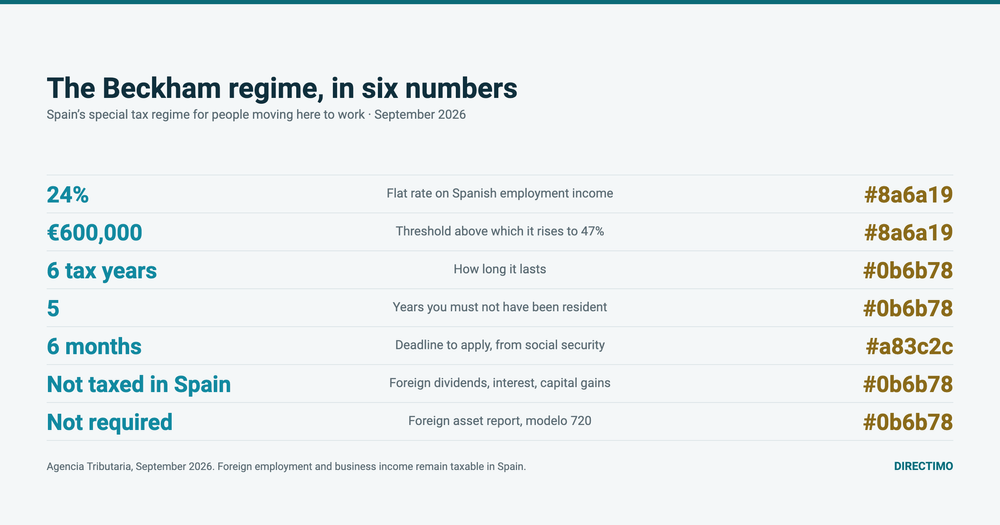
The Beckham regime taxes Spanish employment income at a flat 24% up to €600,000, and 47% above that, while leaving foreign dividends, interest and capital gains untaxed in Spain. It runs for six tax years and it has to be claimed within six months of starting work here.
It suits some people moving to Spain and costs others money. Which one you are depends on how much you earn and where your income comes from.
What the regime does
| Standard residency | Beckham regime | |
|---|---|---|
| Spanish employment income | Progressive, roughly 19% to 47% | 24% flat to €600,000, 47% above |
| Foreign dividends, interest, capital gains | Taxed in Spain | Not taxed in Spain |
| Foreign employment income | Taxed in Spain | Taxed in Spain |
| Wealth tax | Worldwide assets | Spanish assets only |
| Modelo 720 foreign asset report | Required above €50,000 per class | Not required |
| Personal and family allowances | Available | Mostly unavailable |
| Duration | Indefinite | 6 tax years |
You are taxed as though you were a non-resident, on Spanish-source income, while actually living here.
Who qualifies
You must not have been a Spanish tax resident in the five tax periods before you move. Beyond that, one of these has to apply:
- An employment contract with a Spanish employer
- A posting to Spain by a foreign employer
- Remote work for a foreign employer carried out by digital means
- The international remote work visa, which is the digital nomad route
- An entrepreneurial activity certified as innovative by the state innovation agency
- A company directorship, subject to limits on your shareholding in certain entities
- Highly qualified work in research and development
Self-employment on its own does not qualify. Neither does moving here on a non-lucrative visa, because there is no work to attach the regime to.
The two deadlines that decide it
Six months from registering with Spanish social security to apply, on modelo 149. Miss it and the regime is gone for that move.
Modelo 151 each year afterwards, which replaces the ordinary resident return.
The six-month window is the single most common reason people who qualified end up on the standard scale.
Family members
Your spouse and children can be taxed under the same regime, on the same terms, if they meet four conditions:
- They move with you, or within the first year
- They were not Spanish tax residents in the five previous years
- Children are under 25, or any age with a disability
- Each of them earns less than 50% of what you do
The family election is separate from yours and follows the same six-year clock.
When the regime costs you money
24% is a flat rate from the first euro. The standard scale starts lower and only climbs past 24% once income reaches a middling level. Below that point, standard residency produces a smaller bill, and it also gives you the personal and family allowances that Beckham removes.
Three situations where the standard regime is better:
Moderate Spanish salary. A flat 24% on €45,000 costs more than the progressive scale on the same figure, before allowances.
Significant deductible personal circumstances. Children, disability, pension contributions, mortgage relief where it still applies — Beckham removes most of them.
Income the treaty would shelter anyway. If your foreign income is already taxed abroad and the treaty gives Spain nothing, Beckham buys you less than it appears.
The regime earns its reputation at high Spanish salaries combined with substantial foreign investment income. That is the profile it was designed for.
What it does not exempt
Foreign employment income is taxable. Working remotely for a foreign employer while living here is Spanish-source work, and the 24% applies to it.
Business income is taxable regardless of origin.
Spanish property is inside wealth tax. The exemption covers worldwide assets, not the home you buy here. In Andalucía that is academic, because the regional charge is zero. In the Comunitat Valenciana it is not, above the thresholds.
Selling Spanish property produces a Spanish capital gain, taxed here.
The compliance risk
The tax authority has increased inspections of Beckham claims, looking for contractual simulation — arrangements built to fit the regime rather than reflecting real work. The checks focus on whether the employment is genuine, whether the work is actually performed, and whether the structure has substance.
Keep the employment relationship real and documented. A regime granted and later withdrawn produces back tax for every year it applied.
Before you decide
Model both regimes on your actual numbers. The comparison is arithmetic and it takes an afternoon.
Check the five-year clock. Any Spanish tax residency in the previous five periods disqualifies you.
Diarise the six months. From the social security registration date, not from arrival.
Decide the family election at the same time, because the conditions are tested at their move, not later.
Establish what your foreign income actually is. The regime is worth most when investment income is large and Spanish salary is high.
A Spanish tax adviser confirms the position against your own figures before you move.
How Directimo works
Directimo represents the buyer, never the seller. Listing agents in Spain are contracted by the vendor and paid to protect the vendor's price.
Buyers relocating for work usually settle the tax position and the property search at the same time, and the two interact — the region you choose changes your wealth tax and inheritance position. We coordinate the tax number, the bank account and an independent bilingual lawyer alongside the search. The properties we source average 13.5% below area market prices. We have completed more than 1,000 transactions since 2011, totalling over €300M in property sold.
Talk through the move: directimo.com/advisory-call
How ordinary Spanish tax residency works, including foreign pensions, wealth tax by region and foreign asset reporting, is in our tax residency guide. Purchase costs are in our costs and taxes guide, and the annual cost of ownership in our cost of living guide.
Sources. Agencia Tributaria — the special regime for workers posted to Spanish territory: rates, thresholds, duration, qualifying categories, modelo 149 and modelo 151, and the treatment of foreign income and foreign assets. Spanish legislation extending the regime to remote workers, entrepreneurs and highly qualified professionals, and to family members, in force since 2023. Junta de Andalucía and Generalitat Valenciana — regional wealth tax position.
Method. The comparison between regimes describes the mechanism rather than a break-even figure, because the crossover depends on the composition of income, family circumstances and the regional scale where you live. Rates and thresholds are national and stated as at September 2026.
This guide is market research, not tax or legal advice. Eligibility and the outcome depend entirely on your own circumstances and should be confirmed with a Spanish tax adviser before you move.