

Published September 2026 · Data verified September 2026
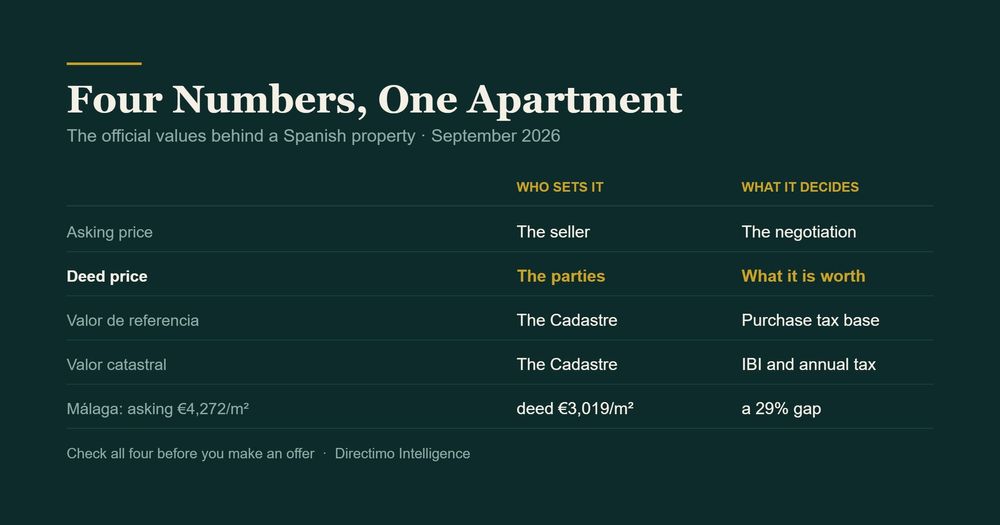
Four different official numbers describe the same Spanish apartment, and they can differ from each other by a factor of two. One decides what you negotiate against, one decides what you pay in purchase tax, one decides your annual bills, and one is what the seller hopes for.
Buyers who do not separate them overpay, under-budget, or get a tax assessment they did not expect.
The four numbers
| Number | Who sets it | What it is used for |
|---|---|---|
| Asking price | The seller | The starting point of a negotiation |
| Deed price | The parties, recorded by the notary | What the market actually paid. The basis for valuing a property |
| Valor de referencia | The Cadastre, published annually and free to consult | The minimum taxable base for transfer tax and for inheritance and gift tax |
| Valor catastral | The Cadastre, private to the owner | IBI, imputed income tax, and the municipal land-value tax when you sell |
The last two are both set by the same body and sound alike. They are different numbers with different jobs, and the gap between them is large.
Asking prices against deed prices
In Málaga province, asking prices averaged €4,272/m² in July 2026 while deed prices averaged €3,019/m² over the twelve months to April 2026. That is a 29% gap, and it is the most misread figure on the coast.
That gap is not a discount available to you. The two series measure different populations:
- Deed data includes cheap inland stock that never reaches the portals.
- Deed data includes off-plan sales agreed one to two years earlier, at older prices.
- Portal data over-represents active coastal listings, which are the expensive end.
- Deed averages are twelve-month figures; asking prices are current, so in a rising market the deed average lags by design.
Alicante province shows the same structure at a lower level: an average transaction price of €1,978/m² and an average purchase of €203,488.
Use deed comparables from the same street or building to value a property. Use asking prices to understand what you are negotiating against. An offer 29% below asking, justified by a provincial average, will not be taken seriously.
The square metre: three measurements
A listing rarely states which one it used.
Usable area (superficie útil). The floor inside the enclosing walls. It includes half of any covered private terrace, balcony or porch. An open, uncovered terrace normally counts for nothing.
Built area (superficie construida). Usable area plus the property's own walls — interior partitions, half the party walls, the full thickness of the exterior walls. Covered terraces again at half. Where covered exterior space exceeds 15% of the total, it is valued as a separate element rather than folded in at half.
Built area with common elements. Built area plus your share of the lobby, stairs, lift and corridors, applied through the building's distribution coefficient. The largest of the three, and the one the Cadastre most often shows.
Who publishes which one
| Source | What it normally shows |
|---|---|
| Developer brochures and price lists | Built area, sometimes including common elements — the largest figure available |
| Property portals | Built area, entered by whoever uploaded the listing, rarely labelled |
| Resale listings generally | Built area, carried through from the seller's agent |
| The deed, and the notarial price series built from deeds | The surface recorded in the deed, normally built area |
| The Cadastre | Built area including common elements |
Nobody is obliged to say which measure they used, and the word "interior" gets applied loosely to all of them. A headline figure described as interior space is usually built area, which includes the walls.
On new developments we publish built area, usable area and terrace area for every unit, because the three answer different questions and the gap between them is not small.
What the gap looks like in a real development
In one La Cala de Mijas scheme currently on our books, usable area runs between 76% and 85% of built across the units — a nine-point spread inside a single development, from one developer to one specification. Layout, wall count and terrace shape drive it, and no rule of thumb predicts it for a specific unit.
The consequence shows up in the price per square metre. One of those units is priced at €676,000.
| Measured on | Surface | Price per m² |
|---|---|---|
| Built area | 134 m² | €5,045 |
| Usable area | 113.6 m² | €5,951 |
The same apartment, the same price, 18% apart depending on which surface the figure is divided by. Two properties quoted at the same €/m² by two different agents are not necessarily comparable.
The working range. Usable area runs roughly 75–85% of built area on these coasts, occasionally up to 90% in an efficiently laid-out apartment. Against built area including common elements the gap is wider again, and there is no standard figure — the coefficient is set by each building's statutes.
Two distortions worth holding onto. Usable area already contains half the covered terrace, so a unit with a large terrace shows a usable figure that overstates the interior. And the deed, the Cadastre and the listing can each carry a different surface for the same property.
The valor de referencia: a floor under your tax bill
Most international buyers have never heard of this. It has been in force since January 2022.
Transfer tax on a resale is charged on the higher of the price paid and the valor de referencia. The same applies to inheritance and gift tax.
| If | Tax is charged on |
|---|---|
| You pay more than the reference value | The price you paid |
| You pay less than the reference value | The reference value |
What that means when you buy below it. Take an apartment with a reference value of €400,000.
| Price paid | Transfer tax base | Tax at 7% | |
|---|---|---|---|
| Paid at or above the reference value | €400,000 | €400,000 | €28,000 |
| Bought 10% below it | €360,000 | €400,000 | €28,000 |
You paid €40,000 less and the tax bill did not move. Seven per cent of what you actually spent would have been €25,200, so the reference value costs you €2,800. The purchase is still €37,200 better off. Check the reference value before you set the offer, so the tax base is known in advance.
The reference value is public and free to consult before you offer. Check it on any property where you expect to buy meaningfully below asking.
When it is wrong. The reference value is a statistical calculation, not a valuation of your specific property. A property in poor condition, or one the model has misplaced, can carry a reference value above what it is worth. It can be challenged, but only after the tax has been assessed on it — by correcting your own filing or appealing, with an independent appraisal and evidence of condition. Your lawyer handles this where it arises.
The valor catastral: what your annual bills run on
A different number again, private to the owner, and typically around half of market value or below. By law it cannot exceed market value.
Three things are calculated on it: IBI, the annual municipal property tax; imputed income tax, charged when the property is not let; and plusvalía municipal, paid by the seller on the land element when the property changes hands.
Because it sits at roughly half of market, IBI and imputed income tax together come to about 0.4% of what you paid each year. Both are confirmed per property from the actual IBI receipt before purchase, and the full annual breakdown is in our costs and taxes guide.
One apartment, every number
A 90 m² built apartment in Marbella with a 20 m² covered terrace.
| Figure | |
|---|---|
| Advertised | 90 m² at the Marbella asking average of €5,950/m² — €535,500 |
| Actual interior floor | About 76 m² usable, of which 10 m² is half the terrace — roughly 66 m² of rooms |
| Deed comparables, Marbella average | €4,582/m² across all stock in the municipality |
| Negotiated price | €480,000 |
| Reference value, illustrative | €465,000 — below the price, so transfer tax is charged on €480,000 |
| Transfer tax at 7% | €33,600 |
| Cadastral value, illustrative | About €220,000 |
| IBI at a typical coastal rate | Roughly €1,000 a year |
| Imputed income tax, taxed at 19% | Roughly €460 a year |
What to ask before you offer
- Which surface the quoted square metres refer to, and what the deed and the Cadastre each record for that property.
- What comparable properties in the same street actually completed at, from deed data rather than listings.
- The reference value, before you decide how far below asking to go.
- The cadastral value and the current IBI receipt, so the annual cost is a figure rather than an estimate.
- Whether the registered surface matches the advertised one. A discrepancy is both a negotiating point and a registration problem.
How Directimo works
Directimo represents the buyer, never the seller. Listing agents in Spain are contracted by the vendor and paid to protect the vendor's price.
We value against deed comparables in the specific street, check the reference value before an offer so the tax base is known rather than discovered, and confirm the registered surface against what is advertised. The properties we source average 13.5% below area market prices. We have completed more than 1,000 transactions since 2011, totalling over €300M in property sold.
The wider set of buyer questions is answered in our questions buyers ask.
Have a specific property valued properly: directimo.com/advisory-call
The full cost of a purchase is in our costs and taxes guide, how to negotiate on this evidence in our negotiation guide, and prices by stretch of coast in our Costa del Sol geographic guide and Costa Blanca geographic guide.
Sources. Dirección General del Catastro — the valor de referencia, published annually and publicly consultable, and the valor catastral and its relationship to market value. Spanish tax legislation in force since 1 January 2022 — the reference value as the minimum taxable base for transfer tax and for inheritance and gift tax. Agencia Tributaria — imputed real estate income on cadastral value. Spanish valuation and surface-measurement standards — usable and built area, and the treatment of covered private exterior space. Directimo new-development unit schedules, La Cala de Mijas, September 2026, for the built and usable areas quoted. Consejo General del Notariado — deed prices, Málaga and Alicante provinces, 2026. Idealista — asking prices, July 2026. Directimo Costa del Sol and Costa Blanca Market Reports, September 2026, and Directimo transaction record.
Method. Asking and deed averages are not comparable as a discount: they cover different property mixes and different time windows. Surface ratios are typical ranges and vary with the age and layout of the building; the development figures are the developer’s own unit schedule for a single scheme and illustrate the spread rather than a coastal average; the relationship to built area including common elements depends on each building's distribution coefficient and has no standard value. The reference value and cadastral value in the worked example are illustrative, chosen to show the mechanism; both are property-specific and confirmed before purchase. IBI rates are set by each municipality within a statutory band.
This guide is market research, not legal, tax or valuation advice. Values, surfaces and tax bases are specific to each property and should be confirmed before any offer.