

Published September 2026 · Data verified September 2026
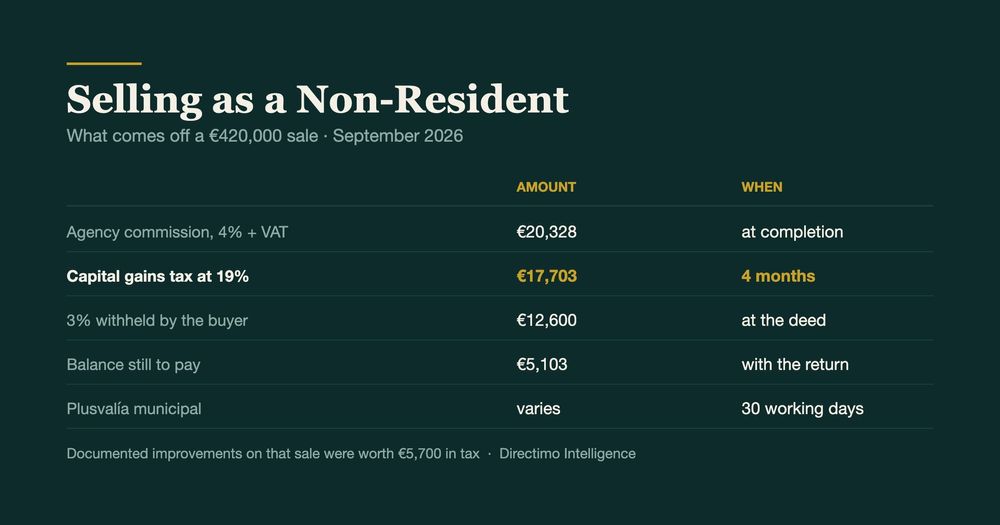
A non-resident selling a Spanish property pays 19% capital gains tax on the gain, whatever their nationality. The buyer withholds 3% of the sale price at completion and pays it to the tax office on the seller's account, and the seller has four months to file the return that settles the difference.
On top of that sit the agency fee, plusvalía municipal and the costs of the sale itself. Together they usually take 7% to 9% of the price before any tax on the gain.
What comes off the price
| Item | Typical cost | Who pays |
|---|---|---|
| Agency commission | 5% plus VAT, typically split 50/50 between the listing side and the buyer's agent | Seller |
| Plusvalía municipal | Varies by municipality and years held | Seller |
| Notary and legal costs on the sale | €600–1,500 | Seller |
| Energy performance certificate | €150–400 | Seller |
| Capital gains tax | 19% of the gain | Seller |
| Mortgage cancellation, if one exists | €400–1,000 | Seller |
How the gain is calculated
The gain is the difference between what you effectively receive and what the property effectively cost you. Both sides can be adjusted, and the adjustments are worth real money.
Added to the purchase price:
- Transfer tax or VAT paid when you bought
- Notary and land registry fees on the purchase
- Legal fees on the purchase
- Documented structural improvements — a new roof, rewiring, an extension, a reconfiguration
Deducted from the sale price:
- Agency commission
- Notary and legal costs on the sale
What does not count. Routine maintenance, redecoration, replacing appliances and furniture are all excluded. The distinction is between improving the property and keeping it as it was.
The inflation adjustment that used to reduce long-held gains was removed in 2024. A property held for twenty years is now taxed on the full nominal gain.
A worked example
A two-bedroom apartment bought in 2016 and sold in 2026.
| Purchase price, 2016 | €250,000 |
| Purchase costs at 10% | €25,000 |
| Documented improvements | €30,000 |
| Acquisition value | €305,000 |
| Sale price, 2026 | €420,000 |
| Agency fee at 4% plus VAT | −€20,328 |
| Notary and legal on the sale | −€1,500 |
| Transmission value | €398,172 |
| Taxable gain | €93,172 |
| Capital gains tax at 19% | €17,703 |
At completion the buyer withholds 3% of €420,000, which is €12,600. The seller files within four months and pays the remaining €5,103.
Without the €30,000 of documented improvements the gain would be €123,172 and the tax €23,403. Keeping the invoices was worth €5,700.
The 3% withholding, step by step
| Step | Who | Deadline |
|---|---|---|
| 3% of the price withheld at completion | Buyer | At the deed |
| Paid to the tax office on Modelo 211 | Buyer | 1 month from the sale |
| Capital gains return on Modelo 210 | Seller | 4 months from the sale |
| Refund, where the 3% exceeded the tax due | Tax office | Typically 6–12 months |
The withholding is an advance payment against the tax, and it comes off the final bill. Where the liability works out lower — a small gain, or a loss — the seller reclaims the difference, and that is common on properties bought near the top of the last cycle.
The refund is slow, and it is only paid if the return is filed. A seller who leaves Spain without filing simply loses the 3%.
One condition catches people: the refund requires the seller's non-resident tax filings to be up to date. Unpaid imputed income tax from earlier years is settled first.
Plusvalía municipal
A local tax on the increase in the land value during your ownership, paid by the seller within 30 working days of the sale.
There are two ways to calculate it and you may choose whichever gives the lower figure:
- The objective method, applying a coefficient to the cadastral land value according to the years held.
- The real gain method, based on the actual increase in the land value between the two deeds.
If you sell at a loss, you pay nothing, provided the purchase and sale deeds evidence it. That has been the position since the calculation was reformed, and sellers who sold at a loss before then may have overpaid.
What a non-resident cannot claim
Two significant reliefs are limited to Spanish tax residents:
The over-65 exemption. A Spanish tax resident aged 65 or over selling their main home pays no capital gains tax. A non-resident of any age does not qualify.
Main-home reinvestment relief. A resident who reinvests the proceeds of their main home in another main home defers the gain. A non-resident holiday home never qualifies as a main home.
Residents of the EU, Iceland and Norway who are selling what was genuinely their main residence in Spain and reinvesting in a main home elsewhere in that area have a narrower route, and it needs advice on the specific facts.
The deadlines
| Obligation | Deadline |
|---|---|
| Buyer pays the 3% withholding | 1 month |
| Plusvalía municipal | 30 working days |
| Capital gains return, Modelo 210 | 4 months |
Miss the four months and the surcharge scale applies, from 5% up to 20% plus interest.
What the seller has to produce
- The title deed.
- An energy performance certificate, which is required before the property can be marketed.
- A land registry extract showing the current position.
- A certificate from the community confirming fees are up to date.
- IBI receipts.
- Utility contracts and recent bills.
- Where the property was let, the tourist registration and its status.
What actually increases the net
Keep every invoice from the day you complete. Improvements are only deductible if they are documented with proper invoices in the owner's name. This single habit is worth thousands, as the worked example shows.
Settle the non-resident filings. The 3% refund depends on them.
Get the energy certificate early. It is needed to market the property, and it is a common cause of a delayed launch.
Price against deed comparables. Asking prices in Málaga province run about 29% above what buyers actually pay. Price the property off deed comparables in its own street, and it sells; price it off portal listings and it sits — how to read the two series is in our guide to reading Spanish property prices.
Check the reference value. It sets the buyer's minimum tax base and shapes what they can afford to offer.
If you inherited the property, the acquisition value is the reference value declared at the time, which is often low and produces a larger gain — the position is in our inheritance and succession guide.
How Directimo works
Directimo represents the buyer, never the seller. Listing agents in Spain are contracted by the vendor and paid to protect the vendor's price.
That is the reason this guide exists in the form it does: an owner selling a Spanish property is usually about to become a buyer somewhere, and the two sets of numbers belong in the same conversation. We can model the net proceeds against what they would buy next on either coast. We have completed more than 1,000 transactions since 2011, totalling over €300M in property sold.
Model the net proceeds and what they buy next: directimo.com/advisory-call
Purchase costs on each coast are in our Costa del Sol costs and taxes guide and our Costa Blanca costs and taxes guide, and the wider set of buyer questions in our FAQ.
Sources. Agencia Tributaria — non-resident capital gains tax rate, the 3% withholding on Modelo 211, the seller's return on Modelo 210 and its four-month deadline, deductible acquisition and transmission costs, and the late-filing surcharge scale. Spanish legislation removing the inflation adjustment on acquisition values in 2024. Spanish local taxation rules on plusvalía municipal — the two calculation methods, the taxpayer's right to choose the lower, and the exemption where the property is sold at a loss. Requirements for the energy performance certificate before marketing a property. Consejo General del Notariado and Idealista — deed and asking prices, Málaga province, 2026.
Method. The worked example uses a €250,000 purchase and a €420,000 sale with a 4% agency fee, and is illustrative; the outcome moves with the improvement invoices available and the municipality's plusvalía position. Percentages are stated on the deed price. Refund timings describe returns filed correctly and complete, and lengthen where earlier non-resident filings are outstanding.
This guide is market research, not legal or tax advice. Your position depends on your tax residence, how long you held the property and what you can document, and should be confirmed with a Spanish tax adviser before completion.