

Published September 2026 · Data verified September 2026
Two separate things decide what happens to a Spanish property when its owner dies: who inherits it, which is a question of succession law, and what tax they pay, which is a question of where the property sits.
On both counts the position for a foreign owner is better than the reputation suggests. A British, Dutch or German owner can choose their own national law and leave the property to whoever they like. In Andalusia and the Valencian Community a child or spouse inheriting a normal coastal property usually pays nothing.
What causes the damage is the paperwork. Heirs have six months to file, the deadline runs from the date of death, and it does not wait for grief, probate at home, or a family that cannot agree.
Who inherits: Spanish rules apply unless you say otherwise
Spanish succession law reserves fixed shares for children. The estate splits three ways:
| Portion | Who it must go to |
|---|---|
| Legítima estricta, one third | Divided equally among all children |
| Mejora, one third | Children, but you choose how it is split between them |
| Libre disposición, one third | Anyone you like |
With no children, parents take half, or a third where there is a surviving spouse. The spouse does not own a share outright; they receive a usufructo, a right of use, over one third.
A foreign owner can set all of that aside. European succession rules let you choose the law of your nationality, in a clause written into a Spanish will. A British owner choosing English law leaves the property exactly as they wish, with no forced shares.
The clause has to be explicit. Without it, Spanish law applies to the Spanish property by default, whatever your will at home says.
The Spanish will
You can leave Spanish property under a will made at home. It works, and it is slow and expensive.
| With a Spanish will | With only a foreign will | |
|---|---|---|
| Time to transfer the property | 2–4 weeks once documents are ready | 12–24 months |
| Additional cost | — | €5,000–15,000 in translation, legalisation and probate |
A Spanish will costs €760–2,065 all in: the notary €100–250, a sworn translator €150–300, and legal drafting €500–1,500. It is signed at a notary, held on the central will registry, and covers only your Spanish assets, so it sits alongside your will at home and leaves it intact.
With no Spanish will at all, heirs need a declaración de herederos — a formal declaration of who inherits. Two to six months, €1,000–3,000, and every heir must agree. A disagreement goes to court.
What the tax actually is
Inheritance tax in Spain is set nationally and then heavily relieved by each region. The region that applies is set by where the property is located, whatever country the heir lives in.
Non-residents claim the same regional reliefs as residents. That changed after European and Spanish court rulings in 2014 and 2018, and a good deal of guidance still online has not caught up.
Andalusia
| Relief | Amount |
|---|---|
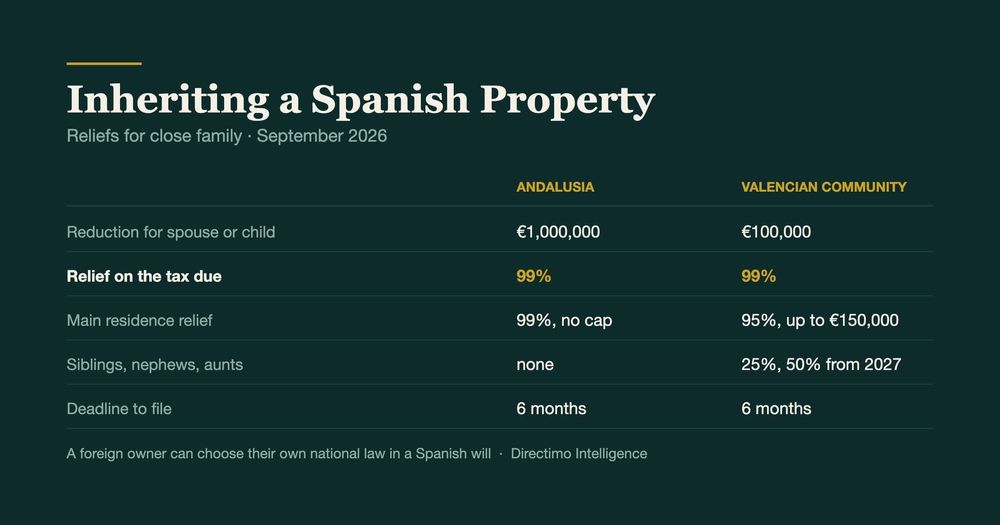
| Reduction per heir, spouse, children, parents | €1,000,000 |
| Relief on the tax due above that | 99% |
| Main residence, held three years | 99% of value, no cap |
A child inheriting a €400,000 Costa del Sol apartment is inside the €1,000,000 reduction and pays nothing.
Valencian Community
| Relief | Amount |
|---|---|
| Reduction on the taxable base, spouse, children, parents | €100,000 |
| Relief on the tax due | 99% |
| Main residence, held five years | 95% of value, capped at €150,000 |
| Siblings, nephews, aunts and uncles | 25%, rising to 50% from 1 June 2027 |
The sibling relief is new, in force since 1 June 2026. Before that they had none.
The Valencian reduction is smaller than Andalusia's, but the 99% relief on the tax itself does most of the work. A child inheriting a €250,000 Costa Blanca apartment pays a small fraction of the headline scale.
Distant relatives and unrelated heirs get neither treatment in either region, and the national scale runs from 7.65% to 34% with multipliers on top. Leaving a Spanish property to a friend, a partner you are not married to, or a niece in Andalusia produces a real bill.
The property is valued at the reference value
Inherited property is declared at the Cadastre's reference value, the same figure that sets the floor for transfer tax on a purchase. Heirs do not choose a low figure, and the number is public before anyone dies, so the tax can be estimated in advance.
That value also becomes the heir's acquisition cost. When they eventually sell, capital gains tax is calculated from it — so a low reference value reduces inheritance tax and increases the gain later. The sale itself is covered in our guide to selling as a non-resident.
The six-month deadline
| Filing deadline | 6 months from the date of death |
| Extension available | A further 6 months |
| When the extension must be requested | Within the first 5 months |
| Interest | Runs from the end of the original 6 months either way |
Late filing costs a surcharge on top:
| How late | Surcharge |
|---|---|
| Up to 3 months | 5% |
| 3–6 months | 10% |
| 6–12 months | 15% |
| Over 12 months | 20% plus interest |
The extension buys time to file. It does not stop interest. And the property cannot be sold, transferred or in most cases even let until the succession is completed and registered, so a family that misses the deadline is paying surcharges on an asset they cannot use.
What heirs actually have to do
- Death certificate, legalised and translated if issued abroad.
- Certificate from the central will registry, confirming whether a Spanish will exists.
- The will, or a declaration of heirs where there is none.
- NIE numbers for every heir. Each one needs a Spanish tax number before anything can be signed.
- A deed of acceptance of inheritance, signed at a Spanish notary, in person or by power of attorney.
- The tax return and payment, within the deadline.
- Registration of the heirs as owners at the land registry.
Every heir needing a NIE is the step that catches families. It takes an appointment each, and the six months are running.
Structures, and what does not work
Joint ownership between spouses is the common arrangement and it works. On the first death the survivor inherits their half within the reliefs above.
Leaving the property to children while keeping a life interest — the parents hold the usufructo, the children own the rest — moves value across generations at a lower tax cost. It suits owners who are confident they will not sell.
Trusts are not recognised in Spanish law. A property held in a trust creates real complications on death, and structures that work at home can behave very differently here.
Company ownership changes what is inherited from a property to shares, which shifts the analysis to the company's own jurisdiction. It brings costs and filings that rarely pay on a single holiday home, and since 2022 it no longer keeps the property outside Spanish wealth tax for a non-resident holder. Structuring above €3M is covered in our prime and luxury market analysis.
One point on the United Kingdom. There is no inheritance tax treaty between Spain and the UK. A British owner's estate can be within scope in both countries, and unilateral relief in each country decides the outcome. Take advice on both sides, before completion.
What to settle at purchase
The ownership structure at purchase determines the position later, and it costs nothing to get right on day one.
- How the property is held — jointly, in shares, with a life interest.
- A Spanish will, with the choice of your national law written in explicitly.
- Who the heirs will be, and whether any of them fall outside the close-family reliefs.
- NIE numbers, ideally obtained while everyone is alive and unhurried.
- Where the money to pay the tax comes from, since it is due before the property can be sold.
Your lawyer confirms the structure before completion.
How Directimo works
Directimo represents the buyer, never the seller. Listing agents in Spain are contracted by the vendor and paid to protect the vendor's price.
We raise the ownership structure while the purchase is still open, and connect buyers with an independent bilingual lawyer who handles the Spanish will alongside the purchase. The properties we source average 13.5% below area market prices. We have completed more than 1,000 transactions since 2011, totalling over €300M in property sold.
Get the structure right at purchase: directimo.com/advisory-call
The full cost of buying is in our Costa del Sol costs and taxes guide and our Costa Blanca costs and taxes guide, the reference value in our guide to reading Spanish property prices, and the residency position in our tax residency guide.
Sources. European succession rules permitting a choice of national law in a will. Spanish civil code — forced heirship shares and the position on intestacy. Agencia Tributaria — inheritance and gift tax, the non-resident return, filing deadlines, the extension and the late-filing surcharge scale. Junta de Andalucía — the reduction per heir, the relief on tax due and the main residence relief. Generalitat Valenciana — the reduction on the taxable base, the relief on tax due, the main residence relief and the extension to siblings and other relatives from 1 June 2026. Court of Justice of the European Union, 2014, and Spanish Supreme Court, 2018 — access of non-residents, including from outside the EU, to regional reliefs. Dirección General del Catastro — the reference value as the valuation basis. Notarial and legal fee ranges for Spanish wills and declarations of heirs, 2026.
Method. Reliefs are those in force in September 2026 in Andalusia and the Valencian Community; other regions differ substantially and a property elsewhere in Spain should be checked against its own rules. Worked outcomes assume close family — spouse, children or parents — and no other Spanish assets. Timings for transferring a property describe straightforward estates where the heirs agree and the documents are in order.
This guide is market research, not legal or tax advice. Succession and inheritance tax depend on your nationality, your family circumstances and the region the property sits in, and should be confirmed with a Spanish lawyer before completion.